Friday, March 11, 2011

What To Do in Case of Psychic Attack or of Being the Victim of Malevolent Spell

Being a relatively visible public Witch, I get plenty of requests for spells, which I politely decline to do. I tell people two things: One is that it's best to create one's own spells rather than have someone else cast them. The other is a caution against performing any magic that would interfere with the free will of another. The exception to that would be a binding of someone else, making them unable to do further harm.

Today, through the agency of the Marin Interfaith Street Chaplaincy of all places, I received this request:
could you get to O[...] [in] contact with a Wikkin [sic] Practitioner who may be able to reverse, break, heal from witchcraft spells. O[...] has a cousin who has a girlfriend from Morocco (speak English) who believes she has had a witchcraft spell put on her.
This has inspired me to publish this brief blog in response to this query and any similar queries that may come my way (or yours) in the future.

If you believe someone has put a negative spell on you (usually called a hex), here are a few things you can do to protect yourself, and possibly reverse the spell.

First, purify your person. Take a shower, or better yet, soak for a while in hot water containing sea salt, bath salts, or Epsom salts. Allow the salt and water to neutralize any negativity within yourself; think of this as you soak. Let any contamination be washed away with the water spiraling down the drain, out of your house and out of your life. Drink lots of water to wash out your insides. Wash your hair, brush your teeth, put on clean clothes. You may also wish to drink mint tea or another tea that you find refreshing.

Second, purify your dwelling. Dust, sweep, vacuum, tidy up, polish. Air out the rooms. Wash the windows with a mild solution of vinegar and water. This allows purifying sunlight and moonlight to illuminate the room as well as making the glass more reflective to deflect unwanted energies.[1]

Circulate through the rooms where you live with sage or other purifying incense, making sure to fumigate everywhere -- stairways, closets, underneath stairways, basement, attic, garage if attached. If your dwelling is one that you can circumnavigate, you may wish to walk all around the outside of the building wafting this smoke.

Then mix salt and water and sprinkle it around the house. As with the incense, do this around the outside of the home, too, if you can. Be sure to cense and sprinkle all openings to the outside -- doors and windows, of course, but also skylights, electrical outlets, heating vents, chimneys, ventilator hoods, toilets, and sink, tub and shower drains. Also do this to mirrors.

While you're doing these things, speak the words, "With Earth and Water I purify this space," and "with Fire and Air I consecrate this space," because that's exactly what you're doing.[2]

Third, ward your space. If you're the witchy sort, trace a protective pentacle with the salt water on all doors, windows and mirrors. Rosemary grows in abundance where I live, so I like to use a sprig of it to sprinkle the salt water. Then I like to leave rosemary sprigs on all the window sills.

When you've done all these things, take a step back, be very quiet, look around, listen and note how different your space feels to you now.

You may also wish to perform these acts at other places where you spend a lot of time, such as work, if you can.

One last thing you may want to do, although it's not as easy and practical as the rest. You may wish to hang little mirrors in the windows or on the outside of the building to reflect away negativity. The mirrors aren't really necessary; they're just extra insurance, if you will. You should be fine just doing the other things I've recommended.

Now envision yourself within a bubble. Project this bubble around you and around your home. Nothing can pass through the membrane that has not been invited by you. Anything unwelcome bounces off the bubble. Build a strong image of this bubble in your mind. If you have a small object, maybe a clear quartz crystal or a piece of rosemary, that reminds you of this visualization, carry it in your pocket or keep it someplace handy. You can't be expected to hold this image in your consciousness all the time. But if you have this object, then at times when the image has faded and you feel you need to reinforce your working, take it out and look at it and touch it to reawaken your sense of your protective bubble.

As with all magic spells, you needn't stick with the formula offered here. If other ingredients call to you or other actions spring from you, trust your intuition and go with them.

These are my recommendations. For another approach, here's a Lemon Uncrossing Spell (to break a curse). I have never tried this so I can offer no assurance of its efficacy.

[1] For a super-duper heavy cleansing of a home, say if you're just moving in after someone else has been living there, and if you have the time, get some dragon's blood incense and burn it on a piece of charcoal in a container left in the bathtub or shower. As soon as you light it, leave and let it fumigate the entire house. You don't want to breathe much of this stuff. Then return a few hours later and open all the windows to let out the dragon's blood fumes.

[2] Some additional things you can do to cleanse a new or dirty home: Walk throughout the rooms with noisemakers, rattles, a drum to frighten off unwanted spirits. Do this before censing and sprinkling. After censing and sprinkling, ring a little bell at the windows and mirrors.

(c) M. Macha NightMare/Aline O'Brien, 2011

Monday, March 07, 2011

The Helicon Nine

On Saturday Corby and I took a day-long workshop called "Courting the Inner Muse," with my old friend Willow Kelly and her partner Crow, who are visiting from Virginia. Besides working with two visiting teachers, we shared the experience with Reclaiming Witches from what appears to be a thriving North Bay Reclaiming community. I guess, technically, since we live in the North Bay, this could become our home community.

During the invocation to the divine at the beginning of the day, I could only remember five of the nine names, so I repeated those five over and over again. Thalia, Urania, Erato, Calliope, Polyhymnia. I know they heard me. I revere the other four as much. So to reinforce the work we did Saturday, and to put a spell for inspiration out into the world, I solicit the influence and aid of the Helicon Nine.

Daughters of Zeus and the Titan Mnemosyne, I call to you in your home high on Mount Helicon

Chief muse, Calliope (beautiful voice), may your writing tablet become my laptop. Bestow eloquence to my public speech. Grant me serenity and good judgment.

Erato (passionate or lovely), muse of mimicry and erotic poetry, I appeal to your favor of crows like me. May the song played upon your lyre bring pleasure.

Thalia (festive or flourishing), fill my life with laughter.

Urania (mountain queen), mistress of the celestial, may my path follow your stars. May I know when to keep silent and when to speak.

Polyhymnia (many songs), grant me the ability to remember sacred songs and to compose new ones in praise of all that is holy.

Clio (proclaimer), speak through the books I read and write, may the lore I pass on by true to our history and informative to those who listen.

Euterpe (rejoicing well or pleasure giver), manifest in me through harmonica, frame drum, soprano recorder, and voice.

Melpomene (songstress), may I speak fluently and convincingly of serious matters.

Terpsichore (rejoicing in the dance or whirling), may I move with your grace; may my voice sing in harmony and fullness with other voices.

SMIB!

Saturday, March 05, 2011

Hindu-Pagan Interfaith Devotional to Our Great Mother


Since deep in my Witch's heart I feel much sympatico with Hindu beliefs and practices, I consider myself fortunate to have been invited to to assist in the performance of the ritual referred to in this press release. Amadae, a Dianic priestess, coordinated the ritual with people from the Hindu American Foundation. Its purpose was devotion (bhakti) to the Great Mother.

There was a two-sided round altar, with Hindu altar objects on one side and Pagan ones on the other. Reclaiming priestess Kala created the Pagan half of the altar. After the puja mentioned below, flowers and petals adorned both altars.

The ritual opened with the beautiful singing of Sangeetha Venkataraman; Corby and I had the pleasure of hearing her at the HAF Annual Dinner last September.

The sitar player, recently moved to the SF Bay Area from Ann Arbor, is a student at the Ali Akbar College of Music about a mile from our home, where he works with Arjun Verma. Arjun was one of four performers at Marin Interfaith Council's Annual Music of the Beloved sacred music concert last month. I invited my new friend to let me know when we might find a chance to visit when he's in San Rafael. I hope he does.

Cosette Paneque, of Beachfyre Coven, EMLC-CoG and Social Networking Coordinator of Cherry Hill Seminary, called upon the spirits of Air; Christine Kraemer, Department Chair at CHS, called Fire; I called Water; Wendy Griffin, CHS Academic Dean and frame drummer, called Earth; and Amadae called Spirit.

The pujari who led the Devi Ma puja and the men who sang with him had strong voices, made louder by the unnecessary use of a mike. This was unfortunate because we were performing in a hotel ballroom, separated by not-very-soundproof, floor-to-ceiling movable partitions from adjacent hotel ballrooms where other PantheaCon events were taking place: Yes They Are! queer gods ritual on the West side and Tarotist Mary Greer on the East. Having been in rituals in these ballrooms when another, sometimes louder event is taking place right next door, I know from past experience that it's a challenging situation for all. In any case, the men chanted for about 20 minutes. I was pleased to find that I was able to understand some of the words they chanted from having gone to many Kali pujas in my town and from kirtan singing.

After that, six lovely temple dancers, with bells on their ankles, exquisite gestures, and smiling faces, arrived to perform a dance to Lord Ganesha so that he may remove all obstacles to the worship of the Great Mother. This dance made me misty, for some reason. I later learned that none of the dancers was over 18 years old, and they had to perform these prescribed dances perfectly for years before they can perform alone.

The dance concluded with a spiral dance led by Amadae, to the chant "We all come from the Goddess..."

As a ritualist, I felt that we Pagans had more flexibility to adapt our ritual to age-old Hindu practices than the other way round, and we did. The fact that the participants wore big smiles at the conclusion convinces me of its effectiveness for each individual participant and as an interfaith collaboration. Those I spoke with expressed pleasure in the working.

As far as I know, this is the first anyone has blended traditional Hindu practices done by traditional Hindu practitioners (as opposed to Western attempts verging on cultural appropriation) with contemporary American Pagan practices. I was pleased and honored to be a part of it, and I was proud of my Pagan colleagues. I hope other opportunities to share sacred space with our Hindu friends present themselves. I will be ready.

Friday, February 11, 2011

Beth "Bone Blossom" Saunders

I am saddened to be writing about the passing of my old Holy Terrors coven sister, Bone Blossom (Ardath Elizabeth Saunders Stanford). We were very close for many years, yet in recent years we had less frequent contact. She had been ill for some time, and the last I heard from her in late October, she spoke of having been very ill but having just turned the corner and begun to recover. Since then she underwent emergency abdominal surgery, then died last night in ICU of a stroke as she was being weaned from a respirator. I'm comforted to know that her husband, Jim, and sons Silas (now Renzo) and Guthrie were with her during her final hours.

Born on the Winter Solstice of 1948 in Little Rock, Arkansas, Bone often spoke of her love for the crystals to be found in Mount Ida. She attended Carleton College in Minnesota, and later landed, with her two sons, in San Francisco, which is where our paths crossed. She became close friends with another psychonaut like herself, Terrence McKenna. She traveled often to Colombia, where she conceived her elder son Silas, and to other parts of South America to learn native weaving techniques and to explore native spiritual practices on their lands, particularly those involving entheogens.

We met in a class created by Starhawk and, IIRC, Lauren Liebling, called The Iron Pentacle, the first of its kind, in around 1979. Several people in that class joined together to form a coven we called Holy Terrors.[1] The four years during which we met every single Tuesday night, plus for sabbats and Reclaiming open rituals -- public rituals were a new thing in those days -- profoundly shaped the Witches we all became. Bone, along with Sophia Sparks, Cerridwen Fallingstar,[2] and myself, formed the nucleus of Holy Terrors.

Soon Bone followed her heart to Middletown, Connecticut, where she continued teaching what she had learned. A coven with the wonderful name of Ouroborous Isis Gnosis formed as a result of that teaching. I had the pleasure of meeting many of its members at CoG's MerryMeet in Amherst, MA, in 2006.

In the early '80s, Bone and Anna Korn co-taught a wonderful course in herbs and plants. In addition to learning specific plants and their uses for healing, dyeing, and such, we went on local herb walks and we created potions and salves and dyed eggs with natural dyes.

Bone had a huge loom in her living room upon which she wove all manner of wonderful cloth. For the direct action at Lawrence Livermore Labs at the maybe Brigit of 198? she created an open weaving into which demonstrators wove flowers, photographs, and other things; then we stretched the web across the road to the lab. It was for this demonstration that Starhawk wrote the chant, "We are the flow, we are the ebb, we are the weavers, we are the web."[CORRECTION] As we sang, a group of policemen on motorcycles tried to destroy the web by driving through it. Well, you know how strong webs are. Instead of rending the web, the cops became entangled in it. Our late friend Sequoia approached the officers and with profuse apologies tried to disentangle the cops, and their guns, from the weaving. Eventually we managed to toss the weaving over the fence separating lab property from the rest of Livermore, where it was charged to do its work.

For one Midsummer action at Livermore, Bone and I took lots of home-fried chicken and other food and designer coffee, with linens for the picnic table, to the park where the direct activists were camping. That night we burned a glorious wicker man. I especially remember Sequoia and me stripped to the waist, sweating, and dancing up the fire that was baking the sacred loaf.[3] Bone and I had young children at home so we weren't planning to be arrested; we came to do magic outside lab property and to support those who risked arrest.

At the very first MerryMeet[4] in 1981, CoG produced, at Rodeo Beach, we Holy Terrors offered a ritual as our contribution to the event. Called the Wheel of the Year, it featured one HT for each of the eight sabbats, with Meg Granito leading in introductory meditation and my late husband, Rod Wolfer, drumming. Needless to say, our Bone was the Hag of Winter.[5]

In 1984, at Harbin Hot Spring, California, where MerryMeet was produced by Glenn Turner as the first Ancient Ways Festival[6], Bone, Sharon Devlin,[7] and I created a ritual we called "Kali, the Terrible Mother, and Other Dark Goddesses." The reason I know it was in 1984 is because that's the year Indiana Jones and the Temple of Doom was released, and that film was one of the instigations for our doing the ritual. All three of us are devotées of the Dark Mother. Sharon in particular was offended at the portrayal of Kali in that movie. We decided She needed a proper revival.

We set the rite out in a triangle around a bonfire under old oaks in the middle of a meadow at the witching hour of midnight. Sean Folsom accompanied us for parts of the ritual on a thighbone trumpet. The late Paul Ehrhorn beat a huge Middle Eastern drum.

We began with Bone, dressed in white, leading celebrants into trance by evoking many bone-white goddesses, like Skadi. As she spoke, I carried an iron cauldron from person to person and had them reach inside and take a bone. (Bone had gotten lots of animal bones from a butcher.) They held these bones while she spoke.

Following Bone, I, dressed in red, spoke of many bloodier goddesses, Sharon passed around a skull chalice[8] containing pomegranate juice for each person to take a sip. Many were completely convinced that the cup contained blood.

Finally, Sharon, in black (big surprise), led celebrants deeper into the mysteries of the Dark Mother.

Then we three, all of whose faces had been veiled in our respective colors up to that point, lined up -- Bone, Macha, Sharon -- and, waving our arms up and down holding in our hands Kali's tools of flaying knife, skull, and other implements, swept off our veils, amidst shrieking, blast of thighbone trumpet, thunder of giant drum. We began a Kali chant --

Jai Ma Kali! Jai Ma Kali! Jai Ma Kali! Jai Ma Jai!
Jai Ma! Jai Ma! Jai Ma! Jai Ma!

over and over again, as each person passed through the tunnel made of our three sets of spread legs and emerged reborn.

After everyone had passed through, we refilled the skull chalice, only this time, in order to facilitate the return of the celebrants to a mundane state of consciousness, we poured in milk and salt. Ick, right? It did the trick.

Oh, the stories I heard afterward from people who participated! Sequoia, who was traveling in India at the time, even heard of it there from someone here. Evidently, it was quite effective. The chant we used has been widely shared around the California Pagan scene and beyond.

In 1987 MerryMeet was again held California, this time at Camp Swig in Saratoga. We were asked to reprise "Kali, the Terrible Mother," except that Sharon had moved and was unable to come, so Bone and I recruited Sequoia to complete our triad. This time Sophia Sparks created a stunning central altar around the bonfire, using lots of bones found in the wild, and we had different musicians. Sequoia had brought home from Bali three demon masks in our three colors.[9] We wore these masks on the backs of our heads, with the veils covering our faces in the front until the time when we unveiled.

When were were dressing for the ritual in the women's shower room, we conscripted a lovely red-haired woman who'd come inside to use the facilities and solicited her help in arranging and fastening our costumes. I remember that in our state of gearing up to perform the rite we were rather demanding. Yet she took it all in good spirits and helped us. Later I learned that our helper was Tarot authority Mary Greer.

By all accounts, this ritual also gave participants a powerful experience. This happened to be during a time when California was being devastated by wildfires. Some people claimed that we should not have performed our ritual because it was exacerbating the fires. Pffft!

Another story about Bone concerns the multicolored weaving she made for magical use in our coven. Mainly, we placed those in need of healing upon the weaving, which we called a magic carpet. One Tuesday night I arrived at coven in a state of agitation. I had just left fighting with my husband at home. My HT sisters insisted I sit upon the magic carpet and chill. We got to some idle chat about Craft names. I had been reading about Macha, and having just been in a state with Rod, I said, "I feel like Macha tonight!" From then on that was what they called me, and it still is.

For some time, when I was living in North Beach and Bone was working nearby on Russian Hill, she would come by most afternoons for coffee and conversation.

There are stories of Bone and some of us other HTs when we went to a Pagan festival in the Oakland Hills produced by the late Gwydion Penderwen and Stephan Abbott.

I could go on and on with stories about things Bone and I shared, but this is plenty to give readers an idea of the woman she was. Besides, some stories cannot be shared publicly.

I invite others who knew Bone to share stories on this blog so all of us may know better the wicked Witch who was Beth Bone Blossom.

My heart goes out to Jim, Silas, Guthrie, Bone's grandson Santino, and all her many, many loved ones who will miss her boney self. In love may she return again.

RHTH, Bone!


[1] We were nine, of whom only six remain alive today. The other departed Holy Terrors are Meg Granito and Judith Johnson.

[2] There is a scene on a beach in Marin County in Cerridwen's book, The Heart of the Fire, describing a shared experience with Bone, me and a few others.

[3] It was at that point that Sequoia finally recognized me as a Witch and not just a legal secretary, so she told me.

[4] CoG had been having annual Grand Councils since its founding in 1975, but its first MerryMeet festival happened the year I joined, 1981.

[5] Somewhere I have a snapshot of the ten of us in costume. I'll try to find it and scan it and publish it here.

[6] Caveat: I remember that Glenn Turner and Greg Harder produced that MM/AW festival, but I'm not entirely sure if it was at that one or a later one when we did this ritual.

[7] See the chapter "Interview with a Modern Witch" in Margot Adler's Drawing Down the Moon (1979).

[8] Yes, a real human skull, from somewhere in the Himalayas, and a real thighbone trumpet, too. We can save the discussion of the ethics of using such an object for another time.

[9] This night she died, Sequoia asked Rev. Jim to find these masks and give them to me, but he didn't find them then and doesn't seem to have found them yet. I promise to put them to good use when they come to me.

[CORRECTION] Here's an example of how the folk process, and individuals' memories, work. Starhawk informs me that she is not the author of the "We are the flow" chant; it was written by the late Shekinah Mountainwater. For two Livermore actions in 1982 Starhawk wrote "Rise With the Fire" and "We Are the Power in Everyone," the latter being for Summer Solstice. My apologies for my mistake.

Monday, January 31, 2011

In Honor of the Lady Brigit

Joining in my friend Oak's call for Brigit Poetry Festival 2011:

Brigit the Healer

You wear a long green dress
Your toes are peppermint chamomile comfrey
golden seal valerian
Your fingers give just the color that's needed
just the jewel that's needed
Yours is the work of the yew tree
for weapon and weapon salve
are one in You
Your power is to keep the stars
bonewhite circling above
or whirling below
Your height is to bind
Your height is to set free

~ Ellen Cooney, from Mother of the Silkless: Inovcations to Goddesses and Gods

Tuesday, December 28, 2010

Greg Bunker, Mensch

Gregory Bunker
September 3, 1948 - December 29, 2010

I was shocked to receive a call today from my sister Catherine telling me that our friend Greg had suffered a massive heart attack yesterday while vacationing with his wife, Stephanie, in Santa Barbara. She said Greg's two sons, one of his sisters, and Stephanie's sister were all on their way there, but that last rites were being performed, and the situation did not look good.

I immediately lit my Brigit candle and said an urgent prayer for Greg. By evening, Catherine called to say Greg had crossed over. What a sweet man he was, and what a great loss his death is to those who loved him, and to many he served.

Greg used to drink too much and eat too much, but in recent years he had been sober, dieting, and had gone back to college, where he'd been earning straight A's. His major, "Organizational Behavior & Leadership," could only enhance his work as Executive Director of Francis House, a counseling and resource center for poor individuals and families in Sacramento. Here's an article on Greg's passing from the Sacramento Bee.

Greg grew up in Ohio, one of eight children in a big Catholic family, then served in Vietnam in his young adult years. I'm so glad he was one of the fortunate soldiers who returned alive. I suspect his experiences in Vietnam influenced his choice of profession, since he undoubtedly had a lot of sympatico with the many homeless who are veterans of that war and whom Francis House serves.

Greg also served on the Board of Safe Ground Sacramento, "protecting the human rights of homeless people."

I remember when Stephanie met Greg and then fell in love. I remember their wedding on the banks of the Sacramento River when my Deirdre was a toddler. I remember once, when my late husband, Rod Wolfer, and I had a big party in our flat on the Mason Street cable car line in North Beach and someone had called the police about the noise. This was during the years when the TV show "All in the Family" was popular. I remember looking over the railing down into the stairwell where Greg was talking to the cops. They asked his name and he answered "Greg Bunker." For some reason his surname had never registered with me, although I undoubtedly knew it, so when he gave that name to the policeman, I laughed, thinking it was a fake name in homage to the character Archie Bunker.

This photo of Greg and Catherine was taken on Christmas Day, only four days before his passing.

Greg and Stephanie, although not technically blood relatives, were, and are, a part of our family. We have celebrated weddings and births and memorials together. He leaves to mourn him his wife Stephanie, sons Jesse and Simon, siblings, and a host of others whose lives were enriched by having known him.

Gregory wasn't Jewish and neither am I, but Greg was the kind of man the Yiddish word "mensch" was meant to describe: a stand-up guy who always made you feel good to be around, always smiling and caring. In love may he return again.

Sunday, December 19, 2010

Midwinter Reflections: Light in the Dark

My local interfaith group, Marin Interfaith Council, created a Winter Interfaith Service to share the celebrations of various member organizations that take place in the winter months. When the director asked me to share a ‘teaching’ from my religious tradition, I had to really think about what a teaching would be like from a Pagan perspective. It got me to thinking about light, which, after all, is what this season is all about – the waning and return of the light.

In our modern world, we tend to take light for granted. We’re used to living constantly amidst all manner of human-made lights. We seldom reflect on the fact that for most of human history our only sources of light came from the sky and from fire. We easily forget that there was a time when torches were a new invention, oil lamps were valued possessions, and chandlers toiled so people could see in the night by candlelight.

Our ancestors bedded down at nightfall, for the most part. Of necessity they lived their lives finely attuned to Nature’s cycles – of light and dark, then later the cycles of sowing and reaping. They knew that their lives depended upon the Sun, so they created rituals to ensure its annual return.

In fact, marking the return of the light was so important to them that at least 5,000 years ago some of our Western European ancestors built megaliths such as Brugh na Bóinne in Ireland and Maes Howe in Scotland. Brugh na Boinne, or Newgrange, is a mound near the Boinne River (named for Boann, a cow goddess) comprised of a passage leading to inner chambers carved with spiral designs. The builders constructed the mound so that the light of the rising Sun on Midwinter morning shines a shaft of sunlight deep inside to illuminate the innermost chambers. Although only a limited number of people can experience this remarkable occurrence from within the mound, today, in the cyber age, millions of viewers can see this phenomenon live on Solstice morn from anywhere in the world via webcams placed inside the mounds.*

Some ancestors decorated their dwellings with evergreens; they cut a tree and decorated its branches with twinkling little candles. Today, if we’re ecologically minded as we should be, we use strings of LED lights. This tree represented the World Tree that unites the Underworld, the Middle World, and the Upper World, and it never dies.

I think humans are hard-wired to gather around fires, especially during the long nights of Winter. Other ancestors gathered round a Yule log -- Yule is a Scandinavian word usually taken to mean “wheel” -- to keep warm through the cold longest night of the year as they sat together, while bards and elders told stories, musicians played and people sang and danced, ate and drank.

Somewhat like the Salvation Army and other charities do today for those with fewer means, the poorer folk trekked from household to household, singing wassail songs in exchange for hot wassail and bread or other food.

We Pagans, at least the majority of us, view the Winter Solstice as the night when our Great Mother labors to bring forth the reborn Sun God. We see in images of Mary and the baby Jesus something ancient and primal, an icon that speaks to us.

In my tradition, we gather on the beach at sunset on the longest night of the year, and as the Sun goes down over the waves, we all plunge into the ocean as a ritual purification; then return to warm up at the big waiting bonfire in the sand.

Later we return to homes, often lots of us in one home, where we sing Yule carols, light candles, drink hot brews. We feast and eat Sun cookies the children have baked. We gather near the fireplace telling and listening to stories, playing games, perhaps doing divination.

As dawn approaches, we go outside and gather in the high places around the Bay Area and sing and sing and sing up the Sun – often in the rain, but always we can see the lightening skies.

When we perform these acts – when we sing the carols, trim our trees, light candles – we reenact the things our ancestors did, we reconnect with them, and we honor our heritage. Celebrating Midwinter together allows us to reaffirm the continuance of life.

In the spirit of the season, I’d like to teach you a little chant as a Yule gift from Pagans to the interfaith community. The words are by American poet e.e. cummings. I don’t know who made a chant of those words, but we have been using them for the past 30-plus years and it seems to be working fine.

i who have died am alive again today,
and this is the sun's birthday; this is the birth
day of life and of love and wings: and of the gay
great happening illimitably earth**

* Webcams have been mounted in these megaliths in years past. People are chosen by lottery to have the privilege of being inside the mound at sunrise.
** Unfortunately, I don't have the expertise yet to record this chant to share it here.

I wish all a joyous Solstice, warmed by the loving hearts of friends and family and a toasty fire.

Thursday, October 07, 2010

Gift from My CHS Class

I'm taking a course at Cherry Hill Seminary called "A Saunter with John Muir and Walt Whitman--The Poetry and Politics of Nature." The instructor, Chris Highland, asked us to choose a poem from Whitman's Leaves of Grass to reflect upon. I happened upon this one, written in 1856, and it blew my mind, so I want to share it here.

Unfolded Out of the Folds


Unfolded out of the folds of the woman man comes unfolded,

and is always to come unfolded,

Unfolded only out of the superbest woman of the earth is to

come the superbest man of the earth,

Unfolded out of the friendliest woman is to come the

friendliest man,

Unfolded only out of the perfect body of a woman can a man

be form'd of perfect body,

Unfolded only out of the inimitable poems of woman can

comes the poems of man, (only thence have my poems come;)

Unfolded out of the strong and arrogant woman I love, only

thence can appear the strong and arrogant man I love,

Unfolded by brawny embraces from the well-muscled woman

I love, only thence come the brawny embraces of the

man,

Unfolded out of the folds of the woman's brain come all the

folds of the man's brain, duly obedient,

Unfolded out of the justice of the woman all justice is

unfolded,

Unfolded out of the sympathy of the woman is all sympathy;

A man is a great thing upon the earth and through eternity,

but every jot of the greatness of man is unfolded out of

woman;

First the man is shaped in the woman, he can then be shaped

in himself.


Wednesday, September 22, 2010

International Day of Peace, and Then Some

Yesterday I set out to attend the re-dedication of the peace pole on the campus of Dominican University. Our local Dominican Sisters, colleagues in Marin Interfaith Council, do this each year. In the past, when my friend Sister Marion headed the order's Social Justice Committee, I have been an active participant. This year, when the event was announced at an MIC clergy luncheon, I spoke with Sister Marion, who's now retired, about participating; she said that whoever was in charge had already formulated all their plans and that I should just show up. Well, I did, but, I'm embarrassed to say, I had written the event in my calendar as taking place at noon when in fact it began at 11 am. So I arrived just as they were concluding.

In 1981, the UN General Assembly passed a resolution declaring an International Day of Peace, and in 2001, it adopted the resolution declaring September 21 of each year International Day of Peace. This year's theme is "Youth for Peace and Development."

Since its inception, Peace Day has marked our personal and planetary progress towards peace. It has grown to include millions of people in all parts of the world, and each year events are organized to commemorate and celebrate this day. Events range in scale from private gatherings to public concerts and forums [sic] where hundreds of thousands of people participate. Anyone, anywhere, can celebrate Peace Day.

International Day of Peace is also a Day of Ceasefire -- a day in which armed conflict is meant to be stilled; a day on which we appeal to combatants to observe a ceasefire; a day on which we reaffirm a commitment to non-violence and the peaceful resolution of disputes.
Last night I missed most of the nightly news I usually watch, but I suspect there were hostile engagements taking place yesterday in spite of the best intentions of those of us who seek to promote peaceful resolutions to conflict.

What was extra special about this year's ceremony was that the words that roughly translate to "May peace prevail on Earth" in the local Coast Miwok** language were to be added. "Hiya aa puli suta weyyatto."* The pole was blessed by the Coast Miwok and all others who were there. Until yesterday, the pole bore those words in English, French, Spanish, and Arabic.***

The assembled people exchanged peace greetings in Arabic: As-salaam aleikhum, Wa-Leikhum As-salaam; Hebrew: Shalom aleichem, Alechem shalom; Serbo-Croatian: Mir nek bude tebi, Nek tebi bud emir; Chinese: Hun pink ban sway nee, Ban sway nee huh ping; Masai/African: Wenna kanta laf-fi, Laf-fi la Bumbu ("God gives peace. Peace is something special."); German: Frie de sei mit Dir, Und mit Dir sei Frie-de; and Coast Miwok: Puli sutammi mikkoni.

In addition to offering prayers for peace from different religious traditions, people sang several songs from song sheets provided by the Sisters. There were the usual, such as "Let There Be Peace on Earth,"to the Pagan-ish "Circle Round," by Linda Hirschhorn, to the utterly wonderful John Lennon song, "Imagine." This last included an additional verse written by fifth grade students at Cornell School in Albany, California.

Imagine that our leaders
Would listen to our voices
And instead of riches
They cared about our choices
Imagine all the people
Caring for the earth...
There is good news in that even though I was late arriving I did meet someone I had hoped to meet there. She is Joanne Campbell, a Tribal Council Elder with the Federated Indians of Graton Rancheria. Graton Rancheria is comprised of Coast Miwok and Southern Pomo peoples. I invited her to participate in the third annual People of the Earth conference at the Interfaith Center at the Presidio of San Francisco in November.**** As soon as I have more concrete information to give her, I'll follow up on this invitation.

The Dominican Sisters of San Rafael's report on this event, with lots of photos, is here.

* * * * * * * * * *

During the afternoon I attended Marin Interfaith Council's Annual Meeting, where we did a lot of thanking of various individuals for their work,reviewed the budget, and officially installed Fu Schroeder of Green Gulch Zen Center as MIC's representative to the Marin Community Foundation.


* The "s" in the word "suta" should be underlined, not an option in this blog program.

** Coast Miwok people greeted Francis Drake when he first landed on the shores of Marin County in 1579 and other Europeans who entered what it now San Francisco Bay. See "Big Time."

*** While we American Pagans all speak English, and most perform their rites in that language, given the spirit of the annual re-dedication, I would imagine the sisters might consider adding these words of peace in Gaelic, assuming some Druid group involved in interfaith activities were to propose it.

**** Unfortunately, there is no announcement on the ICP website nor any flier for this yet. Watch my FaceBook page for updates.

Friday, September 03, 2010

Ruminations on Pagan 'Clergy'

I was rooting around in some of my old writings and discovered this. Originally drafted in 2004 when I was functioning as the chair of the Public Ministry Department of Cherry Hill Seminary, this piece speaks to my ongoing concerns about the growth of the Pagan movement, as I call the entire phenomenon. Since 2004, CHS has undergone changes in emphases and goals, most significantly in its pursuit of accreditation from the DETC (Distance Education and Training Council). However, my essential concerns remain, and require frequent review and re-evaluation. I welcome your comments on this important topic.

* * * * * * * * * * * * *

As a Pagan, I feel it's paramount that we define ourselves rather than leaving that to sociologists, journalists and others. I admit to a mistrust of what I call the 'overculture' - the mainstream, linear-thinking, rational, American consumer culture. We can take from the overculture that which suits our religions, but we don't have to parrot it in everything we do. So even though I'm helping to establish a public ministry program at a Pagan seminary, the goal of which is to offer ordination to Pagan 'clergy,' I don't feel comfortable with the terms ministry, seminary, and most especially, clergy.

What most Pagans do in our spiritual practices is (to make a verb of a noun) 'priest/ess.' In my tradition, the term “to priestess” describes what a priest/ess is doing when performing or conducting ritual. Priest/ess is a role one assumes in that context.

But the world changes, and Paganism, as a living religion, changes with it. Today we see more Pagans offering rituals and other religious practices to the public, although many of us traditionally have practiced in private and continue to do so. Moving from working with a close, intimate bonded group of friends to working with people we may not know at all changes what we do and how we do it. So we need to rethink how we present ritual to others -- to the public and to non-initiates of initiatory traditions. Performing these public celebrations is the work of clergy.

Pagans are assuming many other roles that in the overculture are customarily performed by clergy. We are serving as chaplains in hospitals, prisons and the military. These roles require special knowledge and skills. We officiate at people's rites of passage -– naming ceremonies, coming-of-age rituals, weddings, elderings, funerals, and memorials. These are all 'clergy' roles; they may or may not be priest/ess roles as well. The rituals themselves are 'priest/essed' but they may or may not also include such things as premarital counseling or grief counseling.

We are called upon to speak, to give interviews to media, and to address college classes. We are better served if we have some skill in public speaking and if we know about media relations and journalism.

One significant area where Pagans are acting in some sense as 'clergy' is interfaith. From the largest international interfaith organizations such as the Council for the Parliament of World Religions and United Religions Initiative, to the regional, down to the local, Pagans are joining with leaders of other faith traditions in working on such issues as peace, affordable housing and homeless shelters, education, health care, meals for the hungry, facilities for the differently abled, habitat restoration, disaster relief, and other social concerns, as well as in the arts and music.

I believe it behooves us to prepare ourselves -- those of us who may be called to such public service -- to work effectively in these areas. That means ascertaining what knowledge and skills we feel it's necessary to acquire in order to do that work effectively. Then finding people within our Pagan culture who have specialized knowledge in those subjects so that we can learn from them. We can take what our society offers us and adapt it to our ideas of culture, our worldviews, our belief systems. But we do not have to take all of it. We do not have to take that which doesn't suit how we see and live in the world. We will create new forms and techniques that honor who we are. We can create our own 'clergy' and when we have done that, perhaps we'll have found just the right noun that denotes what we do and who we are.


Friday, August 27, 2010

"Rich Kids, Poor Kids: Same Stress, Different Packages"

Today I attended an MIC clergy luncheon at which the speaker, Don Carney, addressed the problems of Marin County teens, rich and poor. (Contrary to the impression some readers may have that Marin, because it is one of the wealthiest counties in the U.S., has no poor people, it does. And just like in other regions, the ranks of the less privileged are expanding while the middle class is shrinking.)

The speaker shows an obvious passion about the work he does with youth. He spoke mainly about youth courts in the U.S. today, and more specifically about the Marin County Youth Court, run by the YMCA and the Marin County Superior Court and the California Administrative Office of the Courts. Only a few years ago there were about 70 youth courts in the country and now there are 1,350.

Youth who have admitted guilt to a misdemeanor are eligible for this program, which focuses on the principle of restorative justice. In adversarial cases, the offender is prosecuted and defended by youth attorneys, before a youth jury. An adult judge presides and a youth bailiff supervises the process, with adult caseworker support for the youth and his or her family. If the offender completes the program within three months, he or she leaves with no juvenile record. The focus is on healing the harm done to the victim, the community, and the perpetrator.

Mandatory aspects include serving two to five times as a juror, providing 10 to 80 hours of community service, and taking a prevention class. Discretionary sentences imposed by the youth jury include restitution to the victim, letters of apology, reflective essays, anger management class, theft awareness class, drug education class, prevention class, additional counseling, and mentoring.

Seventy percent of the kids in youth court are from white, upper middle class families, and 90% of the offenses involve substance abuse. The pressures on kids to achieve often unrealistic goals contribute to their stress levels. Family dynamics add to the pressure and confusion. Marin has the high rate of binge drinking for both teens and adult, and pot smoking is twice the national average. The good news is that youth involvement in AA is enormous, some arising from sentences imposed in youth court.

Kids with what are known as "surplus assets" do not present like less privileged kids do. High achievers can be as drugged and drunk as lower achievers. Underneath are substance and family issues. He cited Madeline Levine's book, The Price of Privilege: How Parental Pressure and Material Advantage Are Creating a Generation of Disconnected and Unhappy Kids. Dr. Levine is a clinical psychologist here in Marin.

Mr. Carney also showed a TV news feature about the Marin Youth Court and recommended a documentary film called "Race to Nowhere: The Dark Side of American's Achievement Culture," made by Vicki Abeles.

A third resource he recommended was Hold on to Your Kids: Why Parents Need to Matter More Than Peers, by Gordon Neufeld, Ph.D., and Gabor Maté, M.D.

The emphasis on cooperative education rather than competitive education that the youth court espouses can lead to lowered stress for teens. Mr. Carney said that we need alternatives to suspension for students who violate school rules. He said this leads to dropping out of school, when in fact the practice really pushes the kids out of the system. He believes the system should bear the onus, not the kid. As an example, he cited a good student found carrying a Swiss Army knife in his pack. With a zero tolerance policy in effect, this student was sent to a program with chronic offenders. He also said it's not helpful to mix middle school offenders with high school offenders. Whether an offender is put with peers or peers and older teens, the fact that he or she is in any kind of punitive environment leads to more alienation and the potential for greater offenses.

The irrefutable value of youth courts shows in the recidivism rate of kids who've gone through this process: 13% nationally and only 5% in Marin.

* * * * * * * * * * * * *
Among the more compelling upcoming events announced at this luncheon:

  • International Day of Peace on September 21, 2010, celebrated at Peace Pole at Dominican University, sponsored by the Dominican Sisters of San Rafael. This year they will be adding a fifth plaque in the language of the Coast Miwok, the original human inhabitants of this area (see Big Time). I'm hoping to participate in this, as I did in 2007 when my friend Sister Marion chaired the Sisters' Social Justice Committee.

Wednesday, August 18, 2010

MerryMeet 2010 - Return to the Heart of the Mother

Since I arrived on the muggy heat of the night, after 1 am, I figured I'd tiptoe in our room and quietly unpack and go to bed, but to my surprise, my mates, Don Frew, Anna Korn, and Anith, all of us from the Northern California Local Council of CoG. What do you do when you get four loquacious, involved, activist Witches in a room away from home? You talk and talk and talk.

Our very full weekend began on a sad note with the news of Isaac Bonewits' untimely passing. Although I didn't arrive in Indianapolis in time for the opening ritual, those who attended told me that he was honored.

It was great to enter the meeting room and immediately be greeted with enthusiasm by my friend Lord Cuchulain of Everglades Moon LC in Florida, who introduced me to his student, and my new special friend, George. I also enjoyed getting better acquainted with their EMLC colleagues, Lady Bridget of Witch & Famous Coven. (I love that name!)

National First Officer Sylvia Webb opened Grand Council with an invocation of Coventina, she who is special to the Covenant. With grace and focus, Sylvia presided over a refreshingly cordial meeting. I think the years of working by consensus process, or at least trying to do it as well as possible given that different groups and individuals have had a greater or lesser grasp of how it works, and not necessarily much experience, is finally paying off. I am one of those sticklers who frequently harps about process. That role seems less and less necessary, I'm happy to say.

Cherry Hill Seminary's new display debuted at MerryMeet. I neglected to take photos, but I think it looked great and I know several people took flyers and signed the mailing sheet for our newsletter and occasional announcements. Taking a cue from Amber K, who immediately preceded my CHS report with hers on Ardantane, I passed a tumbler -- Amber had a cool copper cauldron to pass -- for donations. I know I should be doing this whenever I'm together with a group of Pagans, but I tend to forget. I'm grateful to the many CoG members who contributed.

After dinner on Friday, Don Frew, Rachael Watcher and I gave a presentation on interfaith. I'm hopeful that the interest expressed by those in attendance will result in a greater Pagan presence in more interfaith organizations in different regions of the country. I remain available for consultation should anyone wish it. If it should happen that local groups are reluctant to admit Pagans, I know that our experiences and friendships with other interfaith activists can often smooth that process. As Swiss Roman Catholic theologian Hans Küng said at the 1993 Parliament of the World's Religions:

There will be no peace among nations,
until there is peace among religions.
And there will be no peace among religions
until there is dialogue among religions.
Oberon and Banshee of Circle of Wondrous Stories designed the Friday evening main ritual. I really appreciated witnessing them working together, as it was obvious they shared a long magical working relationship. That's not something I see much of, and it's a pleasure.

After the ritual, I delighted in schmoozing with old friends Midwestern friends Gail, Ginny, and Magenta, Chamisa LC friends Amber & Azrael, local (to me) pal Prudence Priest, and the younger coveners of the Covenant of Gaia coven. I videoed Prudence doing her hilarious song about channeling in Enochian. Now I have to figure out how to upload it. I also requested that she be given the opportunity to do it at the end of the closing ritual, which she did.

Warrior Blessing Ritual

Various military Pagans, led by Dave Sassman of PEN (Pagan Educational Network), performed a Warrior Blessing ritual honoring all branches of the military and all first responders, both active and veteran. As soon as the flag-bearers entered the room bearing the colors, much to my surprise, I started to choke up. They marched briskly in a circle several times until instructed to present colors. There were at least five, maybe six, flag-bearers, all members of CoG and military vets

Now, the military is not something that plays any role in my life. I am not from a military family. Although I was born during WW-II, my father, working in the vital industry of agriculture, stayed stateside and civilian. I went because I appreciate those who serve on our behalf, and I wanted to give them my respect.

Further, I am not given to open displays of emotion. I can count on one hand the number of times I've been overcome to the point of tears by a ritual. I don't know where the tears came from, but I had plenty of company. Someone came around the circle with a box of tissues eventually. I was completely bewildered by my reaction.

There were several altars around the room, not just at the quarters. There was one for each branch of the military -- I confess I was not able to tell them apart unless I went up and read the badges -- one with a symbolic solitary meal. Several of the altars bore statuettes of Lady Liberty, which pleased me, since I consider her to be the goddess of the USA.

The quarter-calling featured military references and this was followed by a open call for deities, allowing several participants to name their own special protectors.

At one point we recited the Pledge of Allegiance, the pre-1954 one without the words "under God." Again, I'm not especially patriotic. I prefer to consider all of us citizens of the world, human inhabitants of Mother Earth.

Tears rolled down my cheeks throughout.

I am not a pacifist per se, although in general I am opposed to war as a solution and have put a lot of effort into either stopping or preventing the US from becoming militarily engaged. I have very mixed feelings when confronted with the reality of what happens to soldiers. I know one thing on my mind when I was weeping was the needless death and suffering, the sacrifice of the young and less privileged, the devastation of young lives.

The National First Officer of CoG presented the Order of the Pentacle medal to one of CoG's members who hadn't received it in earlier meetings.

At the end, we were invited to take ribbons -- enamel pins shaped like a map of the continental US painted with stars and stripes, with an image of Lady Liberty superimposed over all. The pins are attached to cammo-printed ribbons. I am happy to wear mine.

I tried to take some photos. Strange, there was a day when you would never even think of doing such a thing, and now there were plenty of cameras in action. It never even occurred to me to ask. There was a day when I'd never have made such a presumption. After the ritual, the priest asked those who'd taken photos and videos to provide him with copies, so evidently the practice was not only okay, but even encouraged in this particular situation.

I had begun taking photos, figuring that this particular ritual didn't hold a lot of meaning for me and that those involved would be glad to have them. The latter proved to be the case, but not the former.

* * * * * * * * * * * * *

Thanks to CoG's interfaith fund, I am able to attend the AAR Annual Meeting in Atlanta, where I'll be performing a Samhain ritual on October 31 for the visiting Pagan scholars and friends. Eibhlean (Evelyn to you and me), Hawk, Lady Magdalena from Dogwood LC, along with Sapphire's coven, offered to help me with this ritual. They all agreed on a local Witch named Jason who's an accomplished ritual drummer whom they think would work with us, and have since provided us with a cyber-introduction. More about this when the times comes.

Dave Sassman of PEN showed me an album of photos that were taken at the Pagan Summit sponsored by PEN that took place in Bloomington, Indiana in 2001. What a treat! All of us who were there look so much younger, and only nine years have elapsed. Patrick McCollum's hair was dark brown and is now white; mine was (dyed) red, now grey. Among those assembled is the late Isaac Bonewits. I look forward to receiving scans of these photos.

Kathy Blizzard, one of the organizers of ConVocation in Michigan and a woman active in the Tempest Smith Foundation, supervised the tie-dying of squares that will be assembled into a quilt. The Tye Dye for Tolerance [sic]. She told me that my presentations at ConVocation two years ago garnered laudatory feedback. The organizers evaluate the feedback forms and then forward them to the presenter. Mine were good, but according to Kathy, the oral feedback she's heard since then has been outstanding. So I may be invited again. I hope so. I have lots of ideas of things I'd like to do.

Keynote Speech: Pagans and the New Media

By far the highlight for me of this recent gathering was Jason Pitzl-Waters' talk about Pagans and the New Media. Most readers probably know of Jason's superior blog, The Wild Hunt. He really fired up his audience, and I am ever so grateful. I hope that now we'll begin to see more evidence of the good works of CoG and other Pagan organizations in news media.

I know this sounds like sour grapes, but the fact is that I have been harping and griping and griping and harping about CoG telling the public what it's doing for at least 15 years. After a while the complaints of someone within the organization don't seem to be able to be heard. It takes a fresh, politically un-allied voice. Jason provided this in spades -- and much, much more. I doff my pointy black hat and offer a sweeping curtsey to the man of the hour!

After Jason's inspiring talk, some members approached me asking about Cherry Hill Seminary's Media & PR course. This has not been offered for the past couple of years because our excellent teacher, Victoria Slind-Flor, now works for Bloomberg News and her employer forbids her from teaching outside the company, and we have not found a suitable replacement. Now, however, we have renewed our search for the perfect teacher. And we've found one! Jason Pitzl-Waters will be offering a four-week online course exclusively through CHS. Watch your CHS Newsletter for further developments.

* * * * * * * * * * * * *
I want to take the opportunity to salute the dedication of Stachia and Jack, both of whom have held more than one national office and show no signs of flagging in their dedication to Coventina. I also tip my pointy black hat to Zenah, who as Pursewarden had to put in way more time than the job normally would entail in order to fix problems that arose from mistakes of some previous office-holders. All three live in Southern California. Zenah is proprietor of the Enchanted Crystal in Running Springs, bordering the San Bernardino National Forest.

I commend Co-Second Officers Ronda Dufour and Tony Branam of CoG's newest local council, Midwest Regional LC. and their staff for a job well done. Not only that, but the food was abundant and delicious!

Overall, I left this most recent Grand Council with the feeling that things have come unstuck. Obstacles have been cleared. The drain is clean and now flowing freely. The Covenant has overcome its constipation. I attribute this to several factors. One is the improved skill of members in the use of consensus process. Another is a lack of contention within the ranks over the past few years. A third is the realization on the part of more, if not all, members of the importance of interaction with the public, i.e., friendlier, fresher website; frequent press releases and reports on our activities and accomplishments.

I wish incoming National First Officer Peter Dybing the best. I pledge to support him in whatever ways I can. You will also begin seeing my interfaith reports on the CoG interfaith blog as well as here at the Broomstick Chronicles.

Friday, July 30, 2010

Big Time

Earlier this month, Corby and I attended the 30th Annual Big Time, a midsummer festival of the Coast Miwok and Pomo people of California. The College of Marin, in partnership with the Miwok Archaeological Preserve of Marin (MAPOM) and the Point Reyes National Seashore, offered a special event in conjunction with Big Time.

The first speaker, Betty Goerke, author of Chief Marin: Leader, Reble, and Legend, a biography of the Native (1781-1839) for whom the county was named -- his name was Huicmuse, he was christened at Mission Dolores as Marino, shortened to Marin -- gave a brief history of the Marin's indigenous Coast Miwok people who were living here when English ship captain Francis Drake (prior to being knighted) and his crew, sailing on the Golden Hind, landed at what is now called Drake's Beach in 1579. They were the first Europeans to encounter Coast Miwoks.

She showed the former coastline of what is now California, which extended maybe another 20 miles into the Pacific; this was before the formation of San Francisco Bay. She claims there is evidence of Miwok villages under the sea where the coastline had been, dating back 20,000 years.

She also showed illustrations of Coast Miwoks, in their tule boats, paddling to meet European ships entering the Bay.

Ralph Shanks, an authority on basketry, told us that many of the most exquisite examples of regional basketry are in the collections of European museums -- in Germany, in London, and at the Hermitage in Russia. Russian traders settled along the Russian River and the towns of Fort Ross and Sebastopol in Sonoma County (one county north of Marin) around 1812. Evidently those traders recognized the value and uniqueness of this indigenous art form. Dr. Shanks and his wife, Lisa Woo Shanks, have written books about California Indian basketry.

He showed photos of many kinds of baskets, some of which were decorated with shells and feathers. The red feathers on the heads of the acorn woodpecker were highly prized, both for basketry and for personal adornment.

In addition to their everyday uses, for cooking, gathering and other domestic applications, baskets had ceremonial uses. They held water, but were not suspended over fire or they'd burn. Instead, hot rocks were placed into the acorn mush or whatever they were cooking in the basket, and that cooked the contents as well as any other cooking method could.

Because the coastal hills of California and the sea and waterways contain abundant and diverse edible vegetation, the Coast Miwok had no need to develop agriculture. They did hunt. Due to the mild climate and their semi-itinerant lifestyles living in small villages, they had no reason to erect large structures or to develop sophisticated architecture. Nature provided all they needed for a healthy life of comfort. So their artistry went into basketry. California Indian basketry is known worldwide for its beauty and complexity.

I possess two beautiful baskets that belonged to my former mother-in-law, Eulalie Braden Wolfer, that I think are Pomo. Now that I'm acquainted with Dr. Shanks, I plan to show them to him and get his advice as to their origin, value, and the best ways to preserve them. One is a very tightly woven bowl shape, with triangular designs; I'm sure it can hold water. The other is larger, also bowl-shaped, but of a coarser grass with the design created by the weaving and texture rather than with colors. I hold them as family heirlooms to be passed to my daughter, from her paternal grandmother, at the proper time.

Gene Buvelot, who is on the Board of the Federated Indians of Graton Rancheria, gave a fascinating update on how several local tribes, not all Coast Miwok, organized and petitioned the federal government in 1970 to recognize them as Native people and restore their tribal status. This was necessary because the government had been informed (by whom I don't know) that there were no more Coast Miwok or other local Indians.
Since 1983, thirty of the thirty-eight California tribes that were terminated under the policy have been restored to federal recognition through litigation and legislation. In 2000, following a lengthy process, the Tribe became the most recent of these tribes to have its federally recognized status restored through enactment of the Graton Rancheria Restoration Act (“Restoration Act”).
Interesting lessons in current federal bureaucracy.*

Following the talks, we ate box lunches of broiled salmon with blackberry ketchup, grains of the Americas (red, white and black quinoa, amaranth, and wild rice), citrus seaweed salad tossed with field greens with agave nectar vinagrette, acorn brownies, and mint tea sweetened with maple syrup, prepared by Chef John Farais of Indigenous Edibles .

After lunch we went to Kule Loklo (bear valley), a native village on the grounds of the Bear Valley Visitor Center, Point Reyes National Park, where we watched Native dancers. We also wandered the village, entering the roundhouse, kotchas (family dwellings), and other structures, and viewing Native crafts and jewelry. Others, mostly children, drilled shells to make beads (like those used to decorate baskets), flaked flint arrowheads, and spun bull-roarers.

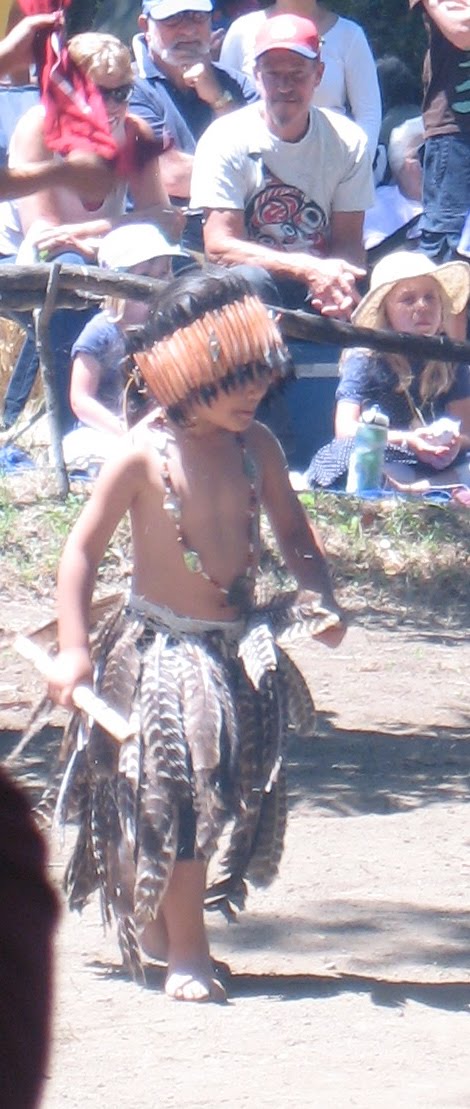
Even though it was a very hot, sunny day, the dancers performed around a small fire pit. Several of the dancers were related -- father, son, grandson, nieces, cousins -- as well as being from different local tribes and blends of different tribes. Accompanied by two drummers and a singer, the dancers did group dances, dances for women and girls, dances for men and boys. The men's costumes consisted of feather skirts that they sometimes flounced up in the rear. Of course, these dancers, performing as it were before a mixed general audience, wore shorts, jeans, sometimes T-shirts, under their costumes, when I'm sure that originally these dances were performed wearing only the feather and leather costumes, with no Western clothing underneath. (The Coast Miwok who greeted Drake wore no clothes most of the year because our weather here is temperate.)

I found it interesting that the males dressed in native ritual garb, mostly made of what appeared to be either hawk or turkey feathers -- there are lots of turkeys roaming the hills hereabout -- and shell beads, while the women's clothing, which was also no doubt traditional among these peoples, being made of cotton cloth, showed the clear influence of European fashion -- and modesty.

The men's dancing consisted mostly of a double tap with each foot, sometimes crouching and seeming to imitate animals, and often flouncing the tail feathers. The women, on the other hand, carried pieces of cloth draped between their two hands, and they rocked these cloths up and down from side to side as they danced. At certain points in the singing, all the dancers twirled around. The ribbons streaming from the women's dresses and their long glossy hair lifted spread out beautifully as they spun.

I learned from this experience something of how I imagine my European ancestors might have expressed their Pagan lifestyles: Accepting the gifts of the land, sky and sea; celebrating together; making art; expressing their joy in living. This, to me, is the best contemporary Paganism has to reawaken.


* I spoke with Gene after his talk because I want to invite local spiritual leaders to the upcoming Third Annual People of the Earth gathering at the Interfaith Center of the Presidio.

All photos, except that of the basket, by Aline O'Brien (Macha). Basket photo from the collection of The Bruce Museum, Greenwich, CT.

Thursday, July 29, 2010

Interfaith Memorial

I've had a busy, eventful Summer, so where to start? Starting with the most recent, last Sunday afternoon, at the invitation of my friend the Rev. Paul Gaffney, I participated in the Marin Interfaith Street Chaplaincy 13th Annual Memorial Procession here in San Rafael. We gathered to the sounds of drums at Albert Park, where we were given flowers* and programs. A Buddhist colleague had set up a small altar there. We circled while he lit some incense and asked us to bow three times, once towards each other.

Following this blessing, we proceeded in silence up A Street to St. Raphael's Catholic Church, built on the site of the old Mission San Rafael Arcángel, the second northernmost mission established by Fra Junipero Serra in the early 1800s. There, right by the sidewalk, grows a Japanese maple planted in honor of those who've died homeless in Marin County. We placed our flowers around the base of the tree.

My friend Chris Highland, who preceded Paul Gaffney as the local chaplain to the homeless (and who now teaches at Cherry Hill Seminary), told me the story behind the planting. The folks at Green Gulch Farm (Zen Center) donated the tree to the homeless chaplaincy in 1999. Before the tree was planted, the homeless chaplaincy and their supporters pushed the tree in a wheelbarrow up and down all the streets of downtown San Rafael to awaken the more fortunate to the presence of their often unseen neighbors who had no homes. A plaque tells passers-by the meaning of the tree.

Father Paul Rossi welcomed us to St. Raphael's, after which all the names of those who died homeless in San Rafael were read and repeated. This list, which grows each year, only includes names of those whose names are known. It was printed on the back of the program. Following this reading, I offered a prayer "For One Who Has Died Violently or in Great Distress."**

While volunteers passed a collection plate around for donations to the homeless chaplaincy, I lead a round called "When We Are Gone," written by Anne Hill and Starhawk and printed in the program.

Paul then invited those assembled to share refreshments, conversation and music in the Kennedy Room of St. Raphael's. Food was donated by Trader Joe's.

I'm pleased that my contributions -- and this is the third time I've participated in this annual event -- are welcomed and valued. This shows us Pagans in a good light, as involved, caring citizens.

Here is a report from the local Marin Independent Journal newspaper on the event. Although it contains minor errors, it's view is positive.***

* Flowers generously donated by Burns Florist in San Rafael. Unfortunately, Burns will not be donating flowers again because, after having served the community for 100 years, they have become victims of the economic downturn and are closing.

** This prayer can be found in The Pagan Book of Living and Dying.

*** You can see me in one of the photos, about five or six rows back.

**** Photo of Paul Gaffney and me by Chris Highland. Photo of March from Marin IJ.

Thursday, June 17, 2010

New Titles of Interest to Pagans

As a member of the AAR, I am on the mailing list of lots of academic and religious publishing houses so I get their catalogs. I enjoy perusing them and sometimes come up with some intriguing titles. Here are few from the latest from Ashgate's Religious Studies and Theology:

Invented Religions: Faith, Fiction, Imagination, Carol M. Cusack, University of Sydney, Australia. "...investigates four religious movements founded in the West which are intentionally fictional: Discordianism ["Chaos is a goddess"], the Church of All Worlds ["science fiction, environmentalism and a holistic pagan vision"], the Church of the SubGenius ["science fiction mythos, culture jamming, and the sacredness of slack"] and Jedism ["Third millennium invented religions"]. ... explores these groups as reactions against the religious marketplace of the 1950s and 1960s. Their continued appeal and success, principally in America but gaining wider audience through the 1980s and 1999s, is chiefly as a result of underground publishing and the internet." [my emphasis] Fewer than 100 pages for a hundred bucks!* I would imagine that an Aussie's perspective on these American phenomena would be enlightening.

From a series on Sexuality and Religion:

Indigenous Religions, edited by Stephen Hunt. This British scholar "...gives full scope to the multitude of attitudes towards human sexuality found in expressions of religiosity outside of the so-called 'World Faiths,' with examples taken from cultures as far afield as Africa, Australasia, South American and the Pacific Islands" A whopping 800 pages for a whopping $250! I'm assuming by "World Faiths" they mean the Big Three Abrahamics, plus maybe Buddhism and Hinduism.

New Religions and Spiritualities, edited by Stephen Hunt. "...reveal the range of contentious attitudes towards human sexuality from the so-called 'new spiritualities,' quasi-religions and the more 'hidden' forms of religiosity, which are now evident on a global scale." [My emphasis.] Contentious, eh? I'm guessing that we Pagans may be among those referred to as "new spiritualities" or "quasi-religions." Five hundred pages for $250!

From series on Vitality of Indigenous Religions: Blackfoot Religion and the Consequences of Cultural Commoditization, Kenneth Hayes Lokensgard, ("Commoditization" is a longer way of saying "commodify.") "...explores the exchange of Blackfoot 'medicine bundles' within contemporary Blackfoot culture and between the Blackfoot Peoples and Euro-Americans. ... deals with the attempts of some Blackfeet to repatriate ceremonial materials from Euro-American hands." There's that old cultural appropriation bugaboo again. For this hundred bucks you get not only 192 pages, but also four b&w illustrations and a map.

Crafting Contemporary Pagan Identities in a Catholic Society, Kathryn Rountree, Massey University, New Zealand. "Contemporary western Paganism is now a global religious phenomenon with Pagans in many parts of the world sharing much in common -- from a nature-revering worldview and lifestyle to a host of chants, invocations, ritual tools and magical practices.

"Taking the Mediterranean society of Malta as a case study, ... [shows] what it is like being Pagan in a society where the vast majority of the population is Roman Catholic ... reveals that Paganism here is a unique brew of indigenous and global influences." [My emphasis.] Well, this book has a few more than 200 pages, plus 21 b&w illustrations, for another hundred bucks. I would love to hear those chants; bet we know many, if not most of them.

Another Southern Hemisphere perspective. I'm glad to see that our English-speaking neighbors below the Equator are getting funded to do this kind of research. Also, note that the word Pagan is capitalized in this book, but not in some of the others.

* Many of these books are available in hardback or as eBooks for the same price.