Showing posts with label contemporary Paganism. Show all posts

Tuesday, March 31, 2020

Justice


Justice
Ma’at, Themis, Justitia

Recently I was invited to sit on a panel on the theme of Justice – what our faith tradition teaches about Justice at the Berkeley Buddhist Temple.  The panel convened after a short Buddhist service.

Each panelist will have 10 minutes to discuss his or her thoughts on the topic from the standpoint of his or her religion or spiritual outlook.  The subject can be approached from any angle desired (personal experience, professional experience, doctrine, personal philosophy, whatever).  There will then be a short question and answer period,

Well frankly, I was kinda stumped.  I know what Justice is and I think I have a strong sense of Justice; however, I don’t know how these sentiments came about, except, I guess, through my Christian parents.  I don’t know of any specific Pagan teachings addressing Justice.

The word "justice" appears in many of the United States' most important documents, including the Declaration of Independence, the Constitution and the Pledge of Allegiance.  However, its precise definition is still a topic of debate for philosophers, theologians, and legislators.

In my process of preparing for the panel, my friend Gus DiZerega was kind enough to provide me with a copy of a talk he gave at the Claremont Conference on Current Pagan Studies entitled “Rethinking Social Justice in Accordance with Pagan Values” in 2016.  Although that helped me in my thinking about this and I’m grateful for Gus’ generosity, I didn’t end up drawing from it.

In addition, I’ve been learning about restorative justice because of my work as a volunteer with the Wiccan circle at San Quentin State Prison, where the Insight Prison Project was born.  Restorative justice:

… seeks to heal the harm caused by crime.  Instead of focusing on retribution, it focuses on rehabilitation. At its core, it is a process that offers both victims and those who caused harm an opportunity to seek answers and accountability to begin to repair the damage caused by crime.

IPP’s core program is:

… the 18-month long Victim/Offender Education Group (VOEG), which includes a curriculum that was designed by licensed mental health therapists in collaboration with survivors of violent crimes and people incarcerated for previously violent behavior. 

Further, I learned a lot from some deeply moving episodes of an excellent television series on CNN called The Redemption Project with Van Jones.  In fact, one of my Marin Interfaith Council colleagues, an interfaith minister, appeared in one episode where she served as the support person for the offender.

Often when I’m stumped about an issue, I turn to various peoples’ goddesses and stories about them.  Pagans commonly learn from the mythology and folklore of our ancestors.  That is how I arrived at the decision to chose three goddesses from three different ancient cultures.


Ma’at

I began with Ma’at.  Ma’at was, and is, the personification of the cosmic order and a representation of the stability of the universe.  Ma’at first appears during the period known as the Old Kingdom (c. 2613 - 2181 BCE) but no doubt existed in some form earlier.  She represents truth, justice, balance, and morality.  She is shown winged and adorned with an ostrich feather

The Spirit of Ma’at presided over Egyptian law courts.  Her priest had a dual role, serving as both a priest and working directly in the law courts and justice system.  He wore the feather of Ma’at in court proceedings, while all other court officials wore small golden images of the goddess as a sign of their judicial authority.  Priests drew the Feather of Ma’at on their tongues with green dye, so that the words they spoke were truth, as a symbol that their judgment would be balanced and fair.  Depictions of Ma’at show her wearing a feather on her head.

At death, on her divine scales Ma’at weighs the heart of the deceased against her feather of truth.  In an entertainment context rather than a religious one. Ma’at’s scales with the feather are shown in the television production of Neil Gaiman’s American Gods.


Contemporary Pagans who practice Egyptian or Kemetic religious traditions, whether they are strict reconstructionists or they syncretize Egyptian thought, mythos, deities into their practices, worship Ma’at, among others.  Some contemporaries propound the “42 Ideals of Ma’at.”


Themis

From ancient Greece, the culture of which permeates Western culture, I chose Themis.  The personification of abstract concepts is characteristic of the Greeks.  Thus, Themis first appears as a divine personage in Hesiod's Theogony.  Hesiod described the forces of the universe as cosmic divinities.  Titled the Lady of Good Counsel, Themis personifies divine order, fairness, law, natural law, and custom.  Her symbols are the Scales of Justice, tools used to remain balanced and pragmatic.  Themis means "divine law" rather than human ordinance.  She was the organizer of the “communal affairs of humans, particularly assemblies.
Themis in Australia

The ability of the goddess Themis to foresee the future enabled her to become one of the Oracles of Delphi, which in turn led to her establishment as the goddess of divine justice.

Themis presided over the proper relation between man and woman, the basis of the rightly ordered family (the family was seen as the pillar of the deme, or connected neighborhood), and judges were often referred to as “themistopóloi” (the servants of Themis).  Such was also the basis for order upon Olympus, where even Hera addressed her as “Lady Themis.”

For Hesiod, Justice is at the center of religious and moral life who, independently of Zeus, is the embodiment of divine will.  Hesiod portrayed temporal justice, Dike, as the daughter of Zeus and Themis.  Dike executed the law of judgments and sentencing

In general, Themis had three subsistences; goddess of natural order, meaning the seasonal and never-ceasing rotation of time; goddess of moral order; and goddess of prophecy,

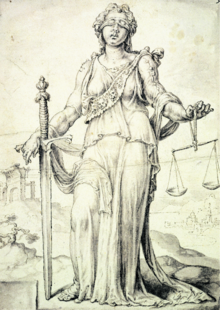
Some classical representations of Themis showed her holding a sword, believed to represent her ability to cut fact from fiction; to her there was no middle ground.
Lady Justice in Czech Republic
Justitia

Justitia, or Iustitia, was the Roman goddess of justice.  She is often referred to in modern times as Lady Justice.  The emperor Augustus, (27 BCE – CE 14) introduced her, and his successor Tiberius established a Temple of Iustitia in Rome.  She became a symbol for the virtue of justice with which every emperor wished to associate his regime.  Later, the emperor Vespasian (9-79 CE) minted coins with the image of the goddess seated on a throne, and many emperors after him used the image of the goddess to proclaim themselves protectors of justice


Justitia has become a symbol of Justice in western culture.  Justitia, in her more modern form as Lady Justice, has appeared in numerous forms at different times throughout the entirety of Western history since classical antiquity.

She is usually depicted holding a sword, just as Themis was in some images, representing authority and conveying the idea that justice can be swift and final.  In some interpretations the sword she holds represents punishment.  As do her predecessors Ma’at and Themis, Lady Justice also carries a scales.  

Since the 16th century, Lady Justice has often been depicted wearing a blindfold. The blindfold, symbolizing objectivity, a lack of prejudice demanded by justice, that justice is impartial and should be applied without regard to wealth, power, or other status.

Many sculptures, such as the one atop the Old Bailey courthouse in London, leave out the blindfold altogether.  Another variation, which can be seen at the Shelby County Courthouse in Memphis, Tennessee, depicts a blindfolded Lady Justice as a human scale, weighing competing claims in each hand.

Contemporary Iustitia in Ottawa
Allegoria della Guistitia


 Scales of Justice

As you can see, one thing that all of these Pagan representations of the concept of justice include is scales.  The scales of justice are a familiar symbol used in many Western presentations of modern law; they represent the weighing of two sides of an argument and the equal, unbiased administration of the law, and the scales lack a foundation in order to signify that evidence should stand on its own.  They symbolize the idea of the fair distribution of law, with no influence of bias, privilege or corruption. 

Lady Justice is most often depicted with a set of scales typically suspended from one hand, upon which she measures the strengths of a case’s support and opposition.

* * * * *

Contemporary Lady Justice
As mentioned above, Pagans commonly learn from the mythology and folklore of our ancestors, and, to a lesser extent, from anthropology and archeology, art, music, dance, and cuisine.  We may draw from many times and cultures, from personal experience and philosophy, from teachings and study.  Personal experience may include direct communication with particular divine entity(ies).  I don’t see this as choosing from a smorgasbord of ancient and contemporary; rather, as are all religions, Pagan religions are syncretic. 

In general, Pagans are not doctrinaire. We are orthopractic rather than orthodox; we share our rituals together, be they scripted or spontaneous, yet each participant may gain insight and understandings, literal belief or healthy skepticism, in different ways.  Further, each participant may have a different belief about what they’re doing, whether literal or metaphorical.

Our ongoing influence is attested by the longevity of our deities and the concepts they represent.  The desks of many attorneys hold a scales; courthouses and other government buildings are warded by statues of Lady Justice or Themis, paintings of these goddesses abound throughout the world, from Brazil to Scandinavia, and beyond.  As we are fond of saying, we practice a “living religion.”


© 2020 Aline O'Brien

Thursday, November 17, 2016

Faith and Aging

My latest blog is at Patheos in their Public Square.  I am joined by eight other faith leaders addressing the topic of Faith and Aging.

hhttp://www.patheos.com/Topics/Faith-and-Aging/Turning-the-Wheel-Aline-OBrien

Friday, April 24, 2015

BNPs, PPPs, & Leadership


Pagan Summit, Bloomington, Indiana, 2001
(Note: Several in this photo have crossed over since this was taken, and most are not published authors.)
 

Ever since I’ve been on a Pagan path I’ve heard of BNPs.  The acronym was told to me to indicated Big Name Pagans.   Over time, as more people found their way to one Pagan path or another, or began to create their own paths more specific to their particular worldviews, the term BNP took on a negative connotation.  I started to hear it explained as Big-Nosed Pagans.

Most of those referred to as BNPs had published a book or several and were known for that.  Of course, when I was coming up, there were few books, and those there were tended to be elementary.  They lacked depth, refinement, and nuance.  Today, thankfully, creative Pagans have explored Paganisms in much greater depth.  They’ve done academic and historical research, as well as incorporating anecdotal evidence for their theories – good ol’ UPGs.  Practitioners of reconstructed traditions of many kinds have explored the traditions they’re reviving, and thereby have advanced this learning tremendously.  As well, walkers on more personal Pagan paths, including “hard polytheists,” have contributed to our growing body of resources.

I’ve encountered plenty of disdain in various Pagan social contexts of what the disdainers called BNPs.  Overall, I think this is unfair.  Yes, there are well-known Pagan authors on the broomstick circuit who expect a degree of deference, who require that their luggage be carried and other assistance rendered.  However, not all behave that way.  And in some cases, as with older or frailer authors or those who may be traveling with small children, such accommodations are justified.

I see many other Pagans who aren’t necessarily authors with a body of published books, although often they contribute to anthologies, to published (in the sense of printed matter) discussions and online fora, and who otherwise contribute to the understanding of our communities among the general public.  They may be known, but not necessarily as authors.  After all, leadership takes many forms.

We Pagans also have poets, sculptors, painters, dancers, musicians, song-writers, ritualists, and other artists who might, by the common understanding of the term BNP, be deserving of the appellation.[1]

There are also many other Pagans who’ve taken on leadership roles.  Some organize festivals, or they may take on the big task of creating the meal plans and arranging for  cooking, feeding, and cleanup; or do the accounting a festival requires; or do all the advertising and promotional work; or book the flights for presenters; or fetch guests from the local airport; or one of the many other roles necessary to make a festival happen.  Some may be leaders while others would more accurately be considered volunteers.  In whatever capacity they work, they are helping to create Pagan culture.

Another kind of Pagan leader may be someone who’s done substantial work in the context of interfaith activities, or is a Pagan scholar.

More recently, I offer as an example one individual, John Halstead, who solicited involvement from Pagans of all stripes who, with his facilitation, created a Pagan Community Statement on the Environment.  This is not a Pagan who has a bunch of books to promote and workshops to lead (that I know of).  Surely this action can be seen as one of assuming leadership.

For them, and others who’ve taken on leadership roles, I propose a new term:  PPPs, or Publicly Prominent Pagans.  How do you like it?


[1]   Check back later for more on Pagan artists, writers, and musicians as agents of cultural change.

Thursday, October 23, 2014

Hit Piece in Sheep’s Clothing

-->

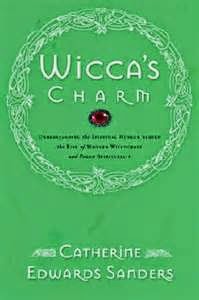
One Saturday when I was chatting with the Native American chaplain who sponsors our Wiccan circle at San Quentin, he handed me a book.  He’d received it from the Jewish chaplain who’d been our previous sponsor.  Wicca’s Charm: Understanding the Spiritual Hunger Behind the Rise of Modern Witchcraft and Pagan Spirituality, by Catherine Edwards Sanders.  I said I was unfamiliar with the author and had not heard anything about it, although I generally keep half an eye open for newer Pagan publications.

He casually mentioned that according to this book, and according to the chaplain who gave it to him, ostensibly for the small library we keep in the Wiccan storage locker along with our ritual supplies, Wicca was for women and had little relevance here in an all-male prison.  Not that he thought that, but that the book made that case.  He gave it to me to take home.  Book slut that I am, I took it, thinking that with all the reading material stacked around my house awaiting my attention, it would be very low priority.

As I was straightening up around the house today, I decided to make these stacks a little shorter and try to find some shelf space for the books that were lower priority on my reading list. I picked up this book and began to page through it.  First I noticed some underlining on this text:

Ironically, neo-Paganism appeals to people because it doesn’t seem to be very commercialized.  One Pagan woman told me, “People are turning to Paganism for many reasons.  The main ones are they are tried of the judgmental hypocrisy of commercialized religions and want the freedom Paganism gives.”  But as we can see at the local bookstore, on the Internet, or on our TV sets, Wiccan is far from uncommercialized…

Then the author goes on to mention Z Budapest’s kids camps that cost $325

…for four days of horseback riding, archery, swimming, and canoeing, as well as lessons in alchemy, the creating of their own magic tools, and identification of magic rocks and crystals.

Well, I ask you: where else can one find food, lodging, planned programs, and other amenities for $325 for four days?  Regardless of who’s teaching what, at the very least it costs producers money to rent facilities and feed people.

So I thought, “Gee, she’s talking about us.  Or at least about people I’m likely to know.”  So I scanned a few more pages, only to arrive at one that said:

Much like Christian preachers, neo-Pagans have joined the speaker’s [sic] circuit.  M. Macha Nightmare [sic] offers two lectures, based on her book The Pagan Book of Living and Dying, titled “Meeting Death and Grieving Loss” and “Healing Ourselves and Healing Our Community.”  The cost for both talks is $75 to $125 per person.  [Emphasis mine.]…

Are you kidding me?  First of all, those two titles the author references are to workshops, not lectures.  I don’t lecture much.  My strength, as anyone who’s ever attended one of these presentations can attest, is in getting people to think about topics that aren’t much discussed in daily conversation and get them talking.

More importantly, however, is that I’ve never gotten even close to charging that kind of money.  I’ve occasionally arrived for workshops when not one solitary soul showed up.  Hardly commercially viable, plus empty houses keep me humble.

Based on just these few quotes, I know that the rest of the book cannot be accurate and truthful.  The book is a hit piece, pure and simple. 

I note in the author’s minibio on the cover that she writes for The Washington Times, so that should tell us how biased she is.  The Times is owned by News World Communications, an international media conglomerate associated with the Unification Church.  Rev. Sun Yung Moon says that the paper is responsible to let the American people know about God” and “will become the instrument in spreading the truth about God to the world.”  Need I say more?

Wednesday, July 30, 2014

Remembering Margot Adler


Much has been posted in both mainstream and Pagan media about the untimely death of Margot Adler.  People have spoken about the many ways she as influenced them, about her teachings, her personality, her inestimable contributions.  Just to round out the picture with yet another perspective, I share her some remembrances.  Because what is remembered lives.

I first heard of Margot when I found Drawing Down the Moon on a shelf in a local bookstore in 1979.  I took it off the shelf and skimmed through it and what do you know?  There was a chapter called “Interview with a Modern Witch” about my friend Sharon Devlin Folsom.  And there on the cover was my friend Anna Korn, clearly identifiable in the photo of the handfasting of Isaac Bonewits and Selene Kumin.

I was friends with both Anna and Sharon by way of the Institute of Celtic Studies here in the SF Bay Area.  Until that time, I was unaware that either was Pagan.  Since that time, Anna and I have shared lots of projects together (in the context of CoG as well as with a former incarnation of Reclaiming Collective), and Sharon and I have done a few rituals together.  All three of us have remained friends.

However, it wasn’t until I went to the first CoG MerryMeet on the East Coast, at Rowe Conference Center in Massachusetts that Margot and I met.  By that time my late coven sister Bone Blossom had been living in Connecticut and connecting with all manner of NELCCOG (North East Local Council, now defunct).  I seem to remember that it was Bone who introduced us.  What I remember more clearly is that Margot had heard of a ritual that Sharon, Bone, and I had brewed up and performed at Ancient Ways a year or three prior.  That ritual, entitled “Kali and Other Dark Goddesses,” seems to have had a profound effect on many people who participated.[1]  In any case, Margot in NYC had heard of it and so had my late friend Sequoia when she was traveling in India.  So I had the thrill of being introduced to Margot, this prominent Pagan whose work I had admired, and she already knew something of me.

We maintained a casual friendship over the years, much like many who may read this.  We encountered each other at events.  She had me over for bagels and coffee at her NYC apartment one time.

Sometime around 2000, both the late Judy Harrow and I both became involved with the incipient Cherry Hill Seminary, thanks to the machinations of Cat Chapin-Bishop.  Margot was Judy’s Gardnerian teacher/initiator/elevator.  In addition to being a well-respected and –loved Witch in the Northeast and beyond, Judy was also Craft mother to another of the founders of CHS, Laura Wildman-Hanlon,  So I’m assuming, although if I knew at the time I don’t recall now, that that is the route by which Margot came to support the seminary.  However, it happened, Margot has been a consistent voice in support of CHS.  For the past several years she has served on the Board of Advisors, where I’m currently proud and honored to serve with her.

Thanks to my dear friend and literary mentor, the late Patricia Monaghan, Margot suspended her standing policy of not providing cover blurbs, and wrote one for my first solo writing effort, Witchcraft and the Web.  She wrote, in part, “…she deftly shows the impact of the Web on the Craft – how it is hanging the religion’s notions of authority, leadership, authenticity, and even the way rituals are conducted.”  I’ve included the quote here because it’s germane to our shared observations about the expansion and new understandings of Paganism in our cyber age.

One of the people Margot quoted frequently in DDTM (the first edition; I don’t know about subsequent ones) was our mutual friend, the late Alison Harlow.  Although Alison was Margot’s senior by a few years, they first bonded over the fact that both of them attended a progressive City and Country Grammar School in Greenwich Village when they were children.  Alison lived in my area of the country.  Our two then-covens, Holy Terrors and Wings of Vanthi, sometimes circled together, and both of us were active on CoG.

As sometimes happens when someone is in the process of leaving this plane, their loved ones get weird.  Alison was a Witch, a fact that some consider prima facie evidence of weirdness, or at least oddness.  In any case, Alison’s loved ones experienced some intramural, if you will, discord at the time of her passing.  Feelings were raw.  Margot was in NYC and I was in Northern California, and further, I was not among those attending to Alison.  I guess I was sort of a neutral yet engaged party.  Both Margot and I paid close attention to any news about Alison’s condition.  She and I had several phone conversations about what was happening surrounding Alison’s dying and in the days following her passing.  There’s nothing like sharing in someone’s birthing or dying to bond people.

In another context, I remember a wonderful and very noisy dinner with about eight Pagan scholars (and their groupies, such as myself) during the AAR Annual Meeting in Philadelphia, city of my childhood.  Some of those in attendance were younger and fresher; some were scholars whose exposure to Paganism had been mainly in the context of their studies rather than in situ, so to speak.  But Margot and I were old-timers by that time, and both of us are talkers and really relish stories about our communities.  Oh, the stories we shared at that lively dinner!  Our gales of laughter sometimes became too loud for a shared public space.[2]

When I last saw Margot, at PantheaCon 2014, she was constantly in demand so I didn’t intrude.  However, I was pretty sure our paths wouldn’t cross again in this life.  So before the con was over, I found a brief moment to embrace her and tell her how much I treasured her.  I’m really glad I had that opportunity.

Crones

We were enjoying the CoG reception at PantheaCon 2013 when someone called for a group shot of the crones in attendance.  There was lots of passing around of people's cameras; these are the shots that were captured in mine.  It's really hard to get people to all be looking at the camera for a group shot.  

-->
Front row: Anna Korn, Glenn Turner; back row: Magenta Griffin, Rachael Watcher, Macha NightMare, Selena Fox, Vivianne Crowley, and Margot Adler


Late.  Late.  Late.  Late.  Late.  Late.  Do you notice how often my references are to folks who have crossed over?  Six cites!  I see many of Pagandom’s early pioneers passing through the veil.  It is my fervent hope that their work, the examples of the lives they led, their teachings, their spirits survive into the future as foundational to contemporary American Paganism.


[1]   That ritual was reprised, by request, at MerryMeet in Saratoga a couple years later, only Sharon wasn’t available so Sequoia took the priestess role originally performed by Sharon.
[2]   I remember that the late Judy Harrow was also at that Annual Meeting, and we had shared dinner the night before, but she wasn’t at this particular table.

Saturday, March 22, 2014

Judy Harrow, 1945 - 2014

Judy Harrow, March 14, 1945 - March 21, 2014
I've just learned of the passing of my old friend Judy Harrow.  Her health had been fragile for some years now, so her passing is not entirely unexpected.  That said, it is a great loss to American Witchcraft and the Pagan movement in general.

First Meeting & CoG

Judy and I first met at CoG's very first MerryMeet festival at Rodeo Beach, Marin County, California, in 1981.1  Not only was this the first MerryMeet, but it was a first in other ways.  It was my first exposure to Witches2 beyond my Northern California Local Council of CoG.  It was the first time Witches from other areas attended a CoG gathering, and among those was Judy.  Also there were two Witches from Chicago and two from Salt Lake City.  From there Judy left to sow the seeds of a CoG presence in the Northeast.  If memory serves me, she also left with a membership in CoG and the first officership!  I'm not entirely sure about that, since it's possible that the two Chicago Witches,  unnamed here because I don't know their preferences about being identified publicly (although I suspect that now, as opposed to then they wouldn't object) left with that office.  CoG records can determine this accurately.  (There is more about Judy's involvement in CoG on Wikipedia; however, since her birth date listed therein is incorrect, I can't say how reliable the rest of the entry is.)

Judy left that event full of enthusiasm for CoG and its goal of assuring Witchen clergy the same rights and privileges as clergy of other religions.  Of course, the definition of clergy has changed since then, and is hardly uniform now.  That was a time when Witches were viewed as the 'clergy' for the rest of Pagandom.3  In any case, shortly thereafter there came into existence, in large part due to Judy's activism, the Northeast Local Council of CoG (NELCOG), encompassing New England, New York, and New Jersey.4

One of Judy's earlier efforts on behalf of CoG was to get CoG ministerial credentials accepted by the City of New York.  I recall this as having involved applications, hearings, petitions and meetings and other bureaucratic bother, with much help from Phyllis Curott, over a period of five long years.  In the end, Judy's and Phyllis' efforts resulted in one more jurisdiction recognizing the validity and authority of ministerial (and elder) credentials issued by a Pagan organization.  For that achievement alone Judy should be honored.

But she didn't stop there.  Judy's coven, Proteus, has engendered many prominent, and I daresay well-trained and -educated, Wiccans.  Some have gone on to write books and help to change and shape culture in other ways.

Some years later, in the 1990s I think, Judy and I sat on a panel at MerryMeet somewhere in Upstate New York.  The panel concerned different Craft traditions; among those speaking was the late Grey Cat of the NorthWind Tradition of American Wicca. This was at a time when Judy was struggling with the Gardnerian oath to which she'd been bound conflicting in some ways with what she believed was "right."  Now one individual's "right," "correct," or "proper" is not necessarily everybody else's "right," "correct," or "proper" even when presumably done with the understanding that everyone is swearing the same oath.  Since I'm not Gardnerian, I hadn't witnessed any of her efforts within that trad.  I do know, from a conversation with a Gardnerian elder this very day, that her statements on that panel claiming a "Protean schism" continue to have repercussions to this day.

I'm reminded of that day by Ivo Dominguez, Jr., who says (to Judy's spirit):
I first met you in 1991 at the COG MerryMeet when you gave a powerful speech before those assembled proclaiming that Protean Gardnerians were as valid as any other stripe of the Gardnerian Tradition. I was moved and impressed though I had no stake personal stake in the debate or the outcome. You made me care and you did it with clear words alone. I will miss the important though infrequent calls we had over the years. May you go forth shining and I'll see you on the other side. 

I remember standing up for Judy and saying I thought the venue she chose to make this announcement was entirely appropriate, much to the dismay of some others in attendance. I thought what she did and how and where she said it were entirely righteous.  I still do.

Gordon Cooper added:  "I encouraged her in that I told her if she felt a need to be heard, it should be said in public, in front of her peers."  Another in attendance, Cayte Jablow, says, "I was there also, & remember her courage & eloquence there as well."

Good people disagree about what Judy did, how she did it, and what it has meant to some of them ever since.

Honoring Precious Friendships

One of the fall-outs from that public announcement involved Judy's and my mutual and much-loved friend, John Patrick McClimans (one of the first Priests of Church of All Worlds).  He had worked with Proteus Coven when he lived in the same apartment building as Judy in Manhattan.  He went on to initiation, and if I'm not mistaken, to his Third Degree.  He was just fine with that, until the time when Judy contacted her initiates about her change of heart concerning the oath they'd all sworn.  John refused to change anything he'd avowed.  This led to an estrangement between the two that lasted for some years, until just before he passed.

I had the privilege of serving a one of John's death priestesses, an experience I described in "Sitting Vigil with the Dying" in The Pagan Book of Living and Dying (1997).  Something not mentioned in that piece is the rapprochement between Judy and John while he lay on his literal death bed in California.  I had alerted Judy to the direness of John's condition.  Judy phoned John, and they talked in low voices for a couple of hours during his final days.  I watched John's face from across the room.  I know both John and Judy were deeply moved and much relieved by this triumph of love over differences of opinion.  I know I was, because I loved both of them and knew how much each meant to the other.  I mention this because I'm hoping that any friends from whom Judy was estranged before her death had the opportunity to make things right between them.  I mention it because it's my hope that no one loses another or leaves this world with fractured relationships that remain unmended and unhealed.  I mention it because none of us ever knows how much time we or our loved ones may have to make such needed repairs.

Writings

Judy also was among the 40-odd contributors to The Pagan Book of Living and Dying, with "Coup de Grâce: Neo-Pagan Ethics and Assisted Suicide."

Shortly after that book was published, a Canadian publisher contacted me to write a book about the impact of the World Wide Web on Witchcraft and Paganism, resulting in Witchcraft and the Web (2001).  At that same time the publisher sought to publish a line of books about contemporary Paganism.  They asked me for suggestions.  I immediately thought of Judy and the late Grey Cat.  As a result, I'm happy to say that ECW Press published two of Judy's books, Spiritual Mentoring (2002) and Devoted to You (2003) as well as Grey Cat's Deepening Witchcraft (2002).

From there Judy and I, who had the same agent, moved to Citadel Press, publisher of subsequent titles.

Interfaith

In 2005 Judy, Katrina Messenger, and I were both invited to Center for Multifaith Education at Auburn Theological Seminary for what they called a "text study," which meant discussing Torah and Bible writings about women and Witches (or women with power?).  We had an interesting discussion with a rabbi, a Catholic sister, a Protestant pastor and others, all subscribers to book-based religions, whereas we are not.  Later than evening we sat on a public panel, at which Judy presented her piece "Exegesis on the Rede."  Others who are active in international interfaith organizations likely have more to say about her involvement on that level.

Cherry Hill Seminary

Somewhere around that time (late 1990s-early 2000s), Judy's and my mutual friend, Cat Chapin-Bishop, asked Judy and me to take a course she's designed for Cherry Hill Seminary.  That class was "Boundaries & Ethics," one of the best courses I've ever taken anywhere, and now a standard required course for all matriculating students.  The results of Cat's scheming have played out big time in Judy's and my continuing involvement with the seminary.  Cat was Chair of the Pastoral Counseling Department at that time, and when she returned to school to earn a teaching credential, she left the department in Judy's hands.

Judy took on this job with her usual determination, broadening the scope and fleshing out the department with new courses and new teachers.  At one point when she was ailing, she chose an assistant department chair, with the understanding that she'd be prepared to take Judy's place if Judy was no longer able to perform her duties.

I ended up taking on several different jobs over our first few years of feeling our way along, striving to keep to the vision, and making a school that worked.  Eventually the seminary shifted and settled and arranged itself into a stable state of operations.

It was during this time that Judy became the strongest influence in overcoming my reluctance to seek accreditation.  Now I'm a proud old hippie, one who treasures the fact that we arose from the smoky rainbow-hued '60s counter culture.  Not entirely, to be sure, but many seekers who eventually found a Pagan spiritual path wore flowers in their hair.  Anyway, Judy was active in a professional organization I recall as being the American Association of Pastoral Counselors, specifically the New Jersey Chapter.  I disliked the entire notion of pastoral care because of its Christian connotations.  Sheep in need of a shepherd indeed!  Hnf!  It seems an inaccurate term when applied to broom-closet Witches and other Pagans.  She convinced me that it is the accepted professional term for the field she'd devoted herself to, and that we needed credibility with such organizations.

Even more, she convinced me that Pagans in the military had a right to Pagan chaplains -- she wrote, or co-wrote, a Wiccan5 chaplains' manual for the U.S. military at one time; I don't think it's in use currently -- and that having graduates come out of an accredited seminary with a Master of Divinity was essential in order for them to be accepted.  The more I learned about the situations of Pagans in the military, especially with the evangelical Christian agenda of most career military chaplains, the more I agreed about accreditation.  The fact that hospital and school chaplains, as well as others in professional counseling positions, benefited too made the prospect even more compelling.

Judy and I both served on the CHS Board of Directors for a while, she for one term, I for longer.  In more recent years her health led to her reduce her workload, so she's left more of the day-to-day work of making a seminary to others.

In 2009 when Judy had retired from CHS, the Board honored her service by designating its new online resource the Judy Harrow Library & Information Center "to meet the specific information requests of professors for their courses and students, and serve as a repository for faculty and student work" and to complement our current relationship with the New Alexandrian Library.

For many years she also served on the Board of the Religious Coalition for Reproductive Choice.

During those years Judy and I also enjoyed our participation in the Nature Religions Scholars Network, which grew to become the Pagan Studies Section of the American Academy of Religion.

As news of Judy's passing circles the globe, our AAR colleague from Dale Cowley Wallace in South Africa writes me:

It is so early here in Africa and I have woken to your mail on Pagan Studies telling of the passing of Judy.  My heart is broken at this news and I feel lost, bewildered and so far away.  This wonderful person I loved so dearly and whose life was such a gift to so many.  I spoke to her very regularly and my last call just a few days ago.  My friend was filled with optimism, new thoughts and much laughter.  Like she told me once in another context, she is "off to new adventures".  Out of words I send blessings to you.

High Maintenance

Like many of us strong, proud, opinionated women, Judy tended towards high-maintenance.  Not so much in physical terms, more in emotional and intellectual terms.  If you knew her, you know what I mean.  That's not a criticism, merely a statement of fact learned from observation and experience.  I'm not exactly low-maintenance myself, though I try to be.  In fact, such tendencies may be evidence of one who is driven to change culture, to serve one's community(ies).

Oh, there's so much more to say about Judy and her life!  Others have told their Judy stories elsewhere.  There's plenty of drama to go round.  In my experience, however, over many years and many projects, Judy maintained the ability to keep her eye on the prize.  Regardless of personal disagreements -- and they could be long and heated and irresolvable -- Judy made sure we kept our focus on the goal toward which we were striving.  Her life influenced many people, from teaching coveners to getting NYC to accept CoG's credentials, from writing a Wiccan chaplains' manual for the military to schmoozing with world religious leaders in Barcelona, from dancing round a bonfire to helping create a respected Pagan seminary.

Knowing Judy has enriched my life beyond measure.  She was a Pagan pioneer.  If you knew her, you know all this.  If you didn't know her in life, know that her work has advanced our religions and made our futures more assured and comfortable.  She has blessed us all.

Judy went to the simmering cauldron of emerging American Paganism and added something every once in a while.  Then she'd stir it to mix it all in and to keep stuff from sticking on the bottom.

Hail the goer!

~~~~~~~~

Note:  I am positive that the date of April 3 which appears on Judy's Wikipedia entry is incorrect.  I know she was a Pisces like me, since we often made note of that fact.  I'm uncertain of the year.  I thought it was 1946; Wikipedia says 1945; I could easily be mistaken.

1.  This was not the first CoG Grand Council, only the first MerryMeet.

2.  CoG is an organization of Witches, some of whom are Wiccans (i.e., lineaged British Traditional Witches).

3.  No need to get on my case about this.  This is not a stance I take, it's just the way it was then.

4.  NELCOG dissolved some years later and reformed in other iterations, including Weavers LC.

5.  Yes, Wiccan, not Pagan.  After all, Judy was a Gardnerian priestess.  Getting this manual under the eyes of military chaplaincy personnel was a righteous act that ultimately benefited all Pagans.