Justice
Ma’at, Themis, Justitia
Recently I was invited to sit on a panel on the theme of Justice – what our faith tradition teaches about Justice at the Berkeley Buddhist Temple. The panel convened after a short Buddhist service.
Each panelist will have 10 minutes to discuss his or her thoughts on the topic from the standpoint of his or her religion or spiritual outlook. The subject can be approached from any angle desired (personal experience, professional experience, doctrine, personal philosophy, whatever). There will then be a short question and answer period,
Well frankly, I was kinda stumped. I know what Justice is and I think I have a strong sense of Justice; however, I don’t know how these sentiments came about, except, I guess, through my Christian parents. I don’t know of any specific Pagan teachings addressing Justice.
The word "justice" appears in many of the United States' most important documents, including the Declaration of Independence, the Constitution and the Pledge of Allegiance. However, its precise definition is still a topic of debate for philosophers, theologians, and legislators.
In my process of preparing for the panel, my friend Gus DiZerega was kind enough to provide me with a copy of a talk he gave at the Claremont Conference on Current Pagan Studies entitled “Rethinking Social Justice in Accordance with Pagan Values” in 2016. Although that helped me in my thinking about this and I’m grateful for Gus’ generosity, I didn’t end up drawing from it.
In addition, I’ve been learning about restorative justice because of my work as a volunteer with the Wiccan circle at San Quentin State Prison, where the Insight Prison Project was born. Restorative justice:
… seeks to heal the harm caused by crime. Instead of focusing on retribution, it focuses on rehabilitation. At its core, it is a process that offers both victims and those who caused harm an opportunity to seek answers and accountability to begin to repair the damage caused by crime.
IPP’s core program is:
… the 18-month long Victim/Offender Education Group (VOEG), which includes a curriculum that was designed by licensed mental health therapists in collaboration with survivors of violent crimes and people incarcerated for previously violent behavior.
Further, I learned a lot from some deeply moving episodes of an excellent television series on CNN called The Redemption Project with Van Jones. In fact, one of my Marin Interfaith Council colleagues, an interfaith minister, appeared in one episode where she served as the support person for the offender.
Often when I’m stumped about an issue, I turn to various peoples’ goddesses and stories about them. Pagans commonly learn from the mythology and folklore of our ancestors. That is how I arrived at the decision to chose three goddesses from three different ancient cultures.

Ma’at
I began with Ma’at. Ma’at was, and is, the personification of the cosmic order and a representation of the stability of the universe. Ma’at first appears during the period known as the Old Kingdom (c. 2613 - 2181 BCE) but no doubt existed in some form earlier. She represents truth, justice, balance, and morality. She is shown winged and adorned with an ostrich feather
The Spirit of Ma’at presided over Egyptian law courts. Her priest had a dual role, serving as both a priest and working directly in the law courts and justice system. He wore the feather of Ma’at in court proceedings, while all other court officials wore small golden images of the goddess as a sign of their judicial authority. Priests drew the Feather of Ma’at on their tongues with green dye, so that the words they spoke were truth, as a symbol that their judgment would be balanced and fair. Depictions of Ma’at show her wearing a feather on her head.
At death, on her divine scales Ma’at weighs the heart of the deceased against her feather of truth. In an entertainment context rather than a religious one. Ma’at’s scales with the feather are shown in the television production of Neil Gaiman’s American Gods.

Contemporary Pagans who practice Egyptian or Kemetic religious traditions, whether they are strict reconstructionists or they syncretize Egyptian thought, mythos, deities into their practices, worship Ma’at, among others. Some contemporaries propound the “42 Ideals of Ma’at.”

Themis
From ancient Greece, the culture of which permeates Western culture, I chose Themis. The personification of abstract concepts is characteristic of the Greeks. Thus, Themis first appears as a divine personage in Hesiod's Theogony. Hesiod described the forces of the universe as cosmic divinities. Titled the Lady of Good Counsel, Themis personifies divine order, fairness, law, natural law, and custom. Her symbols are the Scales of Justice, tools used to remain balanced and pragmatic. Themis means "divine law" rather than human ordinance. She was the organizer of the “communal affairs of humans, particularly assemblies.”
 |
| Themis in Australia |
The ability of the goddess Themis to foresee the future enabled her to become one of the Oracles of Delphi, which in turn led to her establishment as the goddess of divine justice.
Themis presided over the proper relation between man and woman, the basis of the rightly ordered family (the family was seen as the pillar of the deme, or connected neighborhood), and judges were often referred to as “themistopóloi” (the servants of Themis). Such was also the basis for order upon Olympus, where even Hera addressed her as “Lady Themis.”
For Hesiod, Justice is at the center of religious and moral life who, independently of Zeus, is the embodiment of divine will. Hesiod portrayed temporal justice, Dike, as the daughter of Zeus and Themis. Dike executed the law of judgments and sentencing
In general, Themis had three subsistences; goddess of natural order, meaning the seasonal and never-ceasing rotation of time; goddess of moral order; and goddess of prophecy,
Some classical representations of Themis showed her holding a sword, believed to represent her ability to cut fact from fiction; to her there was no middle ground.
 |
| Lady Justice in Czech Republic |
Justitia
Justitia, or Iustitia, was the Roman goddess of justice. She is often referred to in modern times as Lady Justice. The emperor Augustus, (27 BCE – CE 14) introduced her, and his successor Tiberius established a Temple of Iustitia in Rome. She became a symbol for the virtue of justice with which every emperor wished to associate his regime. Later, the emperor Vespasian (9-79 CE) minted coins with the image of the goddess seated on a throne, and many emperors after him used the image of the goddess to proclaim themselves protectors of justice

Justitia has become a symbol of Justice in western culture. Justitia, in her more modern form as Lady Justice, has appeared in numerous forms at different times throughout the entirety of Western history since classical antiquity.
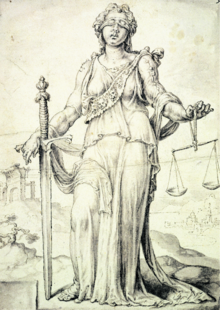
She is usually depicted holding a sword, just as Themis was in some images, representing authority and conveying the idea that justice can be swift and final. In some interpretations the sword she holds represents punishment. As do her predecessors Ma’at and Themis, Lady Justice also carries a scales.
Since the 16th century, Lady Justice has often been depicted wearing a blindfold. The blindfold, symbolizing objectivity, a lack of prejudice demanded by justice, that justice is impartial and should be applied without regard to wealth, power, or other status.
Many sculptures, such as the one atop the Old Bailey courthouse in London, leave out the blindfold altogether. Another variation, which can be seen at the Shelby County Courthouse in Memphis, Tennessee, depicts a blindfolded Lady Justice as a human scale, weighing competing claims in each hand.
 |
| Contemporary Iustitia in Ottawa |
 |
| Allegoria della Guistitia |


Scales of Justice

As you can see, one thing that all of these Pagan representations of the concept of justice include is scales. The scales of justice are a familiar symbol used in many Western presentations of modern law; they represent the weighing of two sides of an argument and the equal, unbiased administration of the law, and the scales lack a foundation in order to signify that evidence should stand on its own. They symbolize the idea of the fair distribution of law, with no influence of bias, privilege or corruption.
Lady Justice is most often depicted with a set of scales typically suspended from one hand, upon which she measures the strengths of a case’s support and opposition.
* * * * *
 |
| Contemporary Lady Justice |
As mentioned above, Pagans commonly learn from the mythology and folklore of our ancestors, and, to a lesser extent, from anthropology and archeology, art, music, dance, and cuisine. We may draw from many times and cultures, from personal experience and philosophy, from teachings and study. Personal experience may include direct communication with particular divine entity(ies). I don’t see this as choosing from a smorgasbord of ancient and contemporary; rather, as are all religions, Pagan religions are syncretic.
In general, Pagans are not doctrinaire. We are orthopractic rather than orthodox; we share our rituals together, be they scripted or spontaneous, yet each participant may gain insight and understandings, literal belief or healthy skepticism, in different ways. Further, each participant may have a different belief about what they’re doing, whether literal or metaphorical.
Our ongoing influence is attested by the longevity of our deities and the concepts they represent. The desks of many attorneys hold a scales; courthouses and other government buildings are warded by statues of Lady Justice or Themis, paintings of these goddesses abound throughout the world, from Brazil to Scandinavia, and beyond. As we are fond of saying, we practice a “living religion.”
© 2020 Aline O'Brien