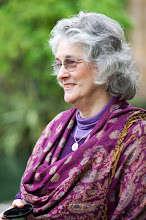
Showing posts with label Patricia Monaghan. Show all posts

Wednesday, July 30, 2014

Remembering Margot Adler


Much has been posted in both mainstream and Pagan media about the untimely death of Margot Adler.  People have spoken about the many ways she as influenced them, about her teachings, her personality, her inestimable contributions.  Just to round out the picture with yet another perspective, I share her some remembrances.  Because what is remembered lives.

I first heard of Margot when I found Drawing Down the Moon on a shelf in a local bookstore in 1979.  I took it off the shelf and skimmed through it and what do you know?  There was a chapter called “Interview with a Modern Witch” about my friend Sharon Devlin Folsom.  And there on the cover was my friend Anna Korn, clearly identifiable in the photo of the handfasting of Isaac Bonewits and Selene Kumin.

I was friends with both Anna and Sharon by way of the Institute of Celtic Studies here in the SF Bay Area.  Until that time, I was unaware that either was Pagan.  Since that time, Anna and I have shared lots of projects together (in the context of CoG as well as with a former incarnation of Reclaiming Collective), and Sharon and I have done a few rituals together.  All three of us have remained friends.

However, it wasn’t until I went to the first CoG MerryMeet on the East Coast, at Rowe Conference Center in Massachusetts that Margot and I met.  By that time my late coven sister Bone Blossom had been living in Connecticut and connecting with all manner of NELCCOG (North East Local Council, now defunct).  I seem to remember that it was Bone who introduced us.  What I remember more clearly is that Margot had heard of a ritual that Sharon, Bone, and I had brewed up and performed at Ancient Ways a year or three prior.  That ritual, entitled “Kali and Other Dark Goddesses,” seems to have had a profound effect on many people who participated.[1]  In any case, Margot in NYC had heard of it and so had my late friend Sequoia when she was traveling in India.  So I had the thrill of being introduced to Margot, this prominent Pagan whose work I had admired, and she already knew something of me.

We maintained a casual friendship over the years, much like many who may read this.  We encountered each other at events.  She had me over for bagels and coffee at her NYC apartment one time.

Sometime around 2000, both the late Judy Harrow and I both became involved with the incipient Cherry Hill Seminary, thanks to the machinations of Cat Chapin-Bishop.  Margot was Judy’s Gardnerian teacher/initiator/elevator.  In addition to being a well-respected and –loved Witch in the Northeast and beyond, Judy was also Craft mother to another of the founders of CHS, Laura Wildman-Hanlon,  So I’m assuming, although if I knew at the time I don’t recall now, that that is the route by which Margot came to support the seminary.  However, it happened, Margot has been a consistent voice in support of CHS.  For the past several years she has served on the Board of Advisors, where I’m currently proud and honored to serve with her.

Thanks to my dear friend and literary mentor, the late Patricia Monaghan, Margot suspended her standing policy of not providing cover blurbs, and wrote one for my first solo writing effort, Witchcraft and the Web.  She wrote, in part, “…she deftly shows the impact of the Web on the Craft – how it is hanging the religion’s notions of authority, leadership, authenticity, and even the way rituals are conducted.”  I’ve included the quote here because it’s germane to our shared observations about the expansion and new understandings of Paganism in our cyber age.

One of the people Margot quoted frequently in DDTM (the first edition; I don’t know about subsequent ones) was our mutual friend, the late Alison Harlow.  Although Alison was Margot’s senior by a few years, they first bonded over the fact that both of them attended a progressive City and Country Grammar School in Greenwich Village when they were children.  Alison lived in my area of the country.  Our two then-covens, Holy Terrors and Wings of Vanthi, sometimes circled together, and both of us were active on CoG.

As sometimes happens when someone is in the process of leaving this plane, their loved ones get weird.  Alison was a Witch, a fact that some consider prima facie evidence of weirdness, or at least oddness.  In any case, Alison’s loved ones experienced some intramural, if you will, discord at the time of her passing.  Feelings were raw.  Margot was in NYC and I was in Northern California, and further, I was not among those attending to Alison.  I guess I was sort of a neutral yet engaged party.  Both Margot and I paid close attention to any news about Alison’s condition.  She and I had several phone conversations about what was happening surrounding Alison’s dying and in the days following her passing.  There’s nothing like sharing in someone’s birthing or dying to bond people.

In another context, I remember a wonderful and very noisy dinner with about eight Pagan scholars (and their groupies, such as myself) during the AAR Annual Meeting in Philadelphia, city of my childhood.  Some of those in attendance were younger and fresher; some were scholars whose exposure to Paganism had been mainly in the context of their studies rather than in situ, so to speak.  But Margot and I were old-timers by that time, and both of us are talkers and really relish stories about our communities.  Oh, the stories we shared at that lively dinner!  Our gales of laughter sometimes became too loud for a shared public space.[2]

When I last saw Margot, at PantheaCon 2014, she was constantly in demand so I didn’t intrude.  However, I was pretty sure our paths wouldn’t cross again in this life.  So before the con was over, I found a brief moment to embrace her and tell her how much I treasured her.  I’m really glad I had that opportunity.

Crones

We were enjoying the CoG reception at PantheaCon 2013 when someone called for a group shot of the crones in attendance.  There was lots of passing around of people's cameras; these are the shots that were captured in mine.  It's really hard to get people to all be looking at the camera for a group shot.  

-->
Front row: Anna Korn, Glenn Turner; back row: Magenta Griffin, Rachael Watcher, Macha NightMare, Selena Fox, Vivianne Crowley, and Margot Adler


Late.  Late.  Late.  Late.  Late.  Late.  Do you notice how often my references are to folks who have crossed over?  Six cites!  I see many of Pagandom’s early pioneers passing through the veil.  It is my fervent hope that their work, the examples of the lives they led, their teachings, their spirits survive into the future as foundational to contemporary American Paganism.


[1]   That ritual was reprised, by request, at MerryMeet in Saratoga a couple years later, only Sharon wasn’t available so Sequoia took the priestess role originally performed by Sharon.
[2]   I remember that the late Judy Harrow was also at that Annual Meeting, and we had shared dinner the night before, but she wasn’t at this particular table.

Saturday, June 07, 2014

Sparky T. Rabbit


Sparky T. Rabbit
Peter B. Soderberg
Bruner Soderberg
Heathenbear
3 February 1954 – 2 June 2014

Back in 1982, if memory serves, I attended the first CoG MerryMeet festival held outside of California, at Circle Pines in Michigan.  I was a very young Witch (not such a young woman, but a young Witch).  I had only been to two smallish, mainly local Pagan festivals, one being the first MerryMeet in ’81 and the other one in the hot, dry coastal hills of the East Bay.  I had no idea what to expect, but I was excited.  I was there for a reason, as a delegate from my Local Council to conduct the business of CoG.  That fact gave me some assurance of who I was and what I was doing out in the woods with a bunch of unfamiliar Witches.

We held our meetings under a pavilion, where I remember shucking Circle Pines-grown corn for the evening meal.

On the first day, I was wandering the grounds between sessions when I came upon two friendly men who introduced themselves and asked my name.  When I answered, the larger bearded man who wore a long black cassock-like garment, let out a tremendously loud and jolly laugh, and said, “Oh, you’re Macha NightMare!  I love that name.  It’s one of the best names I’ve ever heard.  How did you come to get it?”

“You’ve heard of it?” I replied in surprise.  Both men had read it in the old Reclaiming Newsletter (predecessor to Reclaiming Quarterly).  The man who expressed such delight in my name was Sparky T. Rabbit; his slender friend, who has an equally wonderful, wickeder-than-Sparky’s laugh of his own was Steven Posch.  We became absorbed in a lively conversation for some while.  Throughout the festival, we found ourselves together.

* * * * *
From then on we kept in occasional letter and telephone contact.  We did our best to keep up with each other, and when I had occasion to be in Minneapolis, a guest at Steve’s house, Sparky sometimes coordinated visits.

Some years later there, I think it was 1992, there was another MerryMeet at Circle Pines.  Sparky and I really fell in love during that visit.  When I wasn’t in meetings, we hung out, just the two of us, talking, singing, sharing songs and chants, exploring our respective experiences of culture, Pagan community in particular.  You know how it is sometimes – you’re in an unfamiliar environment for a brief period, a weekend or a few days, and you meet someone who captivates you, and who is mutually interested in you and your ideas, and you can’t get enough of each other?

Twisted River Witches

I remember Sparky telling me about his then-coven, the all-male Twisted River Witches, who did, as I recall, public activist magic, maybe on a bridge joining the Quad Cities?  I think it’s a wonderful name for a coven, indicating as it does the home from which they get sustenance, the place where the mighty Mississippi twists.  I don’t know that area at all, plus this memory has dimmed with the passage of time.  There is one wicked Witch from that coven who may be reading this.  He’s generally closeted due to his employment and I don’t want to transgress and ‘out’ him.  Perhaps he’ll share a story about the magical pranks (if pranks they were) done by the Twisted River Witches.

Another all-male coven, this one I think was all gay men, Sparky told me about was Sons of the Bitch in Kansas City.  One of the songs on Hand of Desire, Lunacy’s second and final album, “Praising Her Name,” includes the lyrics “Praising Her name, praising Her name, that Sacred Bitch, that Holy Witch.”  I love it!  I doubt the coven exists today; however, if anyone reading this can tell us more about it, I’d love to learn.

Radical Faeries

Sparky had some involvement with the Radical Faeries, as evidenced by this pithy quote:

“We are the equivalent of Shamans in modern culture,” said Peter Soderberg, during an interview at the 1985 Pagan Spirit Gathering. “Many gay men want to be middle-class Americans. They want to be respected as human beings and they want their sexuality to be ignored.  But radical faeries are willing to live on the edge.  We feel there is power in our sexuality.  You know there is a power there because our culture is so afraid of us.”  Margot Adler, 2006.

I invite anyone who can say more about Sparky and the Radical Fairies to tell us.  Mugwort of Nomenus has placed Sparky’s name on the fairie ancestors list.

"Wicked Witch of the Prairies"
Master Ritualist

In her 1995 anthropological study of contemporary Witches, Never Again the Burning Times, scholar Loretta Orion rhapsodizes about a Full Moon ritual at Pagan Spirit Gathering designed by Peter Sonderberg [sic], whom she says calls himself Peter the Big Blue Fairy.  I think Sparky hated that appellation, at least in later years he did.  Maybe he gave it to himself earlier.

Throughout the book she quotes liberally what Sparky had to say about ritual.  Ritual designers would do well to consider his ideas.  They have served me well.

One of the few opportunities I had to actually perform ritual with Sparky was at a festival in Wisconsin in 1999, “The Union of Earth and Sky: A Ceremony for Thor and Freyr,” I was honored to work with him and the crew he’d chosen, among them Elvis, K.J., Sonja, Melanie, Owl, Archer, Steven, Keith – you know who you are.  For me one of the most touching components of that ritual was the Man in the Moon and the Night-Time Stars.

Steven Posch, Macha, Sparky T. Rabbit
Here’s what some have said on Facebook[1] about Sparky’s ritual expertise:

Wisconsin Witch Mari Powers says, “He taught me that ritual can really rock in 1983. I will miss him very much.”  

Washington Druid Kirk Thomas says, “Sparky facilitated a trancey ritual at a gay men’s pagan festival I attended that was pretty life changing for me.  It was the first (and I hope, last) time I was ridden (non-consensually, no less) by a god.  It opened my eyes to that deity and his power.”

If anyone who was there reads this, I’d welcome your elaboration on your experience of this ritual, either in a comment below, or I’ll be glad to add it in a subsequent post of Sparky stories.

The Pagan Book of Living and Dying and Lunacy

In 1995 Sparky contributed his song “Lament for the Queer Dead” to Crossing Over: A Pagan Manual on Death and Dying, the prototype for what HarperSanFrancisco published in 1997 as The Pagan Book of Living and Dying.  The Lunacy a cappella singers, comprised of Sparky and Greg Johnson, recorded this true lament on their second album, Hand of Desire.  This album was released on cassette tape, but at the time of Sparky’s passing it was nearly ready for a digital release.  Speaking for myself, and others I’m fairly confident, that album will be made available as soon as practicable.  Right now Ray has business surrounding Sparky’s death to take care of.  Watch this space for updates.

The Irish say that music has three purposes: to elicit laughter, to induce calm and sleep, and to elicit tears.  I may not have that exactly right, but I’m certain that music fosters and enhances the experience of mourning.  “Lament for the Queer Dead” fulfills this charge.

Canadian Witch Jane Pawson says, “Oh this is so sad.  I loved the Lunacy tapes.  I have the fondest memories of Sparky at a very early [Reclaiming] B.C. Witchcamp.  He taught and his traveling companions taught that camp a lot.  Like how to dress for ritual and Ms Cow's Maxims and chants and just a more inclusive way of being.   

As a contributor to The Pagan Book of Living and Dying, Sparky describes himself as “a Faggot Witch from Illinois.” 

* * * * *

I think it was in 2000 that I visited my late friend Patricia Monaghan in Chicago, where I was presenting at a gathering that I think was called a Pagan Expo, Chicago.  Sparky was with his husband Ray in Chicago that weekend.  After the expo, we retired to an Irish bar downstairs for socializing.  Sparky had long admired Patricia’s work, her goddess scholarship in particular, and Patricia had long heard of Sparky.  I had raved about both to each other, so this was their first meeting.  The other first was that I finally got to meet Sparky’s beloved husband Ray about whom Sparky spoke often.  Afterwards I told Sparky how cute I thought Ray was, how lucky they were to have each other.  

Sparky & Ray Jump the Broom
Sparky and Ray spent nearly 31 years together.  I only recently learned that two friends here in California whom I’ve known for maybe 25 years officiated at Sparky and Ray’s handfasting.  (I’m not naming names due to uncertainty about their ‘out’ status.)

Pagan Summit

Pagan Summit, 2001
Due to my involvement in a dictionary project initiated by the Pagan Educational Network (PEN), I learned that organization expanded to sponsor what they called a Pagan Summit (not well-chosen title, in my opinion, but nonetheless that’s what it was).  Coordinated by Cairril Adaire and held at the University of Indiana in Bloomington in 2001, the summit organizers sought to include people the organizers considered influential.  Networking fool that I am, I insisted that some others I knew be invited.  Among them were Patrick McCollum, Deborah Ann Light, and Sparky T. Rabbit.  Sparky came as a delegate from the Twisted River Witches.

Sparky served as a sharp facilitator of consensus process breakout groups, a job made especially challenging by the fact that many had not experienced that kind of decision-making.  Sparky was an expert.  Attendee Jerrie Kishpaugh Hildebrand said, “I met Sparky at the Pagan Summit in 2001.  His brilliance around the use of consensus processed was as inspiring as his music.”

Heartland Pagan Festival

The one time I attended Heartland Pagan Festival in Kansas, Sparky came, too.  He’d been there before, I think, and he knew some of the organizers, Parsley being the one I remember best.  My friend Grey Cat from Tennessee, who’s on the Other Side now too, and I were two of the featured guests.  Sparky was there to give a workshop on ritual, in which he emphasized play and spontaneity, and to perform a concert.  Sparky drove there with his pal Beal from Chicago.  We four formed an odd group -- two Midwestern gay men, one Tennessee crone, and one uppity Californian -- shared a cabin not far from the communal showers and the dining hall, but away from the tent campers.  We talked and laughed and had a great time until late into the night.

I gave a workshop I call “Chants & Enchantment.”  Though Sparky and I had been friends for years, we rarely enjoyed face-to-face meetings, so we took this rare chance to experience each other’s teaching.  This workshop happens to be one of my favorites.  In fact, some of the chants we use were written by Sparky.

The first singing I do in this workshop is a Sufi meeting dance of sorts.  I learned it from Ginny Brubaker of Chicago at that very same Circle Pines MerryMeet where I met Sparky and Steven, in fact, although it turns out she learned it from someone here in Marin County, California.  In any case, this chant involves people looking into the eyes of each person in the circle.  (I tend to lead workshops with attendees seated or standing in a circle.)  When I got to that part, Sparky discreetly left.  Later I asked him, “Too California woo-woo?” He confirmed that fact with a nod.

Sacred Harvest Festival

Macha & Sparky at Sacred Harvest Festival
In 2004 Sparky and I, along with Ivo Domingo, Jr., presented at Sacred Harvest Festival in Wisconsin.  I had designed a special ritual for that weekend entitled “Witchual: A Spell.” We cast a spell to view the dark and light, in ourselves and in our communities; to recommit to Goddess; and to reclaim and honor stereotypes.  My design concept was influenced by Sparky and Steven, so I was especially eager to learn how Sparky had experienced it.  However, I have a rule not to critique ritual – every ritual deserves honest critique so that it can become as effective as possible – sooner than 24 hours afterwards.  Sparky laughed a lot that evening that I’d made that rule because he knew I was dying for his feedback.  I made it, though: the next evening he told me he loved it, and got specific about what worked and how.

* * * * *

Much of what Sparky and I shared had to do with Craft, ritual, Pagan community, Pagan groups and organizations, the massive dysfunctions we see that drive us nuts, as well as the ritualists, activists, and artists we respect and admire.  We’re passionate about all of the people and culture we love so much.  That, of course, is why we sometimes become frustrated.

Sparky was not a candidate for Mr. Congeniality, although he was a congenial man in my view; nor was he one for Mr. Popularity, although he was popular in the sense that people liked him and wanted to be around him.  But Sparky didn’t care what anyone thought of him when he spoke his mind.  He would get on a tear about some topic and he would work it and work it and work it until he reached some understanding, and satisfaction that his points were being understood and appreciated, if not agreed with.  I’m sure there are readers who’ve known Sparky, or maybe heathenbear or Bruner, on listserves.  We both got kicked off of one list due to Sparky’s persistence in a particular discussion of het male assumptions.  I had never actually taken a position in that fight, which is what it devolved into, but evidently my friendship with and support of Sparky was enough to get me banned.

At the festival from whose list we were banned.
From time to time Sparky would have a falling out with one friend or another, or more than one at the same time.  He held his grudges in a strong grip.  Eventually, with the passage of time and some perspective, rapprochement could be achieved.  Even forgiveness and renewed vows of friendship.  I am among those who did time away from Sparky for a hurt he felt.  In the end, though – and I’m sure of this from our conversation about a week before his passing – everyone forgave everyone else and he knew who loved him and he loved them back.

He regarded his identity as an artist as sacred.  He took pride of authorship; he insisted on proper attributions; he valued honesty.  He was a perfectionist of his creations.  And he expected nothing less of others.

When I felt I had to disassociate myself from the tradition of my forming, both as Witch and as tradition, Sparky was a tremendous source of support.  He helped me analyze the things that bothered me.  He sent me articles.  He opined.  He reminded me of old feminist analyses about the tyranny of structurelessness.  He took his concerns to the leaders and organizers of the larger community, via an international listserve.[2]  He phoned frequently to see how I was processing this big change.  He was a wonderful friend to me.

* * * * *

Upon learning of Sparky’s death, my friend Ivo Dominguez, Jr. wrote:

Sparky T. Rabbit’s voice is intertwined with the roots of my development as a witch, and we still use the chants that he wrote and the chants that he popularized within our covens today.  I played the cassettes for his two albums so often that I wore them out and had to buy replacements twice.  I cherish the one time that I had the opportunity to sing with him.  It is still a luminous fanboy moment for me.  I grieve the loss of such a beautiful man and his beautiful talents, but I also grieve that so many in the current generation of Pagans have not heard of him.  What is remembered lives.  Take the time to look him up and find copies of his music which is finally available again in digital formats.  Then you'll feel the joy of discovering his music, and also share my sense of loss as well.  May he go forth shining.

Abby Willowroot says, “and yet, the music lives on and nourishes all who and sing it. Many Blessings on the passing of this uniquely creative Pagan Spirit.  May the road he next walks be as inspired and fruitful as the Path just walked.  May All who feel this loss acutely be comforted, and may they soar as they perform rituals in Sparky's memory.”

Even in just that past three days I’ve run across several posts and articles I just have to talk with Sparky about.  It’s not that I have no one to explore these ideas with; I have good friends for that.  But they are not Sparky.  They do not have his unique perception, his sharp edge, his principled stand, his unwillingness to put up with bullshit.

There’s so much more to say!  I hope others will contribute – fill in blanks, offer stories not yet told.  I know many knew him in completely different contexts than I did.  Nothing here touches on his fondness for Lord Ganesha, his explorations of his Scandinavian heritage, so many other things.

The terms Sparky claimed for himself is *argr* seidhmadhr.  I’m embarrassed to say that I’ve forgotten what he said it means.  Can someone who reads this help me?

To Sparky, *argr* seidhmadhr, I say goodbye, dear friend.  May you find peace, wherever you are.  We who remain on this side will keep your light aglow, for what is remembered lives.


[1]   I’ve taken the liberty of copying some Facebook responses to Sparky’s death in order to share them with people who aren’t on Facebook.
[2]  For any Reclaiming folks who may be reading, I had nothing to do with Sparky’s presence on RIDL.  He, in fact, asked me to sponsor him and I declined, believing it inappropriate for me to do so.

Wednesday, February 27, 2008

Interfaith Action for Worker Justice

Yesterday morning I joined others at the Marin County Civic Center to confront the Board of Supervisors about their neglect to fix Marin's Living Wage Ordinance, guaranteeing minimum wage and health care benefits for homecare workers. The ordinance was passed a year ago, yet through administrative sleight-of-hand excludes from its protection 1,000 homecare workers. Homecare workers allow elders to stay in their homes. Shamefully, Marin, one of the wealthiest counties in the entire country, has one of the lowest pay rates for unskilled laborers* in the nine Bay Area counties.

My colleague in Marin Interfaith Council, the Rev. Pamela Griffith Pond, a Lutheran minister who heads Marin Interfaith Worker Justice, solicited help with this effort from members of MIC, and on Monday asked me if I would do a reading as part of the program. I was rushing out the door when she phoned, and I really wanted to help and was honored that she had asked, so I said yes. Then when I got home after my birthday dinner with Patrick & Barbara, Corby, my daughter Deirdre and her boyfriend Matt, I started looking for a suitable reading. Well, ya know, we Pagans don't have readings. We have no holy scripture. We have the seasons and the tides, the Wheel of the Year, the counsel of the cowry.

It was late and I was tired and I wanted to be prepared. So I surfed around the Net for inspirational material of any kind on the subject of worker justice. I found lots of practical resources for people engaged in that effort. I found lectionaries. I'd never heard the word lectionary; it's "a list or book of portions of the Bible appointed to be read at a church service." No, lectionaries wouldn't do. I combed through books on my shelves, felt too weary for inspiration. Then I decided that the best of reading from a Pagan perspective is poetry. Yet finding something both relevant and beautiful left meager pickings.

Once again, I found myself turning to my friend Patricia Monaghan's poetry, from the same collection as the poem I selected for Brigit, Seasons of the Witch.

Standing in a group near the South entrance of the Civic Center, holding signs, with people coming in and out, riding up the escalator, with blasts and other truck and traffic noise just outside the open doors, I read:

Housemagic
You descend the stairs at midnight.
You walk through the sleeping hours.
Light surrounds you in the silent dark.

Was it a nightmare woke you?

You pour a glass of water.
You sit by the window, beside that
cobalt vase filled with blue flowers.
Into the dark blue center of sleep
you slip again, into the blue
blackness of true forms, into
the fragmented pool of meaning.

There, on the boundary of
boundlessness, you dream
and, dreaming, remember what
you have not utterly forgotten:
how your kitchen always has at least one
witch's broomstick, how clove and garlic
are domesticated on your spicerack,
how everything has power.

But you remember only how, not
why. And so your power finds
its limits: You can raise
the bread but you cannot
tame the nightmares that
pasture in the silent house.
You have forgotten the way
to the wildness within you,
to the instinct for order.

Now as you sleep you dream
of a half-remembered house: bedraggled
as old lace, its stairs rot into wooden
filigrees, its attic suffocates in private
dust. And in its flooded basement
the rivers, the sewers of the world
breed terrifying marvels. Because
the house grows wild, disorderly, all
the gardens in the world turn treacherous
and forests strangle on themselves.

But in this house all change is possible.
Some corners--left or right, dining room
or pantry--grow shiny with significance.
A ladder leans against a wall.
Sheer white curtains billow.
A floor creaks. A door closes.

When you wake in the blue hour
before dawn, you remember
am old house with stairways that
lead to attics that connect to trees.
You remember all the paths.

And remembering, you know how
to make the necessary changes
to pull the day towards night, to
let all things revel in meaning,
dreaming the world's secrets like
the favored habitat of blueberries,
like the seasoning of rosehips,
like the uses of lichen and moss.

On a bureau you collect
a chipped mirror with a
woman's face, a stem of bed-
straw that died aslant, your
sister's candlesticks,
an old pot with a mother's
belly, a box covered with
dusty embroideries.

Then, in another room:
rocks in a spiral pattern,
a branch that sang in a
mysterious and certain way,
a whitened bone.
A gray owl feather,
a small pile of seeds.
All in a certain order.

Now, when you sleep
you build a round tower,
you cut new windows,
you carve a pool in shade.
A candle burns beside you
as you dream. It flickers
sometimes in the cool breeze.
Outside your window, a single
leaf breaks against stone
as it falls from the gnarled oak.

And you dream of being in the power
of grasses, frail patched lace,
filigree seedheads, mist of renewal,
reckless with shedding. You dream
your hair full of seeds, your hair
a cushion for seeds to rest on,
you dream you were born to move
seed to new lands, you dream
purposes and reasons, you are
full of thoughtless utility.

And sleeping there, you feel
your dream and the world's
dream join. A path stretches
out before you, the path from
childhood: at its end, a new
trees is taking root, its taproot
drinking your heart's blood.

And, when you wake and move
through the dim silent room,
you know that the wind of your
daily dance brings a storm to
an old forest on another continent,
and that the fall of its giants
leaves room for new growth.

Midnight: You open the door.
A horse comes galloping.
There are no horses where
you live. But she is there,
wearing no saddle, no reins.

With blueblack eye she invites
you. She kneels as you mount.

This is where the dream would
end, if this were a dream.
But it is not, and so
the next thing
you feel is
the rush of wind
in your hair.

* * *
Following the program, we carried our signs up the escalator and around the escalator wells while singing "Oh, when we win a living wage...When every worker has a job...When healthcare's free for you and me..." to the tune of "When the Saints Go Marching In." Pamela carried a stack of letters written to the Board in support of their putting the health care for homecare workers back on their agenda and passing the resolution they'd promised. The letters were from individuals and groups. I had mailed one a earlier. It turned out that, in spite of the fact that a Board meeting had been scheduled for Tuesday morning and that was why were were there when we were, there were no Supervisors on the premises. Pamela gave the letters and her card to the receptionist with instructions to give the letters to Supervisor Hal Brown on the labor committee.

We left the Supes' offices and filed down though the building singing another filk, then dispersed. Some of us went to the cafeteria for coffee and feedback. The discussion yielded some interesting and useful information. I found I had a lot to offer from my Pagan and activist background, tame though it may be. I found that my sense of ritual informed my observations.

At one point, I said that 'we' (meaning Pagans in general) had a few more interesting chants than the usual filk, and that one that had come to me in this situation was a chant known as "Summer Solstice Power Chant," by Starhawk. Surely many readers know it. Grace, one of the other demonstrators did. It begins, "We are the power in everyone..." and ends, "...We are the turning of the tide." I said that I was reluctant to suggest it because to me is sounded maybe a bit more je ne c'est quois than they'd want. To my surprise, they liked it. Carol, one of the home care workers, said that she was a born-again Christian and she would be happy to sing that song.

A Supervisors' meeting is now set for the same time next Tuesday, and we will repeat our protest. Pamela has more letters of support to deliver and wishes to make a public statement to all the Supervisors. In the meantime, however, our message has resulted in a meeting next Monday between Pamela and Supervisor Brown.


* Coincidentally, Marin has the lowest salaries for legal secretaries in the Bay Area as well. Legal secretaries have special skills and knowledge, far more than just typing letters. I'm sensitive to this because I was a single mother trying to make ends meet as a legal secretary in the '80s and '90s. In order to reduce the constant stress of paying bills by triage method, to earn a decent salary, I ended up commuting back to San Francisco and leaving my latchkey child on her own more than I would have liked.

Saturday, February 02, 2008

Poem for the Feast of Brigit

Much as poetry makes my heart sing, it's not my gift. So in honor of my friend Oak's call for poetry in honor of the Feast of Shining Brigit, I've chosen a poem by one of my favorite poets, one I'm happy to call a dear friend and mentor, Patricia Monaghan. This is from her collection, Seasons of the Witch.

Praisesong for Her

She is a tree in a circle of stones.
She is a crossroad at noon.
She is a breeze in the red mountain ash.

She is a hill on a night without stars.
She is a tear of the sun.
She is the moon on the ripening grass.

She is a hawk in the circling sky.
She is the eye of a hound.
She is a fish in the river of glass.

She is a berry of red mountain ash.
She is a seed of bright grasses.
She is a stone in the river of glass.

She is the sigh as time passes.

May the blessings of bright Brigit shower you with light!