Showing posts with label Coast Miwok. Show all posts

Wednesday, September 22, 2010

International Day of Peace, and Then Some

Yesterday I set out to attend the re-dedication of the peace pole on the campus of Dominican University. Our local Dominican Sisters, colleagues in Marin Interfaith Council, do this each year. In the past, when my friend Sister Marion headed the order's Social Justice Committee, I have been an active participant. This year, when the event was announced at an MIC clergy luncheon, I spoke with Sister Marion, who's now retired, about participating; she said that whoever was in charge had already formulated all their plans and that I should just show up. Well, I did, but, I'm embarrassed to say, I had written the event in my calendar as taking place at noon when in fact it began at 11 am. So I arrived just as they were concluding.

In 1981, the UN General Assembly passed a resolution declaring an International Day of Peace, and in 2001, it adopted the resolution declaring September 21 of each year International Day of Peace. This year's theme is "Youth for Peace and Development."

Since its inception, Peace Day has marked our personal and planetary progress towards peace. It has grown to include millions of people in all parts of the world, and each year events are organized to commemorate and celebrate this day. Events range in scale from private gatherings to public concerts and forums [sic] where hundreds of thousands of people participate. Anyone, anywhere, can celebrate Peace Day.

International Day of Peace is also a Day of Ceasefire -- a day in which armed conflict is meant to be stilled; a day on which we appeal to combatants to observe a ceasefire; a day on which we reaffirm a commitment to non-violence and the peaceful resolution of disputes.
Last night I missed most of the nightly news I usually watch, but I suspect there were hostile engagements taking place yesterday in spite of the best intentions of those of us who seek to promote peaceful resolutions to conflict.

What was extra special about this year's ceremony was that the words that roughly translate to "May peace prevail on Earth" in the local Coast Miwok** language were to be added. "Hiya aa puli suta weyyatto."* The pole was blessed by the Coast Miwok and all others who were there. Until yesterday, the pole bore those words in English, French, Spanish, and Arabic.***

The assembled people exchanged peace greetings in Arabic: As-salaam aleikhum, Wa-Leikhum As-salaam; Hebrew: Shalom aleichem, Alechem shalom; Serbo-Croatian: Mir nek bude tebi, Nek tebi bud emir; Chinese: Hun pink ban sway nee, Ban sway nee huh ping; Masai/African: Wenna kanta laf-fi, Laf-fi la Bumbu ("God gives peace. Peace is something special."); German: Frie de sei mit Dir, Und mit Dir sei Frie-de; and Coast Miwok: Puli sutammi mikkoni.

In addition to offering prayers for peace from different religious traditions, people sang several songs from song sheets provided by the Sisters. There were the usual, such as "Let There Be Peace on Earth,"to the Pagan-ish "Circle Round," by Linda Hirschhorn, to the utterly wonderful John Lennon song, "Imagine." This last included an additional verse written by fifth grade students at Cornell School in Albany, California.

Imagine that our leaders
Would listen to our voices
And instead of riches
They cared about our choices
Imagine all the people
Caring for the earth...
There is good news in that even though I was late arriving I did meet someone I had hoped to meet there. She is Joanne Campbell, a Tribal Council Elder with the Federated Indians of Graton Rancheria. Graton Rancheria is comprised of Coast Miwok and Southern Pomo peoples. I invited her to participate in the third annual People of the Earth conference at the Interfaith Center at the Presidio of San Francisco in November.**** As soon as I have more concrete information to give her, I'll follow up on this invitation.

The Dominican Sisters of San Rafael's report on this event, with lots of photos, is here.

* * * * * * * * * *

During the afternoon I attended Marin Interfaith Council's Annual Meeting, where we did a lot of thanking of various individuals for their work,reviewed the budget, and officially installed Fu Schroeder of Green Gulch Zen Center as MIC's representative to the Marin Community Foundation.


* The "s" in the word "suta" should be underlined, not an option in this blog program.

** Coast Miwok people greeted Francis Drake when he first landed on the shores of Marin County in 1579 and other Europeans who entered what it now San Francisco Bay. See "Big Time."

*** While we American Pagans all speak English, and most perform their rites in that language, given the spirit of the annual re-dedication, I would imagine the sisters might consider adding these words of peace in Gaelic, assuming some Druid group involved in interfaith activities were to propose it.

**** Unfortunately, there is no announcement on the ICP website nor any flier for this yet. Watch my FaceBook page for updates.

Friday, July 30, 2010

Big Time

Earlier this month, Corby and I attended the 30th Annual Big Time, a midsummer festival of the Coast Miwok and Pomo people of California. The College of Marin, in partnership with the Miwok Archaeological Preserve of Marin (MAPOM) and the Point Reyes National Seashore, offered a special event in conjunction with Big Time.

The first speaker, Betty Goerke, author of Chief Marin: Leader, Reble, and Legend, a biography of the Native (1781-1839) for whom the county was named -- his name was Huicmuse, he was christened at Mission Dolores as Marino, shortened to Marin -- gave a brief history of the Marin's indigenous Coast Miwok people who were living here when English ship captain Francis Drake (prior to being knighted) and his crew, sailing on the Golden Hind, landed at what is now called Drake's Beach in 1579. They were the first Europeans to encounter Coast Miwoks.

She showed the former coastline of what is now California, which extended maybe another 20 miles into the Pacific; this was before the formation of San Francisco Bay. She claims there is evidence of Miwok villages under the sea where the coastline had been, dating back 20,000 years.

She also showed illustrations of Coast Miwoks, in their tule boats, paddling to meet European ships entering the Bay.

Ralph Shanks, an authority on basketry, told us that many of the most exquisite examples of regional basketry are in the collections of European museums -- in Germany, in London, and at the Hermitage in Russia. Russian traders settled along the Russian River and the towns of Fort Ross and Sebastopol in Sonoma County (one county north of Marin) around 1812. Evidently those traders recognized the value and uniqueness of this indigenous art form. Dr. Shanks and his wife, Lisa Woo Shanks, have written books about California Indian basketry.

He showed photos of many kinds of baskets, some of which were decorated with shells and feathers. The red feathers on the heads of the acorn woodpecker were highly prized, both for basketry and for personal adornment.

In addition to their everyday uses, for cooking, gathering and other domestic applications, baskets had ceremonial uses. They held water, but were not suspended over fire or they'd burn. Instead, hot rocks were placed into the acorn mush or whatever they were cooking in the basket, and that cooked the contents as well as any other cooking method could.

Because the coastal hills of California and the sea and waterways contain abundant and diverse edible vegetation, the Coast Miwok had no need to develop agriculture. They did hunt. Due to the mild climate and their semi-itinerant lifestyles living in small villages, they had no reason to erect large structures or to develop sophisticated architecture. Nature provided all they needed for a healthy life of comfort. So their artistry went into basketry. California Indian basketry is known worldwide for its beauty and complexity.

I possess two beautiful baskets that belonged to my former mother-in-law, Eulalie Braden Wolfer, that I think are Pomo. Now that I'm acquainted with Dr. Shanks, I plan to show them to him and get his advice as to their origin, value, and the best ways to preserve them. One is a very tightly woven bowl shape, with triangular designs; I'm sure it can hold water. The other is larger, also bowl-shaped, but of a coarser grass with the design created by the weaving and texture rather than with colors. I hold them as family heirlooms to be passed to my daughter, from her paternal grandmother, at the proper time.

Gene Buvelot, who is on the Board of the Federated Indians of Graton Rancheria, gave a fascinating update on how several local tribes, not all Coast Miwok, organized and petitioned the federal government in 1970 to recognize them as Native people and restore their tribal status. This was necessary because the government had been informed (by whom I don't know) that there were no more Coast Miwok or other local Indians.
Since 1983, thirty of the thirty-eight California tribes that were terminated under the policy have been restored to federal recognition through litigation and legislation. In 2000, following a lengthy process, the Tribe became the most recent of these tribes to have its federally recognized status restored through enactment of the Graton Rancheria Restoration Act (“Restoration Act”).
Interesting lessons in current federal bureaucracy.*

Following the talks, we ate box lunches of broiled salmon with blackberry ketchup, grains of the Americas (red, white and black quinoa, amaranth, and wild rice), citrus seaweed salad tossed with field greens with agave nectar vinagrette, acorn brownies, and mint tea sweetened with maple syrup, prepared by Chef John Farais of Indigenous Edibles .

After lunch we went to Kule Loklo (bear valley), a native village on the grounds of the Bear Valley Visitor Center, Point Reyes National Park, where we watched Native dancers. We also wandered the village, entering the roundhouse, kotchas (family dwellings), and other structures, and viewing Native crafts and jewelry. Others, mostly children, drilled shells to make beads (like those used to decorate baskets), flaked flint arrowheads, and spun bull-roarers.

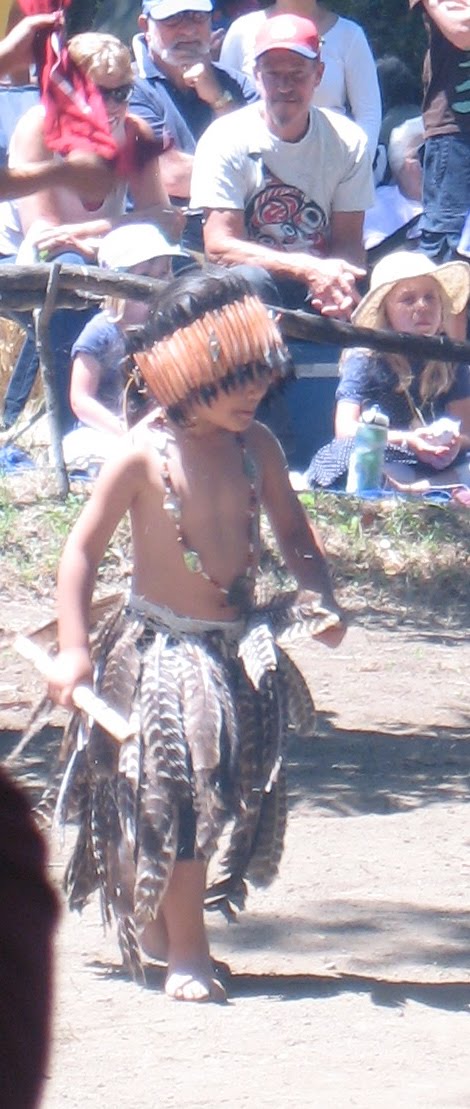
Even though it was a very hot, sunny day, the dancers performed around a small fire pit. Several of the dancers were related -- father, son, grandson, nieces, cousins -- as well as being from different local tribes and blends of different tribes. Accompanied by two drummers and a singer, the dancers did group dances, dances for women and girls, dances for men and boys. The men's costumes consisted of feather skirts that they sometimes flounced up in the rear. Of course, these dancers, performing as it were before a mixed general audience, wore shorts, jeans, sometimes T-shirts, under their costumes, when I'm sure that originally these dances were performed wearing only the feather and leather costumes, with no Western clothing underneath. (The Coast Miwok who greeted Drake wore no clothes most of the year because our weather here is temperate.)

I found it interesting that the males dressed in native ritual garb, mostly made of what appeared to be either hawk or turkey feathers -- there are lots of turkeys roaming the hills hereabout -- and shell beads, while the women's clothing, which was also no doubt traditional among these peoples, being made of cotton cloth, showed the clear influence of European fashion -- and modesty.

The men's dancing consisted mostly of a double tap with each foot, sometimes crouching and seeming to imitate animals, and often flouncing the tail feathers. The women, on the other hand, carried pieces of cloth draped between their two hands, and they rocked these cloths up and down from side to side as they danced. At certain points in the singing, all the dancers twirled around. The ribbons streaming from the women's dresses and their long glossy hair lifted spread out beautifully as they spun.

I learned from this experience something of how I imagine my European ancestors might have expressed their Pagan lifestyles: Accepting the gifts of the land, sky and sea; celebrating together; making art; expressing their joy in living. This, to me, is the best contemporary Paganism has to reawaken.


* I spoke with Gene after his talk because I want to invite local spiritual leaders to the upcoming Third Annual People of the Earth gathering at the Interfaith Center of the Presidio.

All photos, except that of the basket, by Aline O'Brien (Macha). Basket photo from the collection of The Bruce Museum, Greenwich, CT.