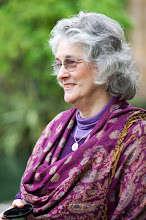
My latest blog is at Patheos in their Public Square. I am joined by eight other faith leaders addressing the topic of Faith and Aging.
Thursday, November 17, 2016


Tuesday, October 11, 2016
Interfaith Retreat -- The Interfaith Path: Many Roads, One Way

Marin Interfaith Council offers periodic retreats, open to all. Two speakers from two different religions reflect on the same topic. This is about the most recent retreat, held at Green Gulch Zen Center last week, and posing the following questions.
What would interfaith spirituality look like if we practiced it faithfully? How do we engage the unique practices and teachings of our own traditions in a way that includes, rather than excludes, those of other traditions? Is there a life-giving path in each tradition that is both unique and inclusive?

“Jesus is only one way.” “The way” is one route; we are to be the road, not the obstacles.” “When you go to the ‘soul of your heart,’ you sense interrelatedness, interdependence, not as ‘we’ but as the awesome One.”
“The tao is a bucket of water. Tip it over and it flows to the lowest places where it is most needed.”
“Who do you think you are? God’s gift to the universe. You are the light of the world. Your responsibility is to let your light shine.”
He spoke eloquently of “the river of peace, the pool of healing, the lake of serenity.”
Fr. Tom also explained, for us non-Catholics, that there are different kinds of priesthood: Diocesan priests “make a promise.” Monastic priests and nuns in orders “take vows.” I had no idea.
 The second speaker, the Rev. Shokuchi Deirdre Carrigan, is a Soto Zen priest in the lineage of Shunryu Suzuki Roshi, founder of San Francisco Zen Center. She met her teachers, Zen Master Tenshin Reb Anderson and Senior Iyengar Yoga teacher Donald Moyer 30 years ago. She has been practicing, and later teaching, Zen and Yoga.
After Fr. Tom spoke, Shokuchi, who was brought up in a Catholic family, was visibly moved when she said that if she’d been brought up with the kind of Catholic scriptural interpretations and teachings Fr. Tom offers, she may not have sought spiritual sustenance elsewhere.
At our quiet delicious vegetarian lunch with other Green Gulch residents, I enjoyed an infrequent opportunity to catch up with my friend Sister Marion Irvine, “the running nun.”[1]
When we returned to the zendo after lunch, Shokuchi had us read aloud together this Loving Kindness Meditation:
Loving Kindness Meditation (Buddhist)
This is what should be accomplished by the one who is wise,
Who seeks the good, and has obtained peace.
Let one be strenuous, upright, and sincere.
Without pride, easily contented, and joyous.
Let one not be submerged by the things of the world.
Let one not take upon oneself the burden of riches.
Let one’s senses be controlled.
Let one be wise but not puffed up and
Let one not desire great possessions even for one’s family.
Let one do nothing that is mean or that the wise would reprove.
May all beings be happy.
May they be joyous and live in safety,
All living beings, whether weak or strong,
In high or middle or low realms of existence.
Small or great, visible or invisible,
Near or far, born or to be born,
May all being be happy.
Let no one decieve another nor despise any being in any state.
Let none by anger or hatred wish harm to another.
Even as a mother at the risk of her life
Watches over and protects her only child,
So with a boundless mind should one cherish all living things.
Suffusing love over the entire world,
Above, below, and all around, without limit,
So let one cultivate an infinite good will toward the whole world.
Standing or walking, sitting or lying down,
During all one’s waking hours,
Let one practice the way with gratitude.
Not holding to fixed views,
Endowed with insight,
Freed from sense appetites,
One who achieves the way
Will be freed from the duality of birth and death.
After that, she invited us to do a slow walking meditation in the glorious gardens of Green Gulch Farm. Unfortunately, I twisted my knee on the walk down the hill, so did the rest of my meditating on a bench. (This was on the right leg, the one that was affected by the stroke I suffered last year and that I’ve been working to heal and strengthen.)
It’s been several months since MIC has sponsored a retreat, and I for one have missed them. The current staff, including Interim Director Rev. Scott Quinn, Acting Programs Associate Stephanie Humphrey, and Executive Assistant Janice Lum, did former Executive Director the Rev. Carol Hovis proud.
Thursday, October 06, 2016
Table to Action Initial SF Bay Area Meeting

Last week I attended an invitational meeting at Starr
King School for the Ministry (UU) of the first local iteration of the Table to Action Project. This
project is co-sponsored by Auburn Theological Seminary in NYC (where I have
presented and served on panels for several years, with, among others Judy
Harrow, Katrina Messenger, and Grove Harris, in case you happen to know those
Witches in interfaith) and the Arcus
Foundation. I really didn’t
know quite what to expect, except for this description on the invitation:
that
seeks to bring together faith and moral leaders from across the landscape of
the social justice sector to build an activist community and network
grounded in right relationship.
Our
goal is to craft a blueprint for multi-issue organizing that presses past
transactional and competitive ways of working and being together toward a
vision of progressive organizing that can allow us to stand with and for
each other in honesty, truth and compassion other over the long haul.
When I checked the website, I found that I had engaged with
several of the key people over the years, at both Auburn and MountainTop about
which I’ve
blogged. I was glad to have another opportunity to engage with the
convener, Lisa Anderson, her colleague in Atlanta, Melvin Bray, and Gabriella Lettini of SKSM.
The first meeting was held in Chicago, the second in Atlanta,
and this was the third. They plan more in other cities, which is where you, my
Pagan colleagues, come in. I will be asked for suggestions of
participants. So if and when one of these meetings takes place in your
area, I can let them know of your interest.
About half of those 20 religious leaders at last night’s
meeting were POC and the majority seemed to be (some said, some didn’t) LGBTQ
folks. There was one Muslim, several Jews, and lots of Protestants.
Evidently two participants were Buddhists, but I didn’t hear them state
that. Needless to say, this collaboration needs more diversity among its
participants. Same problem at MountainTop — a noticeable absence of
Catholics, Buddhists, and Hindus, much less Pagans.
I spoke to the convener, Lisa Anderson, about that
observation, and disappointment, at MountainTop (also co-sponsored by Auburn)
as well as at Table to Action. She said they were well aware and wished
to remedy that. So for the next meeting in this area I will be inviting
some Catholics, Buddhists, and Hindus whom I know in local interfaith.
Maybe a Pagan or two as well.
To be clear, there were four Witches at the first
MountainTop in 2013, which I consider a more than adequate representation. Evidently there were others at the
second MountainTop gathering; I did not attend.
I also mentioned this observation to Dr. Lettini, the local
host, who told me the same thing I heard after MountainTop, which is that
others were invited and for whatever reasons were unable to attend.
I told both Lisa and Gabriella that I was surprised, because
in my experience in local interfaith, my friends from the Roman Catholic Dominican Sisters of San Rafael are among
the most committed activists. So
are my friends and colleagues at Green
Gulch Zen Center, Spirit Rock (Vipassana),
and other local Buddhist groups.
It’s tricky to address the organizers about these omissions
or unbalances without seeming critical and ungrateful. I did, though, and
they were very receptive. (If I’m not good for anything else, I can
really network well.)
So for our next meeting I’m soliciting one or more of my
Catholic interfaith colleagues, whom I know would be a good addition to the
mix. By that I mean they’re
open-hearted and caring, accepting of diversity and not hesitant to work.
I’m eager to see what Table to Action does and to
participate to the extent that a congregation-less Pagan can. That said, I thank the Covenant of the Goddess (an assembly of smaller
congregations called covens) for financial support for my more distant
interfaith activities.
Thursday, September 22, 2016
Interfaith Report -- Religious Leaders' Gathering
 |
| Green Gulch Farm & Zen Center |
Last month I attended one of MIC’s religious leaders’
gatherings at Westminster Presbyterian
Church in Tiburon, California.
As is customary with these gatherings, three leaders from three
different religious traditions spoke on the same topic or theme, followed by
small group discussions and Q&A with the presenters.
At this gathering, we explored and shared “how we can speak
from our different faith perspectives in a way that not only honors our
similarities but also honors our diversity and places of disagreement.”
The Rev. Stephen Hale of Green Gulch Zen Center said Zen
teaches practitioners to honor the similarities and differences of all faiths. Zen also stresses impermanence and seeks
to end suffering. With respect to
theism, trying to prove or disprove the existence of God(s), efforts are futile
because “ultimate reality is beyond comprehension.” Rather, one’s efforts are better expended in cultivating and
acting with kindness, generosity, and compassion towards all.
 |
| Moina Shaiq |
Moina Shaiq, President of the Tri-City Interfaith Council and founder
of the Muslim Support Network,
has dedicated her life to dispelling misunderstandings of Islam and its
followers. She maintains that all
religions and their practitioners are different so we must look beyond exterior
appearance. She advocates getting
to know one’s neighbors in the surrounding area of forty homes in diameter
Neighborly neglect seems more the norm in contemporary
society than in earlier times.
Nowadays people focus on careers and acquisitions, and families relocate
more frequently, in my view. I think
her suggestion is a good one. We
humans fear what we do not know, so the obvious remedy is to listen and learn,
and to reciprocate.
When queried about the prescriptions, prohibitions, and
exhortations in sacred text, she responded that one is judged based on piety
over obeying texts. This statement
directly contradicts the interpretations of the precepts of the Koran by those
who seek to eliminate or convert all non-Muslims by jihad. I welcome Moina’s alternative views.
 |
| Rob McClellan |
The third speaker, the Rev. Rob McClellan, Senior Pastor at
host congregation Westminster Presbyterian, said that when he was at Reed College in Oregon, either he or a group
with which he was affiliated issued an apology by testifying to all the wrongs
done in the name of religion.
Generally speaking, I love these opportunities for religious
people to share their views, beliefs, and experiences in an appreciative,
non-judgmental milieu of multi-faith colleagues. I’m grateful to Stephen, Moina, and Rob for their sharing
and to Marin Interfaith Council for
providing the opportunity.
[Please bear with me, readers, because since my stroke I cannot write clearly and quickly. I’m interpreting some sloppy notes, hoping they are accurate.]
Thursday, August 18, 2016
Charlie Murphy -- Hail the goer!

Earlier this month I got the sad news of Charlie Murphy’s
passing. This was not unexpected, since
we knew that he’s been ill. I have been
including him in my devotions to Brigit for many months. Still, it’s a shock when the time comes.
I knew Charlie
fairly well from his early collaborations on Reclaiming Spiral Dances and other
Reclaiming activities, and though we seldom saw each other out of that context,
I always felt a connection between us.
On one of his early visits to the SF Bay Area he opened the
Spiral Dance ritual with a rousing rendition of his song, “Burning Times .“ That particular production took place in the
Hall of Flowers in Golden Gate Park. He
and I walked as a pair in the opening procession, and I told him that he was
about to participate in a rite that really showed how to honor our gods and our
Beloved Dead. After the ritual, he
agreed.
I’m not sure if it was during that visit or another, but we
spent one beautiful sunny day together in North Beach where I then lived. Over the course of the day, Charlie and I
climbed up Telegraph Hill to the base of Coit Tower. There, overlooking our glorious Bay Area, he
taught me a new song he would soon be recording. It was “Calling on the Spirits.” One phrase from that song in particular I
have had occasion to use again and again over the years: “With visions of the past and memories of the
future…”[1] I even used it as the title of a panel on
NeoPaganism in California in 2005.
Charlie and I had lost touch for some years until we became
reacquainted on Facebook. I did not know
his husband or family, only Jami Sieber. I extend them my condolences over the loss of
their loved one, such a remarkable man loved and esteemed by many.
The other song Charlie wrote that I have disseminated far
and wide is “Light Is Returning “ Its
appeal crosses religious boundaries, a characteristic I’m always on the lookout
for in my work in the area of interfaith relations. When my local Marin Interfaith Council offers a multi-religious
celebration of light, I offer reflections
on Midwinter and the light in the dark from my Pagan perspective. After that we conclude the entire ceremony
with a lively rendition of “Light Is Returning.” Everyone in the room, of whatever religious
persuasion, sings this song together.
This, to me, is one of Charlie’s lasting legacies.
I am grateful to Charlie for enriching my life. May his contributions, his voice, and his
unique magic live on.
Thursday, June 02, 2016
Creating a New Oracular System
The Green Pulse Oracle
Frequently
people ask me what I’ve been doing.
Well, one of the projects I’ve been helping my friend Jo Carson to brew
is a new oracular system that’s never been seen before. The late Fred Adams, founder of a
religion he called Feraferia, chose
Jo as his literary executor, and I must say it’s a testament to his foresight
that he selected Jo; she’s taken his entire archives, which are extensive, and
has been working on bringing his teachings alive and making them available to
others beyond the Southern California birthplace of Feraferia.

For readers
who may not know of Fred, he had a visionary experience of what he called the
Goddess in 1956, and thereafter dedicated the rest of his life to bringing
awareness of Her into the contemporary world. He formally introduced the religion he called Feraferia in
1967. Its symbol is the Phytala.
The periodical that he published
and illustrated he named Korythalia,
describing Feraferia thusly:
Feraferia is a Pagan fellowship for the
erotic celebration of Wilderness Mysteries with Faerie style and grace, and for
the lyrical unification of ecology, mythology, and sacrament. In such play-love-work may women and men
be reunited with Great Nature, each other, and their own beings...
Beginning circa
1970, Fred began amalgamating his understandings of various writings,
divinatory systems, and symbols into his own unique set of symbols. Drawing from the Tarot, the Celtic Ogham
alphabet, the Chinese I Ching, astrology, and especially the Tree Alphabet
Calendar as articulated by Robert Graves.
Originally called the Axerian Hieroglyphs by Fred, this nature-based
system is now called The Green Pulse Oracle, the phrase “Her green pulse” taken
from one of Fred’s poems.
In an effort
to make Fred’s research available to the public, Jo has taken these massive
amounts of notes, diagrams, marginalia, and such and synthesized them into the
more accessible form of this Green Pulse Oracle.

We felt we
needed something tangible to use in divination. Jo and her artist husband, John
Reed, began by creating a set of cards, pictured below.

The idea is
that they can be consulted, like the Tarot, the Ogham, or the I Ching, to help
people get a sense of the forces and influences at play in a given situation.
John Reed
then undertook the task of turning the symbols into three-dimensional markers. First he began making prints of real
leaves to use as markers, with the leaf pattern on the reverse and the glyph on
the front. They were pretty, but
didn’t lay flat and were made of fired clay, which would have been heavy,
easily breakable or chippable, and difficult to manufacture on any scale beyond
an individual custom-made set.
Still, the
leaf shape appealed to us and was in concordance with a system based on
trees. John experimented with thin
pieces of wood, cut into a vesica piscis
(Latin “bladder of a fish”) shape.
This shape carries many associations in sacred geometry, including the
union of male and female, and the vagina, and is said to be a “source of
immense power and energy.” As Jo
said, “We liked the idea of calling the markers ‘Leaves,’ since the system is
based on the Tree Alphabet Calendar.”

In the photo
above, you can see the wax version, prepared for using on ceramic markers,
featuring the glyph called Ailm.
“Ailm” correlates with the Water
element, the Moon Tarot card, the Silver Fir, Palm or Elm tree, birth and
cosmic stimulus, the number one, the vowel A, Winter Solstice and Yule, and
with the ocean deeps.
The second
marker is a wooden “leaf” with the Ailm
glyph burned into it. The
following leaves show test versions of the Feraferia Phytala design that will
be on the reverse of all the leaves.
An
explanatory book, featuring lots of Fred’s artwork, will accompany The Green
Pulse Oracle.
The work of
correlating Fred’s voluminous writings and notes, and fortifying it with
independent research, is tremendous.
Jo is doing the heavy lifting while I am serving as consulting
editor. I find this project
fascinating and engrossing, and I’m delighted to be in on the ground floor, as
it were, in creating a brand new oracular system.
Thursday, April 21, 2016
Kith & Kin

Upon my
initiation as a Witch, I swore a vow that I assume many others have also sworn,
which is to always protect and defend “my sisters and brothers of the Art.” Now I’m
wondering over the longer term exactly what that means. Or what it might mean to me.
Who are my
sisters and brothers? Who are my
kin? This is a topic worthy of
further exploration. However,
while awaiting that further exploration, I want to speak of my main takeaway
from the 2015
Parliament of World Religions.
That is the
notion of kinship.
I wasn’t as
acutely aware of kinship, and its depth of meaning, when I was younger. Now that I’ve experienced more turnings
of the wheel, more dyings and birthings, more deaths and births, more souls
leaving this plane of existence and more entering, I see kinship from a broader
and longer perspective.
Native Americans and Indigenous Peoples
When I go to
powwows (from Narragansett
powáw ‘magician’
(literally ‘he dreams’)),
which are held regularly in San Quentin State Prison where I volunteer with the
Wiccan circle under the sponsorship of the Native American chaplain, I hear all
people addressed with terms denoting kinship. Older people such as myself are called “aunties” and
“uncles,” elders are called “grandmother” or “grandfather.” Younger folks are addressed as
“sister,” “brother,” or “cousin.”
I
experienced this again at the PWR, where there was a fire kindled by members of
various indigenous peoples from around the world (the USA, Canada, Nigeria, New
Zealand, Greenland, Lithuania, et al.).
At their various presentations and at the Indigenous Peoples Plenary, I
heard similar references.
Black Churches
The same is
true of much of the African-American community, as well as, I would assume, in
the societies in Africa where they originated. In Black society, particularly in churches (which are
generally Protestant Christian), such forms of address are common. We are all sisters and brothers.
Philosopher,
scholar, and activist Cornel West both
refers to and addresses everyone as “Sister” or “Brother.” Barack Obama is “Brother Barack” and I
am “Sister Aline” (or “Sister Macha”) to him. (I introduced myself to him in an elevator lobby once,
meaning to tell him what a fan I was, and he hugged me, said how wonderful it
was to see me, though we hadn’t met before, and called me Sister.)
Quakers
Quakers (Society of Friends)
in general have in the past addressed one another as sister, brother, or
friend. In the 1945 Jessamyn West
book The Friendly Persuasion, later
made into the film Friendly Persuasion,
Friends referred to each other by the kinship terms of sister and brother. A biography of Betsy Ross, purported maker
of the first American flag in 1776, also uses these terms for members of the
Philadelphia congregation to which she belonged.
The Friends
have a complicated history as a religion, as in fact most religious movements
do. Paganism(s) is certainly no
exception. Currently this practice
of addressing other members in kinship terms has fallen away.
Notions of Kinship within Contemporary
Paganism
Often I’ve
referred to different individuals as my “witchkin.”
Other terms
heard amongst Pagani are “tribal” and “clan.” The former is often used in a utopian way to reflect the
sense that we have found our own, or have “come home.” Yet it’s also seen in a negative light
when used in the context of nativism and xenophobia. I’d like to see those notions discussed further, but for now
my take-away from the Parliament is remembering our interdependence by
considering ourselves kin.
Friday, March 11, 2016
Claremont Pagan Studies Conference - III (2016)
 |
| Dike Astraea in Vermont |
This year's theme was Social Justice.
Sunday, January 25
Keynote: Nikki Bado, “The Athame Cuts Both Ways: Pagan Responsibility and Social Justice”
Through the modern miracle of electronic communication,
Nikki was able to speak to us from the facility in Iowa where she was
recovering from surgery. I usually
have a chance to visit with her at the AAR, but due to travel – she worked for
a while in Japan – and health issues, she’s been unable to attend for a few years,
and my not attending the last one because of a recent stroke, we haven’t seen each
other in some years.
I love the title of her talk (even though I see the
double-sided blade of the athame as a piercing, pointing, thrusting, stabbing tool
rather than a cutter or slicer).
The root Craft tradition from which I sprang places a high value on
expressing one’s spirituality, in part, in political and social
involvement. In a word, activism.
Nikki articulated three areas in which Pagans could serve
their communities well in the area of Justice, the theme of this
conference. Nikki’s “3 Rs” are
Religious Literacy, Respect, and Responsibility.
Religious Literacy:
The first is religious
literacy. Religious literacy
is not something that Pagans learn in classes, study groups, or ritual work. Nor is it, in general, taught in public
schools, Ignorance of such common Biblical phrases such as, “as old as
Methuselah,” or the distorted translation of “Thou shalt not suffer a witch to
live” diminishes one’s fuller appreciation when such phrases appear in
literature, or even in everyday speech.
One Biblical quote, from the book of Ecclesiastes, is very common, and has the advantage of working for
nearly everyone, Pagans included, since it reflects the Wheel of the Year as
well as the five stages of life articulated by Robert Graves (birth,
initiation, consummation, repose, and death):
To every thing there is a season,
and a time to every purpose under the heaven: A time to be born, and a time to
die; a time to plant, and a time to pluck up that which is planted;
Yet how many know its source?
Neither are theological notions of immanence and
transcendence paid much heed in standard secular education. Who ever emerged from an American high
school knowing the concepts of, and differences among, monotheism, polytheism,
pantheism, atheism, and henotheism?
Pagans, on the other hand, arrive upon a Pagan
religio-spiritual path after plenty of searching and sampling. Few Pagans were brought up in
practicing Pagan households. (This is true of adults, and less true for
Americans, especially those reared in metropolitan and/or academic
environments.) So we learned about
various religions on our own. I
think it’s fair to say that Pagans generally have greater knowledge of
non-Abrahamic religions than most people have. I’ve also learned a lot through my involvement in
interfaith. I wish I could say
that curiosity about religions that are not one’s own were more in evidence
within the mainstream.
Respect:
Which brings us to the second topic Nikki addressed, respect. Again, speaking in generalities, and more particularly from
the point of view of my own vintage, Pagans are countercultural. Our movement in many ways grew in the soil
of the 1960-70s countercultural revolution (hippies), which evolved from the
Beat Generation, preceded by Bohemianism, itself preceded by Romanticism. As such, our religion(s) is
oppositional in nature. Which
tends to make us disdainful of the orthodoxy and dogmatism of mainstream
religions with their established institutions.
This disdain had its place in the arc of growth, but is less
serviceable as one matures (both personally and in terms of religious thought
and practice). It loses its
usefulness in the pluralistic society in which most of us live today.
Speaking for myself and other Pagan colleagues who involve
themselves in interfaith (more aptly, “inter-religious,” since Paganism(s) is
not based on faith or revelation, rather, on experience), I have scrupulously
observed this convention. I only
wish some of my non-Pagan interfaith colleagues were less presumptive about
belief. (See the last section here.)
Responsibility:
The third R is responsibility. To illustrate these ideas, she spoke of
the care we must take to avoid cultural appropriation. We need to be mindful of unconscious
racism. We need to remember some
nations’ tendency towards colonization.
A good rule of thumb if you’re not sure of the provenance of a practice
and accepted use is to ask, “May I?”
(Dr. Sabina Magliocco offers a useful overview on “Folklore, Culture & Authenticity.” Note: Video is
longer than one hour.)
Nikki also referenced Kareem Abdul Jabar and the Skeptics dictionary. I’ve found this to be an excellent
resource, if a bit cynical.
Kahena Dorothea Viale, founder of the Claremont Pagan
Studies Conference -- praise be her name! – spoke in “Kali Dancing in Justice,” about the value of dance as prayer, and
as a fun and healing activity, regardless of grace and skill. Better, of course, when a dance has
grace and skill of expression, but valuable to the dancer in any case.
 |
| Themis |
He said that balance is a vector, not a still point; it’s
motion. Therefore, when it comes
to Justice, we are better served by applying a vector instead of a scale, as
shown in ancient images of the Titan Themis, Egyptian
Ma’at, and Lady Justice herself.
In the field of Logic, “a statement that is true by
necessity or by virtue of its logical form.” Joseph claims that most human thought is “monotautalogical,”
yet justice involves a feeling between two entities and therefore
“polytautalogical.” Justice is
non-institutional (although often institutionalized in terms of having legal
and court systems), individual, community-based, and direct. (I apologize for what may be
misperceptions or imprecise descriptions of this talk.)
 |
| Ma'at Weighing the Heart |
Although I don’t feel qualified to comment knowledgeably on chaos magic, I merely
mention that Joseph, who himself practices chaos magic, included it in his
talk, and his citing of servitors,
egregores, and fetches.
* * * * *
My accounts of these presentations do not address every
talk. They are recountings of
those that had the strongest impression on me.
 |
| Lady Justitia presides in Rome |
[Finis.]
Subscribe to:
Posts (Atom)