Showing posts with label Green Gulch Farm Zen Center. Show all posts

Tuesday, October 11, 2016

Interfaith Retreat -- The Interfaith Path: Many Roads, One Way


Marin Interfaith Council offers periodic retreats, open to all.  Two speakers from two different religions reflect on the same topic.  This is about the most recent retreat, held at Green Gulch Zen Center last week, and posing the following questions.

What would interfaith spirituality look like if we practiced it faithfully?  How do we engage the unique practices and teachings of our own traditions in a way that includes, rather than excludes, those of other traditions?  Is there a life-giving path in each tradition that is both unique and inclusive?

 The first speaker was Fr. Thomas Bonacci, C.P.  Our paths had not crossed prior to the day of the retreat, even though we are both active in interfaith locally.  A scriptural scholar and activist, Fr. Tom is founder and director of The Interfaith Peace Project, which “encourages interfaith peace and mutual respect through small discussion, study, prayer, ritual, and practice.”  Here are some of his observations that I managed to note:

“Jesus is only one way.”  “The way” is one route; we are to be the road, not the obstacles.”  “When you go to the ‘soul of your heart,’ you sense interrelatedness, interdependence, not as ‘we’ but as the awesome One.”

“The tao is a bucket of water.  Tip it over and it flows to the lowest places where it is most needed.”

“Who do you think you are?  God’s gift to the universe.  You are the light of the world.  Your responsibility is to let your light shine.”

He spoke eloquently of “the river of peace, the pool of healing, the lake of serenity.”

Fr. Tom also explained, for us non-Catholics, that there are different kinds of priesthood:  Diocesan priests “make a promise.”  Monastic priests and nuns in orders “take vows.”  I had no idea.

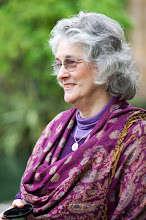
The second speaker, the Rev. Shokuchi Deirdre Carrigan, is a Soto Zen priest in the lineage of Shunryu Suzuki Roshi, founder of San Francisco Zen Center.  She met her teachers, Zen Master Tenshin Reb Anderson and Senior Iyengar Yoga teacher Donald Moyer 30 years ago.  She has been practicing, and later teaching, Zen and Yoga. 

After Fr. Tom spoke, Shokuchi, who was brought up in a Catholic family, was visibly moved when she said that if she’d been brought up with the kind of Catholic scriptural interpretations and teachings Fr. Tom offers, she may not have sought spiritual sustenance elsewhere.

At our quiet delicious vegetarian lunch with other Green Gulch residents, I enjoyed an infrequent opportunity to catch up with my friend Sister Marion Irvine, “the running nun.”[1]

When we returned to the zendo after lunch, Shokuchi had us read aloud together this Loving Kindness Meditation:

Loving Kindness Meditation (Buddhist)

This is what should be accomplished by the one who is wise,
Who seeks the good, and has obtained peace.
Let one be strenuous, upright, and sincere.
Without pride, easily contented, and joyous.
Let one not be submerged by the things of the world.
Let one not take upon oneself the burden of riches.
Let one’s senses be controlled.
Let one be wise but not puffed up and
Let one not desire great possessions even for one’s family.
Let one do nothing that is mean or that the wise would reprove.
May all beings be happy.
May they be joyous and live in safety,
All living beings, whether weak or strong,
In high or middle or low realms of existence.
Small or great, visible or invisible,
Near or far, born or to be born,
May all being be happy.
Let no one decieve another nor despise any being in any state.
Let none by anger or hatred wish harm to another.
Even as a mother at the risk of her life
Watches over and protects her only child,
So with a boundless mind should one cherish all living things.
Suffusing love over the entire world,
Above, below, and all around, without limit,
So let one cultivate an infinite good will toward the whole world.
Standing or walking, sitting or lying down,
During all one’s waking hours,
Let one practice the way with gratitude.
Not holding to fixed views,
Endowed with insight,
Freed from sense appetites,
One who achieves the way
Will be freed from the duality of birth and death.

After that, she invited us to do a slow walking meditation in the glorious gardens of Green Gulch Farm.  Unfortunately, I twisted my knee on the walk down the hill, so did the rest of my meditating on a bench.  (This was on the right leg, the one that was affected by the stroke I suffered last year and that I’ve been working to heal and strengthen.)

It’s been several months since MIC has sponsored a retreat, and I for one have missed them.  The current staff, including Interim Director Rev. Scott Quinn, Acting Programs Associate Stephanie Humphrey, and Executive Assistant Janice Lum, did former Executive Director the Rev. Carol Hovis proud.


[1]           More about Sister Marion hereherehere, and here.  There’s lots more.

Thursday, September 22, 2016

Interfaith Report -- Religious Leaders' Gathering

Green Gulch Farm & Zen Center
Last month I attended one of MIC’s religious leaders’ gatherings at Westminster Presbyterian Church in Tiburon, California.  As is customary with these gatherings, three leaders from three different religious traditions spoke on the same topic or theme, followed by small group discussions and Q&A with the presenters.

At this gathering, we explored and shared “how we can speak from our different faith perspectives in a way that not only honors our similarities but also honors our diversity and places of disagreement.”

The Rev. Stephen Hale of Green Gulch Zen Center said Zen teaches practitioners to honor the similarities and differences of all faiths.  Zen also stresses impermanence and seeks to end suffering.  With respect to theism, trying to prove or disprove the existence of God(s), efforts are futile because “ultimate reality is beyond comprehension.”  Rather, one’s efforts are better expended in cultivating and acting with kindness, generosity, and compassion towards all.

Moina Shaiq
Moina Shaiq, President of the Tri-City Interfaith Council and founder of the Muslim Support Network, has dedicated her life to dispelling misunderstandings of Islam and its followers.  She maintains that all religions and their practitioners are different so we must look beyond exterior appearance.  She advocates getting to know one’s neighbors in the surrounding area of forty homes in diameter 

Neighborly neglect seems more the norm in contemporary society than in earlier times.  Nowadays people focus on careers and acquisitions, and families relocate more frequently, in my view.  I think her suggestion is a good one.  We humans fear what we do not know, so the obvious remedy is to listen and learn, and to reciprocate.

When queried about the prescriptions, prohibitions, and exhortations in sacred text, she responded that one is judged based on piety over obeying texts.  This statement directly contradicts the interpretations of the precepts of the Koran by those who seek to eliminate or convert all non-Muslims by jihad.  I welcome Moina’s alternative views.

Rob McClellan
The third speaker, the Rev. Rob McClellan, Senior Pastor at host congregation Westminster Presbyterian, said that when he was at Reed College in Oregon, either he or a group with which he was affiliated issued an apology by testifying to all the wrongs done in the name of religion.

Generally speaking, I love these opportunities for religious people to share their views, beliefs, and experiences in an appreciative, non-judgmental milieu of multi-faith colleagues.  I’m grateful to Stephen, Moina, and Rob for their sharing and to Marin Interfaith Council for providing the opportunity.

[Please bear with me, readers, because since my stroke I cannot write clearly and quickly.  I’m interpreting some sloppy notes, hoping they are accurate.]

Thursday, November 29, 2012

Witches, Black Panthers & Sufis

Interfaith at Samhaintide

Marin Interfaith Council has been offering monthly interfaith contemplative services for peace.  The October gathering, at Sausalito Presbyterian Church, was to feature Pagan religions (specifically "Wiccan") in honor of the season of Samhain.  I had committed to conducting this hour-long service; however, I was also selected to be a Deputy Inspector at the polls and the mandatory training for that job was scheduled for the same evening.  So I asked my friend Gwion Raven, who had helped me at the Thanksgiving Eve service for the homeless (and their supporters) last year, if he would do it.  I had planned on two readings, which I suggested he use.  He did use them, plus taught some chants that the group did together.  In reflecting on his experience, Gwion said, "It really affected me...I had never experienced being recognized as a Pagan and been so warmly welcomed in a Christian church.  [Attendees showed] genuine curiosity." I thank Gwion for his work.

The following day, when I attended MIC's clergy luncheon, three people, including Paul Mowry, the new pastor at Sausalito Presbyterian, who had been to the contemplative service told me how much they enjoyed it.  I was glad to hear that and glad to relay that feedback to Gwion.


* * * * * * * * * * * * *
Interfaith as Matrix for Social Justice

The topic of discussion at the luncheon, held in the new Hannah Project1 Gallery space at Marin City,2 where we sat amidst an exhibit of photographs and other ephemera called "Architects, Activists, and Avengers: The Black Panther Party 1968, and featuring photographs by Pirkle Jones and his wife and collaborator, Ruth-Marion Baruch, was "The Role of Religious Communities in Movement Making."

I shared a table with two friends from Green Gulch Zen Center and Chris Highland, while we listened to three speakers.  Sister Colleen McDermott, Ph.D., told us of her study of the Highlander Center in Tennessee.

Founded in 1932 during the Great Depression in Tennessee as the Highlander Folk School, it began with programs to help rural women and organized different groups working for social justice and workers' rights. Among its founders and prominent participants were Myles Horton and his wife, née Zilphia Mae Johnson, Jane Wilburn Sapp, and Septima Poinsette Clark.  In the '30s and '40s the institute helped organize miners and textile mill workers.

In the 1950s Highlander taught desegregation and citizenship workshops with such participants as Dr. Martin Luther King, Jr., Rosa Parks, and Ralph Abernathy, and organized voter registration efforts. The ubiquitous movement song "We Shall Overcome" comes from Highlander, which has always included music and the arts in its programming.  SNCC (Student Nonviolent Organizing Committee) has roots at Highlander.

During the 1960s and '70s Highlander refocussed on Appalachia, organized protests against toxic dumping, and more recently it has featured LGBT programs, multilingual programs for organizing immigrants (Pueblos de Latinoamerica Justice School), and post-Katrina relief.

Sister Colleen pointed out that religious organizations such as churches have the institutional structure that's an important underpinning of efforts at social change.  Institutions grant the authority to speak up and engage.  Myles Horton's early seminary studies at Union Theological Seminary in New York informed his dedication to organizing for social justice.

This is one of my arguments for having Pagans establish institutions such as Cherry Hill Seminary.

Pastor Johnathan Logan, Sr., from Cornerstone Church of God in Christ in Marin City, spoke of his church's mission, quoted in part below:

Glorifies God by its standards of holiness, righteousness, and obedience to His Word. Demonstrates Christ's command to love one another. ... Worship God in spirit and truth recognizing that Jesus is Head of the Church  Recognize its interdependence with other members within the body of Christ which [sic] may not be of the same denominational affiliation. ...  Fulfills Christ's command to evangelize the world.
Third to speak was Pastor Veronica Goines of St. Andrew Presbyterian Church, a "historical multicultural congregation" also in Marin City.

I found the speakers demonstrated an inordinate underlying assumption of an Abrahamic religious viewpoint.  For instance, the name of Martin Luther King, Jr. was invoked frequently, yet no mention was made of such figures as Malcolm X and others in the Black Muslim movement that also arose from those fertile and changing times.  Neither was there acknowledgement of the African diaspora religions that also gained adherents since those transformative years of the '60s and early '70s.

Now I understand that Marin's population is predominantly white.  And I know that this program was not intended to reflect every change to have arisen from religious communities in the those times.  Further, local branches of the Black Muslim church have either dissipated or fallen into corruption.3

I wanted to mention this as I, a polytheist, sat there with my non-deist friends amidst the assumption of monotheism, but I couldn't come up with a constructive way to comment.  Having said all this, I will say I enjoyed the program; I learned a lot that I hadn't known before and may never have been exposed to otherwise.  The speakers provided insights and provoked further reflections.  It was worth every minute.


* * * * * * * * * * * * *
Visionary Marin


In a busy two weeks for MIC, we concluded with the annual Visionary Marin Awards Ceremony, this year honoring Dr. Nahid Angha.  Musicians played while people sampled delicious food prepared by the sisters of Brahma Kumaris and from Green Gulch Farm and elsewhere, and bid on an array of silent auction items as well as buying raffle tickets for several beautiful gift baskets.  A slide show of photos of religious activities by the member congregations of MIC demonstrated the rich variety of our membership.  I was pleased to see some photos of Pagans dancing round a Maypole that I had taken.

Among the many accomplishments that led MIC to give Nahid this year's Visionary Marin award is her  founding of the International Association of Sufism and Sufi Women Organization  , "an international humanitarian organization promoting universal human rights."

We learned more about Nahid from a Q&A session done with the Rev. Charles Gibbs, Executive Director of the United Religions Initiative.

Everyone left feeling that their culinary, intellectual, and community appetites had been satisfied.  Plus we met our fundraising goal for the year.  Kudos to the Rev. Carol Hovis and her assistant, Allison Kirk, and the many volunteers who worked with them to make this event a success.


~~~~~~~~~~

1.  The Hannah Project assists African-American and other low-income students ages 8-22 and their families in efforts to boost academic performance and college graduation rates.

2. Marin City, begun with housing designed by the late Frank Lloyd Wright for the many workers who migrated here during World War II to work on the Liberty ships in the Sausalito shipyards. It is now home to the largest African-American community in the county.  Coincidentally, the famed architect's final commission was our Marin County Civic Center.

3.  See Your Black Muslim Bakery and murder of journalist Chauncey Bailey.

Monday, November 28, 2011

Thanksgiving Eve Celebration

Once again this year I joined the Rev. Paul Gaffney and the folks at Marin Interfaith Street Chaplaincy for a Thanksgiving Eve celebration with the homeless population of our city.  A significant part of the ceremony is the gathering of offerings -- primarily sleeping bags and socks -- and blessing them for their use in keeping people warm and cozy through the cold, wet winter months.

Some of the ritual contributions, mostly drumming, poetry, and singing, came from the homeless population.  I've come to know a few of them over the years and to appreciate their talents.  In particular, we have enjoyed the singing of Cup Bach Pham, a woman from Southeast Asia.

Among the religious leaders who participated were Fr. John Balleza, the new priest at Church of St. Raphael and Mission San Rafael Arcangel; Dr. Laura Stivers, a religion and philosophy professor at Dominican University; Qayyum Johnson from Green Gulch Farm and Zen Center, the Rev. Dr. Curran Reichert of Community Congregational Church of Tiburon (site of the 9/11 Contemplative Service for Peace reported on earlier); the Rev. Dr. Liza Klein of San Rafael First United Methodist Church; and others.

Most touching, to me, was a personal story told by Clair Mikowski from Congregation Rodef Shalom about her parents' immigration to this country and some of the things her mother taught her.  She delivered this story on the day her mother would have turned 100 years old.

Among the musical offerings, Taneen, from the International Association of Sufism, sang an evocative sacred chant.  They have performed at MIC events in the past and I always look forward to hearing them.

Corby usually accompanies me to this annual event and sings with me.  This year he was away for the holiday.  I was fortunate in that my friend Gwion from North Bay Reclaiming joined me as a Pagan presence.  I told an abbreviated version of the story of the abduction of Kore, later called Persephone, by Hades and the searching and grief of her mother, Demeter.  It's a familiar story to many non-Pagans, and since we are celebrating harvest and the fruits of field, orchard, and barnyard, it seems perfect.  We followed the brief story by singing "Demeter's Song" by Starhawk.  I love the song.  I love the melody and harmonies.  And I especially love the theology, or worldview, it illustrates.

After the service we moved to a room nearby to share seasonal comestibles.

Monday, June 14, 2010

Interfaith Retreat Day

Last Monday I attended Marin Interfaith Council's only retreat of this year, at Green Gulch Farm, shown in this photo and scene of other retreats I've mentioned here. The day was sunny and gorgeous. Proceeding without a specific theme, the two teachers offered a variety of commentary.

Sheikh Jamal Granick, raised Roman Catholic in the Bronx, now practices Sufi Muslim and is associated with the International Association of Sufism, founded by one of his teachers and one of my colleagues in MIC, Dr. Nahid Angha. He works as a psychotherapist.[1]

Sheikh Jamal's co-teacher was the Rev. Arlene Lueck of the host Zen center. She, too, was brought up in a Roman Catholic family. After a life as a wife, mother, and high-powered businesswoman, she visited a monastery around the time she was divorcing, and stayed. She had entered with no intention of seeking a religious life. She is now tanto, or practice leader and mentor, of Green Gulch Retreat Center.

Jamal began by saying that "practice is implementation of faith, otherwise it is just belief." As someone for whom faith is minor to non-existent, and who relies upon experience over belief, this statement doesn't quite apply. That said, I guess you could consider it to be walking one's talk, a practice I admire and try to do.

Arlene said that Zen is about breath. It is above and beyond any "ism." It is about not attaching, letting it be, but not a free-for-all. She says nothing is an absolute, that meditation leads the voice, and that "not knowing" is most intimate. "Buddha" means awakened mind.

They compared the concept known in Sufi as "primordial nature" with that known in Zen as "original mind."[2]

We sat in silence for maybe a hour, after which the teachers opened the floor to questions. Jamal explained that there are many orders of Sufi and many kinds of dancing. The dervishes originated with Rumi, a Persian in Turkey. Rumi was in mourning, so he began to move, and out of that movement came dance and then poetry.

Arlene claims that sacred sound, sacred dancing, and sacred silence are all the same, forms of "deep listening." She said that all of us were there because we had "ecumenical minds."

Jamal compares the teacher to a mirror. The word sheikh means "teacher." He says if you need the teacher too much, you're not taking responsibility for yourself. If the teacher needs you too much, you're caught.

Because he is a psychotherapist, Jamal was asked to speak of the difference between religious practice and psychotherapy. He said our acquired personality is what we learn from the senses, and that ours sense of self is derived from reflections from our environments. On the matter of transference/projection, he claims that a good teacher will not accept transference, it won't "take." Again the teacher is the mirror of the student. This was a timely thing for me to hear.

In Pagan circles, I sometimes encounter those who use their time working together as a form of therapy, and I don't think this is the purpose of circle work. I know that ritual work can be very therapeutic, and I think it's great to use it that way. Gods know I've used ritual and magic as a form of personal therapy. But to use the circle mainly for the deep down and dirty work of therapy does not, in my opinion, honor our gods. If we need therapy, we can seek out a competent therapist or group. Then we can fortify the work we do in therapy with our magic. But I am uncomfortable using circle work as a primary method of therapy. Of course, I know there are plenty of covens who don't do this.

We shared a scrumptious vegetarian lunch lovingly prepared with fresh vegetables grown right there by people staying, learning, and serving at the retreat. Some of us ate in silence, while those who wished to converse ate in another section of the dining room.

Both teachers spoke a bit about how their organizations were structured. Both of their religious organizations are relatively young groups within much older religious traditions, and both were founded in the U.S. Women play a prominent role in both. Arlene said that she's observed in older Japanese Zen orders an openness to the active participation of women that they didn't have before their interactions with American orders. I think you can say this about Craft, to some extent. Women are more prominent in Witchcraft in America than in Europe, and I'm hoping that the "backcrossing"[3] has a similar effect in Craft in Europe to the effect it's had in Zen in Japan. In most other American Pagan religions women seem to have parity with men.

The Zen group was founded by Americans coming out of the counter-culture of the 1960s and '70s, as has American Paganism. Most of those who created the Zen center came from middle-class backgrounds, relatively privileged and well educated, just like much of the Pagan population. They had no experience with organizing a religious group, much less a Utopian community where they all had to live together in harmony. They have their internal disputes, things they have to confront and work out. They are human.

As these two teachers described the structure of their respective organizations, I couldn't help but reflect upon my experiences with Pagan organizations. There are a few Pagan groups in the U.S. who own property communally and live on it together, often gaining their livelihoods from some kind of shared business or farming endeavor. I have never been drawn to be a part of them. However, I've involved myself in other efforts at Pagan organizing (Reclaiming, CoG), and currently work at making an accredited Pagan seminary. (Cherry Hill Seminary: Distance Education for Professional Pagan Ministry; please consider making a donation to support our work.)

Jamal claims that no group has authority in Sufi, that authority comes from within. This notion comports with my own position as a Pagan. As an example, he said that if when you're thirsty and someone offers you water to quench your thirst, you're more likely to follow that person to the source of more water. But if someone just tells you about a source of water, well, so what? Perhaps this is the difference between care and kind acts on the one hand and preaching on the other. We Pagans tend to dislike being preached to (although I personally really appreciate a good orator like our President).

Arlene says that Zen has no greeters; you find your own way in. This is how I've always understood Craft. One of its appeals to me was the fact that you had to do a little searching to find it. This made the finding all the more precious. That is not the case anymore. We have become much more visible in the past 15 years or so. I don't mind the visibility so much, although I know plenty of Witches who prefer to stay deep within the broom closet. What I do mind, though, is what sometimes seems almost like commodification of Craft. Sometimes I see streaks of proselytization that make me very uncomfortable.

Arlene told of how each person makes his or her own rakasu (rakusu), stitching it as I would a quilt, as a meditative act. A rakusu is a bib, the color of which indicates the wearer's position in the order. Teachers wear brown or gold rakasu. One must have achieved a certain level of teaching in order to wear a rakasu. They are worn for a ceremony of receiving Bodhisattva Precepts.

Arlene, in her early 60s, reflected on the fact that she realizes that she has reached the last part of her life. Me, too, only I'm a bit older. She said it's a time of life when you don't take life too seriously, but you do treat it seriously. I like that.

She claims that boddhisattvas equate to Catholic saints, something that I, and probably other Pagans, have been noting for years, particularly when discussing theology, a monotheistic concept in the first place.

We concluded the day with a walking meditation. Arlene showed a specific way of holding the hands if we wanted to. We were to walk with our gaze down, looking at nothing and being aware of everything.

I have attended nearly all of the retreat days MIC has offered. Some turn out to be nice days in nice company, being quiet. Others give evidence of attitudes that annoy me. I nearly always gain some insights, usually unexpected.


Note on photos: The bed of bright orange California poppies grows just to the left of the entrance to the zendo. The foxglove grows near the restrooms.

[1] Interestingly, one of the co-leaders of MIC's retreat last Winter was a Philadelphia-born, Catholic-raised Sufi Muslim college professor.

[2] I realize that many Pagans are knowledgeable about Zen and Sufi beliefs and practices. I think that, in general, contemporary Pagans are more familiar with other religions than the practitioners of those other religions are about each other, let alone Paganism. One of the fun things about doing interfaith work is finding your commonalities.

[3] "Backcrossing" is a term used in animal breeding when a domestic animal is bred with a wild animal of the same species. (Not being a breeder myself, I'm no doubt oversimplifying.)

Thursday, May 06, 2010

11th Annual Interfaith Prayer Breakfast

Today my local interfaith group celebrated National Day of Prayer in a more ideal form than many have come to expect. By more ideal, I mean in a truly diverse and tolerant way, respecting all religions. With over 200 in attendance, many for the first time, we had 21 tables, each with a table captain to facilitate discussion. I was one such table captain. The question for discussion was in what ways you use prayer in your life. Due to the size of the crowd and the noise of people getting their breakfasts from the buffet tables, our conversations were limited to those few sitting on either side of us instead of involving all seated at a table.

After a welcoming by our director, the Rev. Carol Hovis, and an opening prayer, the Marin Interfaith Singers sang "Dona Nobis Pacem," a song I really love.

The Rev. Linda Ruth Cutts, a Zen Buddhist priest from Green Gulch Farm Zen Center, said that although prayer is not a term used in Buddhism, "everything we do is prayer." She said Zen practitioners do have words/language similar to what others might consider to be prayer, such as the words they say when offering gratitude for a meal and all the life forms, sunlight, soil, cultivation, preparation, and such that went into the meal. She said that monasteries and in some private homes altars are erected outside the restrooms for the users to take a moment to acknowledge their interdependence on all things. She differentiated between seated meditation and active meditation (out in the world), followed by a brief seated meditation for all of us.

David Stevens, Christian Science practitioner and teacher, although he is an accomplished speaker, articulated his Christianity with a degree of certainty that I found less appealing. His prayers were understandably limited to appeals to a single god, with the assumption that all his listeners shared this perspective. He reminded us that prayer is unconfined, it's portable, and it's natural. He claims that prayer "replaces fear with confidence" and "confusion with clarity." I agree it can.

He concluded with a reading of the Christian Lord's Prayer. He had a colleague reach each line in the familiar language from the King James Bible, followed by his reading the interpretation of the same line as found in the writings of Mary Baker Eddy in Science and Health with Key to the Scriptures. Personally, I did not resonate with these words.

The final speaker was Sister Mary Neil of the Dominican Sisters. Sister Mary holds a Ph.D. and taught religious studies and theology at the University of San Francisco for many years. Now retired, she is a very young-looking 77 years old. (That's Sister Mary on the left in the photo. The woman in the center is my friend Sister Colleen McDermott, a member of MIC's Board of Directors.)

One of the first things Sister Mary did was apologize to anyone who may have been hurt by her church, and then to ask whom of those present was ever hit by a nun. One woman raised her hand. Sister Mary asked her to come up, and then asked her to hit her and with that hit, to let go of the hurt. The woman's slap was weak, so Sister Mary asked her for a stronger one.

She said that prayer isn't something you really think about very much; rather, when you are in crisis, you cry help! Prayer is "remembering who I am." She claims prayer is difficult because it demands intimacy and it demands truth.

She says she feels a strong pull towards Buddhism, particularly for its development of meditative techniques. She explained a chakra meditation she does in which she applies scriptural words and phrases to each chakra as she meditates upon it. For instance, at the throat chakra she speaks of the hunger and thirst for God, and at the crown chakra, she says Jesus' final words, "into thy hands I commit my spirit."

I think it's really interesting to recall that it was due to the participation of the Hindu Swami Vivekananda at the first Parliament of the World's Religions in 1893 at the Chicago World's Fair that opened the world of Eastern religion to the West, and here we are today, more than a century later, listening to a Roman Catholic nun speak of applying the chakra system to her Christian meditation and prayer.

Before I even got this, this article about the event appeared in the Contra Costa County Times. (Contra Costa is across the SF Bay from Marin County.)

Tuesday, October 13, 2009

Blending In, Standing Out

Two weeks ago I attended a the 6th Annual Marin Leadership Luncheon sponsored by the Marin Leadership Foundation. Marin Interfaith Council had sponsored two tables they sought to fill, so I signed up. Having gotten a bit lost on the way there, I arrived about 15 minutes late and entered a crowded ballroom. I was grateful to see Fu Schroeder from Green Gulch Zen Center wave at me from one of the tables. I was assigned to the other, with Carol Hovis, Chris Highland* and Nafisa Haji.

Usually I do a bit more research before attending an event that I understand to be interfaith in nature. This time I didn't. Imagine my surprise when I heard readings from the Bible and Christian prayers. Had I done my homework, I'd have known this was a Christian, although ecumenical, group.

I must admit I was impressed by the singer, Ken Medema, not that I liked his style so much as I admired his ability to be in the moment and to capture that moment right there as he sang extemporaneously. As a priestess, I have sought to cultivate this is a skill (not necessarily in song).

Jim Wallis, an "author, public theologian, speaker, and international commentator on ethics and public life," addressed the gathering with a talk entitled "Don't Hold on to Your Lunch." He works with a group out of Washington, D.C. called Sojourners, which claims to focus on faith, politics and culture. The best I can say for his talk is that he spoke in support of public health care as a moral issue, which to me it is. Most of what he had to say had little relevance to my life as a Pagan.

I'm not sure how comfortable Nafisa (Sufi) Chris (Nature chaplain), and Fu, (Zen Buddhist) were with the emphasis. At one point Carol thought I was going to get up and walk out, but I was only retrieving my purse from where it had fallen by my chair. If I've been invited somewhere and I've accepted the invitation, I'm not so rude as to leave before it's over. There would have to be some sort of personal attack for me to do that. Mom done brung me up better than that. I tried to blend in.

On the feedback forms, however, I commented that I found the event "uncomfortably Christian-centric." Cheeky of me, perhaps. Of course it would be Christian-centric if its mission is to be a Christian organization, but since this was billed as being interfaith I guess I expected a little more pluralism.

That evening at dinner I ran into Father Paul Rossi, another MIC colleague from St. Rafael's Church at Theresa & Johnny's Night Kitchen.** Paul laughed and said he'd been at the breakfast sponsored by the same group (MLF) -- evidently this was a day-long event -- and could have told me how strongly Christian-centered MLF is. Corby and I dined at T&J's because the proceeds of that evening's meals was earmarked for the Marin Interfaith Street Chaplaincy.

* * * * *

Thursday night my friend Patrick McCollum and I will be driving to Santa Clara to attend The 3rd Annual Dialogue and Friendship Dinner sponsored by the Pacifica Institute. This group, although they claim to be interfaith, limits itself to the big three Abrahamic religious traditions. It promotes the work of the Gülen movement, founded by a Turkish-American Sunni/Hanafi Muslim named Mehmet Fethullah Gülen. Patrick and I may be the first two Pagans to have been invited. The invitation, quite formal in its extension, is the work of my UU sister, Catherine, who's known this group for a few years. This past May Catherine and her husband Anthony spent about two weeks touring Turkey under the sponsorship of the Pacifica Institute. All they had to pay was their airfare.

Will we stand out?

* Carol and Chris are the couple at whose wedding I led a dance.
** Theresa & Johnny's only serves breakfast and lunch, except for one night a month when the serve dinner and give the proceeds to a specified charity.

Friday, November 07, 2008

Celebrating Isabel Allende

Last night the Marin Interfaith Council honored author Isabel Allende with the Visionary Marin award. While a band played, we wandered around bidding on auction items, dropping raffle tickets in buckets for prizes, and noshing on lovely little tidbits of food at high, small round candlelit tables -- in other words, no sitting down to eat.

I chatted with several of my MIC friends and acquaintances, and recognized a few luminaries of sort: The Rev. Janie Spahr (I nearly introduced myself to her), Jean Shinoda Bolen (a close friend of Isabel's and BFF of one of the attorneys for whom I occasionally).

Leili First, one of our Sufi members, had assembled a slide show showing events of members of MIC. This played throughout the evening until the ceremony began. I was happy to see among them a photo of people dancing the Maypole that I took in Anne Hill's yard some years ago.

When the time came for introducing Isabel and bestowing the award, all the seats were filled except up front, so I caught the eye of Fu Schroeder, abbess of Green Gulch Farm Zen Center, who was in the front row, and she indicated I should sit in one of the empty seats next to her. After the ceremony, I realized I was in the section reserved for members of what Isabel calls her "tribe." (That's Green Gulch Farm in the photo, the way it looks driving by on Highway 1; that's the Pacific Ocean in the distance.)

Without exception, from Buddhist to Roman Catholic, from to Sufi to Presbyterian, from Hindu to Pagan, every single person I spoke with was elated about the election of Barack Obama. Most were also disappointed at the passage of Proposition 8, which changes the Califorinia Constitution to ban same-sex marriages, and which, I am confident, will not stand the test of the courts.

When the Rev. Carol Hovis, Director of MIC, first took the mike, her mention of the election outcome elicited cheers. The election results were obviously on everyone's mind because they were referenced frequently and each mention drew unrestrained applause.

Isabel is a tiny woman with a big spirit. In an inspiring acceptance speech from atop a plastic milk carton so she could look over the lectern and reach the microphone, she spoke of her life and the changes and challenges she'd met along the way. She spoke of her work and of the death of her daughter Paula. She spoke of her relatives in Chile and of her American husband. Several times she referred to the "plums" on her chest. Her beloved maternal grandfather had hoped she'd been a grandson rather than a granddaughter, and only finally accepted the fact that she was a girl when she grew small plums on her chest.

She spoke later of the joys of lovemaking and how both she and her husbands appreciated her somewhat bigger plums. She said that she admired the Dalai Lama, but that he was celibate and she much preferred carnal pleasure in her life. She said when she writes love scenes in her books, she is fantasizing about Antonio Banderas. Towards the end of her speech, she revealed that her husband, attorney Willie Gordon, does not seem to notice that the plums have turned to prunes.

Isabel is about five months older than I. She looks fabulous. At one point she asked the audience if they did not agree that she looked great for a 66-year-old, to applause. She said with a laugh, it's very expensive and takes a lot of hard work.

She spoke of fear and risk, and that being paralyzed by fear was a waste, how life was worth taking risks, that it was not without pain but was well worth it. In this regard, she mentioned her soul mate, Grace, who, with her daughter Sabrina, been in a head-on collision on the Golden Gate Bridge this past May. Grace broke many bones, displaced all the organs in her body except her heart, and lay comatose for many weeks. When she finally regained consciousness, she proclaimed how happy she was to be alive. She said the episodes of pain pass, and when they're gone, she doesn't remember them so she is happy. Grace had been a long-time Zen practitioner who gained enlightenment from a close brush with death. While Isabel spoke of this, I sat next to Fu Schroeder, who happens to be Grace's partner.

Isabel ended her speech with yet another reference to Tuesday's election, saying she is now so proud to be an American. Her last words were, "Yes, we can!" Of course, we repeated this heartening phrase.

When Fu had left her seat to go on the dais to present Isabel with her award, and Isabel returned, Isabel set next to me for the rest of the evening. She loved the California poppies tattooed on my forearms. At the end of the ceremony, I introduced myself to her as the "token Pagan" in MIC, and she said she herself is a pagan. (I use the lower case because she is pagan by nature and in outlook but not by affiliation and practice.) She had already identified herself using that term earlier in her speech. I am not "outing" Isabel Allende on this blog; I am merely stating a similarity in outlook that she shares with Neo-Pagans.

All in all, I felt welcomed with genuine warmth by my colleagues in MIC and comfortable representing a Pagan presence at this significant event.

Thursday, June 21, 2007

"Enlighten" Interfaith Board Game


This has been my month to immerse myself in interfaith activities, it seems. I already wrote here about interfaith and immigration on May 30th. I started to write about the Marin Community Foundation's second annual Celebration of Giving awards ceremony I attended on June 7th, but never got a chance to finish. In a nutshell, the Marin Interfaith Council I've mentioned so many times before received a $25,000 grant from MFC. There's lots more to say; that's the reason I was invited. A very swanky affair, I must say.

Then on June 11th, my daughter's birthday, Malendia, her friend Marianne and I attended another of MIC's quarterly retreat days, this time at Green Gulch Farm Zen Center, lead by the Rev. Fu Schroeder, tanto of the center, and Fr. Paul Rossi, pastor of the Church of St. Raphael and Mission San Rafael Arcangel (twentieth and second most northerly of the original 21 missions established by Spanish Jesuits between 1769 and 1823 in Alta California). We spent a restorative day in contemplation and reflection.

Tonight I went to the MIC Forum & Annual Meeting. One of the things we did was play a new interfaith board game called Enlighten. The game is surprisingly comprehensive and not all that easy to play, since it requires a fair knowledge of many religions. Not to worry, we Pagans are represented in three ways, as I see it:

  • Prehistoric Religions: Shamanism, Native American, African, Central & South America, Australia, New Zealand, Pacific Islands
  • Classical Paganism: Greek Gods, Egyptian Gods, Roman Gods, Persian Gods, and Scandinavian Gods
  • New Religious Movements: Mormonism, Bahai, Jehovah's Witness, Unitarian Universalism, Unity Church, Krishna Consciousness, Rastafarianism and more.
NRMs are those which arose within the last 200 years. In the world of religious studies, Wicca, Druidry, Heathenry, et al. are considered NRMs because they cannot be proven to be older. I call our religion(s) "ancient-future" because we draw upon our ancient heritages (all reflected in the list above), we apply them and live them in 21st Century society, with the hope that we leave a viable and satisfying legacy of a sustainable future for our descendants.

Today is Midsummer, when there are no shadows and nothing is hidden. May the light of the Sun illuminate our many paths as we travel life's road together on our precious life-giving green Earth.