Showing posts with label Dominican Order. Show all posts

Thursday, May 06, 2010

11th Annual Interfaith Prayer Breakfast

Today my local interfaith group celebrated National Day of Prayer in a more ideal form than many have come to expect. By more ideal, I mean in a truly diverse and tolerant way, respecting all religions. With over 200 in attendance, many for the first time, we had 21 tables, each with a table captain to facilitate discussion. I was one such table captain. The question for discussion was in what ways you use prayer in your life. Due to the size of the crowd and the noise of people getting their breakfasts from the buffet tables, our conversations were limited to those few sitting on either side of us instead of involving all seated at a table.

After a welcoming by our director, the Rev. Carol Hovis, and an opening prayer, the Marin Interfaith Singers sang "Dona Nobis Pacem," a song I really love.

The Rev. Linda Ruth Cutts, a Zen Buddhist priest from Green Gulch Farm Zen Center, said that although prayer is not a term used in Buddhism, "everything we do is prayer." She said Zen practitioners do have words/language similar to what others might consider to be prayer, such as the words they say when offering gratitude for a meal and all the life forms, sunlight, soil, cultivation, preparation, and such that went into the meal. She said that monasteries and in some private homes altars are erected outside the restrooms for the users to take a moment to acknowledge their interdependence on all things. She differentiated between seated meditation and active meditation (out in the world), followed by a brief seated meditation for all of us.

David Stevens, Christian Science practitioner and teacher, although he is an accomplished speaker, articulated his Christianity with a degree of certainty that I found less appealing. His prayers were understandably limited to appeals to a single god, with the assumption that all his listeners shared this perspective. He reminded us that prayer is unconfined, it's portable, and it's natural. He claims that prayer "replaces fear with confidence" and "confusion with clarity." I agree it can.

He concluded with a reading of the Christian Lord's Prayer. He had a colleague reach each line in the familiar language from the King James Bible, followed by his reading the interpretation of the same line as found in the writings of Mary Baker Eddy in Science and Health with Key to the Scriptures. Personally, I did not resonate with these words.

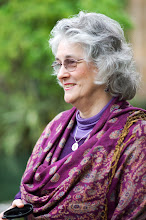
The final speaker was Sister Mary Neil of the Dominican Sisters. Sister Mary holds a Ph.D. and taught religious studies and theology at the University of San Francisco for many years. Now retired, she is a very young-looking 77 years old. (That's Sister Mary on the left in the photo. The woman in the center is my friend Sister Colleen McDermott, a member of MIC's Board of Directors.)

One of the first things Sister Mary did was apologize to anyone who may have been hurt by her church, and then to ask whom of those present was ever hit by a nun. One woman raised her hand. Sister Mary asked her to come up, and then asked her to hit her and with that hit, to let go of the hurt. The woman's slap was weak, so Sister Mary asked her for a stronger one.

She said that prayer isn't something you really think about very much; rather, when you are in crisis, you cry help! Prayer is "remembering who I am." She claims prayer is difficult because it demands intimacy and it demands truth.

She says she feels a strong pull towards Buddhism, particularly for its development of meditative techniques. She explained a chakra meditation she does in which she applies scriptural words and phrases to each chakra as she meditates upon it. For instance, at the throat chakra she speaks of the hunger and thirst for God, and at the crown chakra, she says Jesus' final words, "into thy hands I commit my spirit."

I think it's really interesting to recall that it was due to the participation of the Hindu Swami Vivekananda at the first Parliament of the World's Religions in 1893 at the Chicago World's Fair that opened the world of Eastern religion to the West, and here we are today, more than a century later, listening to a Roman Catholic nun speak of applying the chakra system to her Christian meditation and prayer.

Before I even got this, this article about the event appeared in the Contra Costa County Times. (Contra Costa is across the SF Bay from Marin County.)

Tuesday, September 11, 2007

Retreat Day with Two Nuns

Yesterday I spent a restorative day with others in the Marin Interfaith Council at one of our quarterly retreats. The theme was balancing the inner and outer life, taught by Dominican Sister Marion Irvine and Brahma Kumaris ("daughters of Brahma")* Sister Chandru.

Sister Chandru, who speaks very quietly with a melodic Hindi accent, told us about the founding of Brahma Kumaris by Brahma Baba (Lekhraj Kripilani) in 1936 in an area that was then in India but is now part of Pakistan. At that time Hinduism was dominated by males, and Baba thought there would be benefit in giving women charge of a group dedicated to peace. The movement began with 300-400 young women aged 16-21 years, and has now grown to 8,500 centers in 100 countries.

Brahma Baba
The Brahma Kumaris sisters at Anubhuti Meditation and Retreat Center**, the location of the retreat, were in mourning for their late leader, Dadi Prakashmani, who had died only a few days earlier. (Dadi means respected elder sister.) Dadi Prakashmani was one of the original sisters to whom Brahma Baba entrusted his entire worldly estate and the administration of the order; she joined when she was 14.

Born in Mumbai, Sister Chandru uses the masculine form of her given name, Chandra, because in her youth when she joined Brahma Kumaris, Brahma Baba told her she was like a son to him.

The Brahma Kumaris practice a form of meditation called Raja Yoga. It is a method of relaxing, refreshing and clearing the mind and heart. It helps you look inside to rediscover and reconnect with your original, spiritual essence. Meditation enables an integration of your spiritual identity with the social and physical realities around you, restoring a functional and healthy balance between your inner and outer worlds.

We spent the latter part of the morning, through lunch (delicious fresh vegetarian lovingly prepared and served by residents of the retreat) in silent meditation. We sat, and later walked the grounds or the labyrinth.

Sister Marion is a hoot. Really unshakable. When she was 47, overweight and smoking two packs of cigarettes a day, she took up running to relax after her workdays as principal of a grade school. Soon she became the oldest to ever qualify for the Olympic Trials. She even made it into Time magazine. Here's a photo (about halfway down the page) of her in her running days. She's now 77, with the spirit of a youngster and the sass of a woman who knows who she is and enjoys life.

She told us a bit about the founders of her order, the 12th Century CE Spaniard, St. Dominic de Guzman, and St. Catherine of Sienna (the youngest of 25 children!). In general, Dominicans seek to purify themselves from 'evil' by asceticism. The sisters established places of retreat for itinerant friars during the Late Middle Ages.

Dominicans have three orders. Sister Marion is in the third, or active, order. The second is contemplative, and the third is completely cloistered.

Dominican sisters, also known as the Order of Preachers, live their lives supported by four common values, often referred to as the Four Pillars of Dominican Life, they are: community life, common prayer [both liturgical and contemplative, according to Sister Marion], study and service.

Of course, we Witches know the Dominicans as the propagators of the Inquisition, the authors of the Malleus Malifacarum (published in 1487), torturers and burners of heretics, and she did mention the Dominicans' persecution of the Albigensians. I actually considered mentioning Kramer and Sprenger, but just didn't think it was a good time to get into that particular discussion.

Sister Marion is a native San Franciscan and product of Dominican schools. In high school, she observed that her teachers, all Dominican sisters, seemed happy in their lives and work, and since she considered herself to be a rather upbeat person, she was attracted to that life. She claims she never had a mystical experience that lead her to join, and she's never had one in the sixty years she's been in the order.

I did manage to jump on a potential teaching moment when we were talking about the power of collective prayer, chant and meditation focusing on a common goal. I pointed out that this is another name for what we might call 'spellwork.'

Sister Marion showed us a teaching method used in her order wherein a short passage of the Bible is read aloud slowly, and really listened to. After a brief period of silence, they are read a second time. I volunteered and found myself in the odd position of reading just a few verses of the Gospel of Luke.

We Pagans don't have a sacred text, per se; however, I intend to try this practice with a few lines of poetry, lyrical words about Nature, or maybe part of The Charge of the Goddess. I think it could enhance our understanding. As I get older, I find I enjoy contemplative spiritual practices at least as much as more active practices, if not more.

There were some things said that were mistaken assumptions on the part of the teachers, particularly assumptions about monotheism from Sister Marion.

Although we usually think of Hindus as being polytheists, the Brahma Kumaris seem to pay little heed to individual deities. Instead, their focus is on world peace. The artwork at the retreat was comprised of a surprising number of white sculpted angels -- a large angel stood at the edge of the labyrinth -- plus photographs of temples and assemblies of people, and mystical paintings of colors and images drawing the eye into "the one."

I find enrichment in every retreat I've attended. This is the fourth. I missed the one at the Vedanta Society in West Marin, but attended two at Santa Sabina Center and one at Green Gulch Zen Center, plus several International Day of Prayer breakfasts at Congregation Rodef Shalom.

Our director, the Rev. Carol Hovis, has a real talent for putting together interesting spiritual leaders to present on topics relevant to all of us. She's someone other interfaith folks might consider looking to for creative ideas leading to greater religious tolerance and understanding.


*Brahma Kumaris means ‘daughters of Brahma.’ Seminal to the vision of world renewal was the revelation of the important and prominent role of women as spiritual teachers. Brahma Baba correctly foresaw that core values based on traditionally feminine qualities – patience, tolerance, sacrifice, kindness and love – would increasingly become the foundation of progress in personal growth, human relations, and the development of caring communities. To maintain the emphasis on this vital core of leadership, he named the organisation the Brahma Kumaris World Spiritual University.

** Anubhuti means 'to experience."