Monday, June 14, 2010

Interfaith Retreat Day

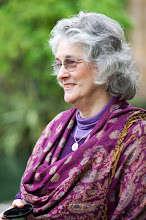
Last Monday I attended Marin Interfaith Council's only retreat of this year, at Green Gulch Farm, shown in this photo and scene of other retreats I've mentioned here. The day was sunny and gorgeous. Proceeding without a specific theme, the two teachers offered a variety of commentary.

Sheikh Jamal Granick, raised Roman Catholic in the Bronx, now practices Sufi Muslim and is associated with the International Association of Sufism, founded by one of his teachers and one of my colleagues in MIC, Dr. Nahid Angha. He works as a psychotherapist.[1]

Sheikh Jamal's co-teacher was the Rev. Arlene Lueck of the host Zen center. She, too, was brought up in a Roman Catholic family. After a life as a wife, mother, and high-powered businesswoman, she visited a monastery around the time she was divorcing, and stayed. She had entered with no intention of seeking a religious life. She is now tanto, or practice leader and mentor, of Green Gulch Retreat Center.

Jamal began by saying that "practice is implementation of faith, otherwise it is just belief." As someone for whom faith is minor to non-existent, and who relies upon experience over belief, this statement doesn't quite apply. That said, I guess you could consider it to be walking one's talk, a practice I admire and try to do.

Arlene said that Zen is about breath. It is above and beyond any "ism." It is about not attaching, letting it be, but not a free-for-all. She says nothing is an absolute, that meditation leads the voice, and that "not knowing" is most intimate. "Buddha" means awakened mind.

They compared the concept known in Sufi as "primordial nature" with that known in Zen as "original mind."[2]

We sat in silence for maybe a hour, after which the teachers opened the floor to questions. Jamal explained that there are many orders of Sufi and many kinds of dancing. The dervishes originated with Rumi, a Persian in Turkey. Rumi was in mourning, so he began to move, and out of that movement came dance and then poetry.

Arlene claims that sacred sound, sacred dancing, and sacred silence are all the same, forms of "deep listening." She said that all of us were there because we had "ecumenical minds."

Jamal compares the teacher to a mirror. The word sheikh means "teacher." He says if you need the teacher too much, you're not taking responsibility for yourself. If the teacher needs you too much, you're caught.

Because he is a psychotherapist, Jamal was asked to speak of the difference between religious practice and psychotherapy. He said our acquired personality is what we learn from the senses, and that ours sense of self is derived from reflections from our environments. On the matter of transference/projection, he claims that a good teacher will not accept transference, it won't "take." Again the teacher is the mirror of the student. This was a timely thing for me to hear.

In Pagan circles, I sometimes encounter those who use their time working together as a form of therapy, and I don't think this is the purpose of circle work. I know that ritual work can be very therapeutic, and I think it's great to use it that way. Gods know I've used ritual and magic as a form of personal therapy. But to use the circle mainly for the deep down and dirty work of therapy does not, in my opinion, honor our gods. If we need therapy, we can seek out a competent therapist or group. Then we can fortify the work we do in therapy with our magic. But I am uncomfortable using circle work as a primary method of therapy. Of course, I know there are plenty of covens who don't do this.

We shared a scrumptious vegetarian lunch lovingly prepared with fresh vegetables grown right there by people staying, learning, and serving at the retreat. Some of us ate in silence, while those who wished to converse ate in another section of the dining room.

Both teachers spoke a bit about how their organizations were structured. Both of their religious organizations are relatively young groups within much older religious traditions, and both were founded in the U.S. Women play a prominent role in both. Arlene said that she's observed in older Japanese Zen orders an openness to the active participation of women that they didn't have before their interactions with American orders. I think you can say this about Craft, to some extent. Women are more prominent in Witchcraft in America than in Europe, and I'm hoping that the "backcrossing"[3] has a similar effect in Craft in Europe to the effect it's had in Zen in Japan. In most other American Pagan religions women seem to have parity with men.

The Zen group was founded by Americans coming out of the counter-culture of the 1960s and '70s, as has American Paganism. Most of those who created the Zen center came from middle-class backgrounds, relatively privileged and well educated, just like much of the Pagan population. They had no experience with organizing a religious group, much less a Utopian community where they all had to live together in harmony. They have their internal disputes, things they have to confront and work out. They are human.

As these two teachers described the structure of their respective organizations, I couldn't help but reflect upon my experiences with Pagan organizations. There are a few Pagan groups in the U.S. who own property communally and live on it together, often gaining their livelihoods from some kind of shared business or farming endeavor. I have never been drawn to be a part of them. However, I've involved myself in other efforts at Pagan organizing (Reclaiming, CoG), and currently work at making an accredited Pagan seminary. (Cherry Hill Seminary: Distance Education for Professional Pagan Ministry; please consider making a donation to support our work.)

Jamal claims that no group has authority in Sufi, that authority comes from within. This notion comports with my own position as a Pagan. As an example, he said that if when you're thirsty and someone offers you water to quench your thirst, you're more likely to follow that person to the source of more water. But if someone just tells you about a source of water, well, so what? Perhaps this is the difference between care and kind acts on the one hand and preaching on the other. We Pagans tend to dislike being preached to (although I personally really appreciate a good orator like our President).

Arlene says that Zen has no greeters; you find your own way in. This is how I've always understood Craft. One of its appeals to me was the fact that you had to do a little searching to find it. This made the finding all the more precious. That is not the case anymore. We have become much more visible in the past 15 years or so. I don't mind the visibility so much, although I know plenty of Witches who prefer to stay deep within the broom closet. What I do mind, though, is what sometimes seems almost like commodification of Craft. Sometimes I see streaks of proselytization that make me very uncomfortable.

Arlene told of how each person makes his or her own rakasu (rakusu), stitching it as I would a quilt, as a meditative act. A rakusu is a bib, the color of which indicates the wearer's position in the order. Teachers wear brown or gold rakasu. One must have achieved a certain level of teaching in order to wear a rakasu. They are worn for a ceremony of receiving Bodhisattva Precepts.

Arlene, in her early 60s, reflected on the fact that she realizes that she has reached the last part of her life. Me, too, only I'm a bit older. She said it's a time of life when you don't take life too seriously, but you do treat it seriously. I like that.

She claims that boddhisattvas equate to Catholic saints, something that I, and probably other Pagans, have been noting for years, particularly when discussing theology, a monotheistic concept in the first place.

We concluded the day with a walking meditation. Arlene showed a specific way of holding the hands if we wanted to. We were to walk with our gaze down, looking at nothing and being aware of everything.

I have attended nearly all of the retreat days MIC has offered. Some turn out to be nice days in nice company, being quiet. Others give evidence of attitudes that annoy me. I nearly always gain some insights, usually unexpected.


Note on photos: The bed of bright orange California poppies grows just to the left of the entrance to the zendo. The foxglove grows near the restrooms.

[1] Interestingly, one of the co-leaders of MIC's retreat last Winter was a Philadelphia-born, Catholic-raised Sufi Muslim college professor.

[2] I realize that many Pagans are knowledgeable about Zen and Sufi beliefs and practices. I think that, in general, contemporary Pagans are more familiar with other religions than the practitioners of those other religions are about each other, let alone Paganism. One of the fun things about doing interfaith work is finding your commonalities.

[3] "Backcrossing" is a term used in animal breeding when a domestic animal is bred with a wild animal of the same species. (Not being a breeder myself, I'm no doubt oversimplifying.)

Thursday, May 20, 2010

Three Pagan Elders Gone

Just last month I mentioned reading the "Irish Sporting Green," which is what this blog seems to be becoming.

On Beltane, after having danced two Maypoles in Berkeley, longtime NROOGD Witch Robin Goodfellow died of complications of diabetes. Robin was a familiar figure riding his bike around town. In the past he'd worked as an artist's model. He took the Pagan notion of skyclad seriously by doffing his clothes the minute he crossed a boundary into clothing-optional space, such as at Harbin Hot Springs. Widely read and loquacious, Robin never met an invocation, or even a notion, he could not expand upon indefinitely.

In 1981 when I first joined CoG, CoG was a member of the young Berkeley Area Interfaith Council. Several of us local CoG members attended a meeting where it fell upon me to lead a guided tree of life meditation. You may think this is no big deal, but the Pagan movement was really young then, most practitioners were firmly "in the broom closet," and I was a brand new Witch. Robin and his longtime partner, Gaia Wildwood, as experienced members, encouraged my participation and assured me I could do it. I did. I will always be grateful to them for that kindness when I was a baby Witch. Gaia survives Robin.

I think it's fair to say he went in style, though, since he attended a "Pictish Feri"* Beltane in one park and a NROOGD Beltane in another that afternoon, dancing two Maypoles. This photo was taken by Mick Roche at one of those rituals.

When I informed my friend Cerridwen Fallingstar of Robin's passing, she told me of the untimely passing of another Pagan friend back on March 24, 2010. I have circled with Susan Leigh Star's coven since I first set foot on the path back in the '70s. Leigh led her life in academia, where she explored "the broad roles of the library and of information in modern society." She chose to remain in the broom closet, but I always felt assured of her support of my being such a public Pagan. I am trusting that blowing her cover now that she's on the other side of the veil won't upset anyone. Although I did not know her well or see her frequently, we shared one of those friendships where you feel like old friends who'd just talked yesterday whenever we got together. Leigh's husband, Geoff Bowker, survives her. I plan to attend her memorial in August.

The following week I received from my friend Jo Carson the following announcement of the death of one of the founders of Feraferia, the long-time partner of the late Fred Adams, Lady Svetlana. Jo is Fred's literary executor. There will be a memorial in Los Angeles this coming weekend.
Svetlana Butyrin, or Lady Svetlana of Feraferia, as she liked to be called, passed into the realm of the beloved dead on Thursday, May 6, 2010. Born Svetlana Golubeff on November 2, 1934, she was 75 years old. ....

Svetlana, along with her long time mate Fred Adams, founded Feraferia, Inc. as an official church in the state of California on August 2, 1967. Feraferia means "celebration of wildness" in Latin, and on and off for many years Svetlana and Fred created rituals and parties to celebrate Nature and the divine feminine, especially in the form of "Kore", the daughter or young girl - with all the playfulness and spontaneity that implies. Svetlana wrote a complete set of Feraferian seasonal rituals which were published in Amsterdam, Holland by Feraferia initiate Peter Tromp.

Feraferia was designed to be a religion based on the bliss between lovers and earth, with both the Goddess and the God. "Feraferia is a Pagan fellowship for the erotic celebration of Wilderness Mysteries with Faerie style and grace, and for the lyrical unification of ecology, mythology, and sacrament. In such play-love-work may women and men be reunited with Great Nature, each other, and their own beings..."

While it was most active, Feraferia members spent time in wilderness singing, dancing, communing with nature and nature spirits, and having a rambunctious good time. Feraferia flourished in Southern California during the 60's and the 70's, and then reemerged in Nevada City, California in the 90's, when Svetlana moved there to be near her children.

[Photo at left] ... (photo credit Don Harrison, Church of the Eternal Source) of Svetlana joyfully leading a ritual in her later years. Plagued by occasional panic attacks since a frightening dream in her teens, Svetlana was increasingly fearful during her last eight years. However after Fred died in 2008, she gradually lost her fear of death, partly due to dreams wherein she saw Fred sitting by the gates of a Feraferian Paradise, urging her to come on over. She would answer him "I'm not ready". But finally, she was ready. May the Maiden Goddess bless her on her way.
I never met Lady Svetlana, but I heard lots of stories about her, and when Starhawk and I published The Pagan Book of Living and Dying, Svetlana wrote us a long handwritten letter scolding us for what she considered an erroneous description of what happens to people after they die. She insisted that they descended to Hades where they were greeted by Persephone. I suspect Svetlana was received by the Queen of the Underworld in style.

I cannot over-stress the importance I give to documenting those who've been on the front end of what I now see as the Pagan movement. I am grateful that Jo Carson has accepted the job of keeping alive the ideas and works of Fred Adams and Lady Svetlana. I hope younger Pagans have an interest in interviewing those who spearheaded this movement while they live. I believe it's important, for so many reasons, for us to learn our history.

* Forgive me, Tony, if this term is inaccurate.

Thursday, May 06, 2010

11th Annual Interfaith Prayer Breakfast

Today my local interfaith group celebrated National Day of Prayer in a more ideal form than many have come to expect. By more ideal, I mean in a truly diverse and tolerant way, respecting all religions. With over 200 in attendance, many for the first time, we had 21 tables, each with a table captain to facilitate discussion. I was one such table captain. The question for discussion was in what ways you use prayer in your life. Due to the size of the crowd and the noise of people getting their breakfasts from the buffet tables, our conversations were limited to those few sitting on either side of us instead of involving all seated at a table.

After a welcoming by our director, the Rev. Carol Hovis, and an opening prayer, the Marin Interfaith Singers sang "Dona Nobis Pacem," a song I really love.

The Rev. Linda Ruth Cutts, a Zen Buddhist priest from Green Gulch Farm Zen Center, said that although prayer is not a term used in Buddhism, "everything we do is prayer." She said Zen practitioners do have words/language similar to what others might consider to be prayer, such as the words they say when offering gratitude for a meal and all the life forms, sunlight, soil, cultivation, preparation, and such that went into the meal. She said that monasteries and in some private homes altars are erected outside the restrooms for the users to take a moment to acknowledge their interdependence on all things. She differentiated between seated meditation and active meditation (out in the world), followed by a brief seated meditation for all of us.

David Stevens, Christian Science practitioner and teacher, although he is an accomplished speaker, articulated his Christianity with a degree of certainty that I found less appealing. His prayers were understandably limited to appeals to a single god, with the assumption that all his listeners shared this perspective. He reminded us that prayer is unconfined, it's portable, and it's natural. He claims that prayer "replaces fear with confidence" and "confusion with clarity." I agree it can.

He concluded with a reading of the Christian Lord's Prayer. He had a colleague reach each line in the familiar language from the King James Bible, followed by his reading the interpretation of the same line as found in the writings of Mary Baker Eddy in Science and Health with Key to the Scriptures. Personally, I did not resonate with these words.

The final speaker was Sister Mary Neil of the Dominican Sisters. Sister Mary holds a Ph.D. and taught religious studies and theology at the University of San Francisco for many years. Now retired, she is a very young-looking 77 years old. (That's Sister Mary on the left in the photo. The woman in the center is my friend Sister Colleen McDermott, a member of MIC's Board of Directors.)

One of the first things Sister Mary did was apologize to anyone who may have been hurt by her church, and then to ask whom of those present was ever hit by a nun. One woman raised her hand. Sister Mary asked her to come up, and then asked her to hit her and with that hit, to let go of the hurt. The woman's slap was weak, so Sister Mary asked her for a stronger one.

She said that prayer isn't something you really think about very much; rather, when you are in crisis, you cry help! Prayer is "remembering who I am." She claims prayer is difficult because it demands intimacy and it demands truth.

She says she feels a strong pull towards Buddhism, particularly for its development of meditative techniques. She explained a chakra meditation she does in which she applies scriptural words and phrases to each chakra as she meditates upon it. For instance, at the throat chakra she speaks of the hunger and thirst for God, and at the crown chakra, she says Jesus' final words, "into thy hands I commit my spirit."

I think it's really interesting to recall that it was due to the participation of the Hindu Swami Vivekananda at the first Parliament of the World's Religions in 1893 at the Chicago World's Fair that opened the world of Eastern religion to the West, and here we are today, more than a century later, listening to a Roman Catholic nun speak of applying the chakra system to her Christian meditation and prayer.

Before I even got this, this article about the event appeared in the Contra Costa County Times. (Contra Costa is across the SF Bay from Marin County.)

Saturday, April 17, 2010

The Irish Sporting Green

Lately this blog looks like the Irish Sporting Green. One of the bigger local newspapers, the San Francisco Chronicle, publishes its sports page on green-tinted paper. I don't know if other papers do this or not. This section is called the sporting green. Many Irish-Americans regularly read the obituary column, so it's fondly called the Irish Sporting Green. I keep posting about dead relatives and friends; hence, this appears to be the Irish Sporting Green of the Broomstick Chronicles. Obviously I'm feeling especially vulnerable to the loss death brings. I mourn.

And speaking of the departed, my sister sent me this wonderful photo, lifted from a very large group shot, of my parents. It was taken in 1946, so my mom would have been 35 and Daddy 37. Such a fine-looking couple!


Thursday, April 15, 2010

I don't feel like it

I don't feel like blogging. I don't feel like doing anything. I've been done in for too long.

Christy's family held her memorial at the Lovejoy's Tea Room, her favorite place. It had been so long since I'd shared tea with Christy there that the tea room was in a new location down the street. They had displayed lots of Christy's hats on the Victorian hat rack, and had lots of wonderful photos of Christy throughout her life playing on a video screen. It was great to see her at so many ages and in so many circumstances, loving life and brightening the lives of others. I had brought a tube of extra posters that she and I had printed for the book we did in case some of her loved ones wanted a copy. They seemed glad to have them.

When we were invited, I spoke about my relationship with Christy. I brought condolences from some of our other Goddard friends. (Some of us are planning a picnic on Ring Mountain later this month in memory of Christy.) Others had mentioned how she was always giving little gifts. I told of a Waterford crystal shot glass she gave me that I intended to fill with Jameson's when I got home and lift a toast to Christy.

After the ceremony, Richard shared with me some of the details of Christy's crossing. I don't want to share them here because I don't know if that might feel too revealing to her family, but I can tell you they moved me deeply. They underscored my feelings and knowledge of the dying process as well as what a special person Christy was.

Richard asked me to close the ceremony with this poem that Christy loved, written by a mutual friend of ours from the San Francisco Writers Workshop we used to attend at the library named Mary TallMountain. Mary, now also sadly gone, was an Athabascan from a remote village in Alaska.*

There Is No Word for Goodbye**

Mary TallMountain

Sokoya, I said, looking through

the net of wrinkles into

wise black pools

of her eyes.


What do you say in Athabaskan

when you leave each other?

What is the word

for goodbye?

A shade of feeling rippled

the wind-tanned skin.

Ah, nothing, she said,

watching the river flash.


She looked at me close.

We just say, Tlaa. That means,

See you.

We never leave each other.

When does your mouth

say goodbye to your heart?


She touched me light

as a bluebell,

You forget when you leave us;

you’re so small then.

We don’t use that word.


We always think you’re coming back,

but if you don’t,

we’ll see you some place else.

You understand.

There is no word for goodbye.


* Bill Moyers featured an interview with Mary on a show he did about Native American poets. He found her enchanting.

** Unfortunately, this blog will not accept the proper formatting (indents) even if I don't put the poem in quotes. Apologies to Mary and all poets.

Sunday, February 28, 2010

Christy Kearney

My dear friend Christy Kearney (aka Chrys Rasmussen and Christy Werbel) passed away last Saturday after a long battle with breast cancer. Christy was a Goddard friend; we met when we both arrived at the Goddard Adult Degree Program at Asilomar, California, in 1977. At the time, Christy lived in Illinois and I in North Beach, San Francisco. She was determined to move to San Francisco, which she did shortly thereafter.

My daughter Deirdre turned one year old during the course of that two-week stay at Asilomar. Her dad, Rod, brought her down for a birthday celebration Christy was part of at the lodge. Christy was wonderful ‘auntie’ to my daughter Deirdre throughout her life. Deirdre wore some beautiful dresses that had been worn by Christy's daughters, Heidi, then Marcy. When Rod was dying back in 1988, Christy took Deirdre out for meals and other diversions to give her a break from the hospital vigil. Three years ago when I needed help for Deirdre, unsolicited, she sent a chunk of money.

One of the things not mentioned in this lovely obit linked above is that Christy was a fine poet. In 1981, she and I formed a publishing company, Continuing Saga Press, and published an anthology, co-edited by the two of us and another Goddard friend, Kitty Costello, called WomanBlood: Portraits of Women in Poetry and Prose, which contains some of Christy's work. Of course, in our enthusiastic naïveté we knew nothing of book marketing and had no budget for ads or much else in the way of promotion (although we did share a booth with IBPA and COSMEP* at the ABA convention), so we didn’t sell all our print run. Regardless, the book garnered favorably reviews and contained the works of well-known poets and writers as well as those of the relatively unknown. We proudly consider it a worthy work.

I'm sorry to say that Christy and I had less frequent contact over the past few years, mainly due to her being away caring for her ailing mother and our respective schedules, later exacerbated by her weakening condition. When I received an email from Marcy saying that Christy was dying, I planned to visit her right away but my car was in the shop for what was supposed to be one day. Unfortunately, that day turned into two days, by which time Christy had passed. I wanted to tell her how much she means to me and and how much I loved her. I deeply regret that I didn't get to do that, and I hope she died knowing that fact all the same. (Let this be a lesson to all to keep close contact with loved ones. They won't always be there.)

Christy was a Beltane baby, born May 1, 1947. Beltane babies are said to be able to see the fey; I’m sure she did.

In love may she return again.


Donations in Christy's memory to U'ilani Fund.


* COSMEP = Committee of Small Magazine Editors and Publishers

Tuesday, February 02, 2010

In Honor of Holy Bridey


I want to thank my friend Oak for reminding me again this year to stop and hear Her song. I've been in the midst of family changes, including the death of my partner Corby's mother in the wee hours of Friday morning, as well as having just returned from the Sixth Annual Conference on Current Pagan Studies at Claremont Graduate University, far from my home in Northern California. Candlemas nearly got away from me. (Corby circled with some of our Gardnerian friends last night, but I was too wiped to go.) Whining over; here are the poems I've chosen this year. Since Brigit is a triple goddess, I offer three.

My friend Penny Novack, in her new book Your Luminous Self,* written in the woodlands of Western Massachusetts, calls Brigit:

Hail Brede

Bride of fire
Brede of flame
Melting thought
Moulding song

Brede of Bards
Brede of Smiths
Hammering iron
Moulding gold

Winter-change Brede
Weird of the Boundaries
Cradle of Inspiration
Brede who sets to forge
The Fates, the Muses
And the creation
Of the soul

From the collection Dark Beauty, by Katrina Messenger:

Oh Mother
Oh Mother, guide my feet
Calm my heart
Calm my mind
Calm my soul
Oh Mohter, guide my feet

There she stands
A child in fear
Balled up fists
Face in tears

Crying out
For love and support
For safety
And a kind word

Oh Mother, guide my feet

Expectant she eyes
The horizon
Cynical cuz
She knows the score

Prove her wrong
Prove her right
But leave her in
The wilderness no more

Oh Mother, guide my feet

I know her name
And her history
I've seen her harmed
At every turn

Pick her up
Carry her home
Wipe her face
Take away her wish
That she'd never been born

Oh Mother, guide my feet

I am her
I am she
I am mother
And I am me

And as we walk
This path together
Oh Mother,
Guide my feet

This third poem is also from Your Luminous Self.

She Changes
(Second Meeting With A Red-Haired Woman)

Surprised, you say she appeared
A different way
Our meeting last.
Yes, I say, you can never tell.
Though you think yourself now to be
At a warm, light hearth,
Crowded and merry,
For all you know
You may have insteaad
Stopped off in the dew-cold woods
And be holding blind council
With a fox,
A crow,
And a grey-tufted owl.

The photograph of Brigit is of a mask made by Lauren Raine and worn by a priestess in a ritual. You can find it in her book, The Masks of the Goddess. Although I am unable to find a credit for the photo, I am almost certain it was taken by Thomas Lux. I cannot be sure, but I suspect the priestess is Diane Darling.

* Your Luminous Self can be purchased from Asphodel Press, Hubbardston, Massachusetts.

Thursday, January 07, 2010

New Year Greetings from Cherry Hill Seminary

Greetings! We here at CHS hope your holidays were filled with the warmth of shared times with loved ones.

As I move into my year as president of the Board of CHS, I am mindful of the big shoes I have to fill after the year headed by Druid Kirk Thomas. Kirk has helped us become more steady and ready for further growth. During his term, CHS has grown in revenue (although not yet nearly enough to really roll), staff, faculty, offerings, and, most important, enrollment. Kirk worked closely with Executive Director Holli Emore and the Board throughout the year, and I think the results are truly encouraging.

The past year has seen the introduction of CHS’ Master of Divinity and Master of Pagan Studies programs, now numbering nearly 20 matriculated students. Meanwhile, four Board members have taken the course required for CHS to apply to the DETC (Distance Education and Training Council) for accreditation.

In August, after months of hard collaboration, our administrative staff published a comprehensive Student Handbook.

Judy Harrow, who has been such a strong supporter and active participant in helping to shape CHS, retired this year to tend to her health. We were sorry to see her go, and remain ever grateful for her tremendous contributions. Judy continues to assist us at times and will be teaching two short courses this Spring semester. (Judy and I joined the folks at CHS at the same time.) We have named our library, created under the direction of Caroline Dechert, the Judy Harrow Virtual Library created under the direction of Caroline Dechert.

We continue to work with the New Alexandrian Library, a project of Assembly of the Sacred Wheel in Delaware, on establishing our bricks-and-mortar library. (Having a library of a certain size is one of the requirements for accreditation.)

CHS has for some years had a strong presence at the American Academy of Religion (AAR). CHS faculty, students and Board members have been active as presenters and moderators, as they were this year in Montreal.

This year we are joined by two new Board members: Richard L. Hall, CPA, CMA, and Gretchen Faulk. Ryk, who regularly attends EarthSpirit events in Massachusetts, lives in Salem, Virginia, where he has been active in, among other things, wildlife rescue. He has taken over as Treasurer from the capable but overburdened Diane Edgecomb, freeing her to attend to other matters such as applying for grants for CHS. Gretchen, a Dianic Witch and Thelemite who works in the field of cancer research, lives in Salt Lake City, Utah, where she is well-known in the Pagan community there. I welcome them with open arms and look forward to the benefits of their contributions.

In 2010, I anticipate expanding our Board membership to 16. CHS’ Board, unlike some, is a working board; we who serve on it are collaborating in the creative process of nurturing and bringing to maturity a seminary born in Vermont in 2001.

A few words about my personal involvement: I have been involved with CHS in various capacities, beginning as faculty, for several years. Over the course of that time CHS has grown and changed in unexpected ways. Since our students and potential students expressed a strong desire for a master’s program and eventual accreditation, we had to shift gears a bit in order to design programs that would meet the criteria of accrediting bodies. We have chosen DETC as being the most appropriate accrediting institution for our Web-based school. In the long run, we also plan to gain accreditation by the ATS (Association of Theological Schools).

I have had mixed feelings about adapting Pagan ways to the type of professional training expected in mainstream culture. My concerns have been satisfied by the implementation of the PCELL (Pagan Continuing Education for Lifelong Learning), a compliment to the Master’s Program serving Pagans who are not seeking a degree but who wish to take courses for personal enrichment and more general community service. We are ever mindful of not compromising the unique characteristics of Paganism as we develop the seminary.

So far, my experience on the Board, as well as in other capacities at CHS, has been rewarding. Although we are diverse and many of us have, shall we say, strong personalities, we have always been able to keep the mission of CHS foremost above any personal issues. This speaks to maturity and depth, and bodes well for the future of the seminary and Pagan culture.

I wish for the seminary at large, and for myself, to remain open to discussion, ideas, suggestions, and the thinking of our students and the Pagan public. To that end, I invite you to subscribe to our newsletter, join our FaceBook community, help us publicize our courses and other events, send us your ideas, and, most importantly, consider fiscal sponsorship. Our fundraising committee has designed several clever options for your coven, grove, nest, hearth, church, circle, family or other group (or individual) to sponsor CHS. Contact Holli Emore for details. CHS is our seminary. We design it in harmony with our Pagan culture and values.

We begin the decade with several goals, not all of which have yet been articulated. But one is establishing an endowment fund. Ryk and Holli will be providing more information about this over the next few months. Meanwhile, you help us to keep tuition low and run more efficiently by your regular contributions to the annual fund, plus purchases from our student bookstore, Scrip program, and occasional gift items (like the Yule ornament, and soon to be announced cookbook and auto sticker).

One last thing: you may know me as Macha NightMare. I’m still Macha, but in recent years I’ve returned to using my birth name, and I suspect you’ll agree that Aline O’Brien may open more doors as I represent Cherry Hill Seminary in the mainstream professional world of education, interfaith activities, and fundraising.

Yours in changing culture,

Aline O’Brien
President

* * * * * * * * * * * * *

Paganism and the Academy: A Brief Overview of Pagans at the AAR

The American Academy of Religion (AAR) celebrated 100 years at its Annual Meeting in Montreal in November. For four days scholars and theologians gathered to present papers, serve on panels and attend plenary addresses, films, concerts, walking tours, and concerts.

People who study Pagans and Paganism, as well as some who practice one or another form of Paganism, comprised a portion of the presenters and attendees. For about 12 years a Contemporary Pagan Studies group has been establishing its presence and credibility, organized by Chas Clifton, Michael York, Wendy Griffin, Kat McEachern and others. Thanks to them, Contemporary Pagan Studies is now an official Group within the AAR. (Areas of study begin as Consultancies. When they have attracted greater interest, they progress to become a Group. Fully established areas are called Sections.)

This year’s offerings in the Contemporary Pagan Studies Group and Indigenous Religious Traditions Group (combined) began on Saturday afternoon with a session on the theme of “Common Ground/Differences: Pagan and Indigenous Studies in Religion.” Suzanne Owen of Leeds Trinity spoke on “Indigenous Religious Expression? Mi’kmaq Tradition and British Druidry,” followed by “Houses for the Holy? A Reconstructionist Debate among Modern Norse Pagans,” by Michael F. Strmiska of Orange County Community College in Middletown, NY, then “The Goddess and the Virgin: Examining the Role of Statue Devotion in Western Europe,” by Amy Whitehead of The Open University in the UK. Ms. Whitehead compared the devotional practices of the Virgin of Alcala in Spain with those of a contemporary goddess temple in England. One scheduled presenter did not appear. Jace Weaver of the University of Georgia then responded to the three papers.

“Idolatry” was the theme of the Contemporary Pagan Studies Group session on Sunday morning. Graham Harvey of The Open University spoke on “Materiality and Spirituality Aren’t Opposites (Necessarily): Paganism and Objects,” followed by Bron Taylor of the University of Florida on “Terrapolitan Earth Religion or Ecototalitarianism? Assessing the Peril and Promise of Nature Religion in Environmental Governance,” and “Idolatry, Ecology, and the Sacred as Tangible” by Michael York of the Academy for Cultural and Educational Studies, London.

The third and final session of the Contemporary Pagan Studies Group addressed the theme “The Book and the Practice: The Relationship between Literature and Contemporary Paganism.” Four papers were read. Chas S. Clifton of Colorado State University, Pueblo, called his talk “Before Stranger: Twentieth Century Paganism as a Literary Response to Texts.” Christine Kraemer of Cherry Hill Seminary spoke on “Contemporary Paganism, Utopian Reading Communities, and Sacred Nonmonogamy: The Religions Impact of Heinlein and Starhawk’s Fiction,” followed by “Journeys Upstream and Encounters Across Time: Reading the Pagan and Indigenous through Cinema,” by Adrian Ivakhiv of the University of Vermont, and “Open Source Religions Versus Citationality: The Function of Literature in Contemporary Pagan Praxis,” by Megan Goodwin of the University of North Carolina. While all presenters put forth good data and analyses, I found Dr. Kraemer’s paper to be exceptionally informative, insightful and polished.

In addition, Pagan scholars contributed papers to other related Sections, most notably the Ritual Studies Group (“The Denial of Ritual”) and New Religious Movements, but also in the Death, Dying, and Beyond Consultation (“American Funerary Practices Since the 1960s”), Comparative Studies in Religion Section (“Trees, Goddesses, and Conflict in Myth and Theology”), Bioethics and Religion Group and Religion and Ecology Group (combined) (“Frankenfood, Bridges, and Hazards: An Interdisciplinary Exploration of Social Justice and Sustainability in a Global Context”), Religion, Media, and Culture Group and Ritual Studies Group (“Exploring Ritual in Contemporary Media and Culture,” with one paper entitled “Performing Religion in Virtual Worlds: A Contested Field”), and Religion and Ecology Group (“Exploring Ecological Discourse in Global Contexts: Tensions and Tropes Rooted in Local Soils,” including papers on “Elephant Tails and a Mother’s Good Deeds: Local Expressions of Mother Earth Inspire Engaged Buddhism in Southeast Asia,” “Religion, Ecology, and Globalization (Colonialism, Imperialism, Population, Pronatalism, Political Holism, and Food),” and “Grow Bees Grow: Of the Sacred and of Human Affinity with Bees”).

A dean, a department chair, a Board member, and several faculty members from Cherry Hill Seminary attended sessions on many topics, from those on distance learning, a field in which Cherry Hill Seminary is in the vanguard, to those on Religion and Politics; Ethics; Science, Technology, and Religion; Music and Religion (“Oxum and Yansan: Candomblé Trickster Archetypal Models for Female Drummers,” “Scriptures, Soundtracks, and the Acrobatic Self: Reception and Use of the Music of U2 in the Contemporary Process of Identity Formation”); Religion, Medicines, and Healing; Queer Theory and LGBT Studies in Religion; and many others.

I attended on behalf of Cherry Hill Seminary and as an interfaith representative of the Covenant of the Goddess. I’ve managed to make it to most of the past 12 annual meetings and I really enjoy the stimulation, not to mention the opportunity to become acquainted with the best of Pagan scholars. (I took notes at some of the presentations I attended and plan to share my impressions in more detail in subsequent posts.)

Note: This piece previously published at examiner.com.

Tuesday, January 05, 2010

Celebrating Art

This year past I celebrate three artist friends. Corby and I join a small group of middle-aged Pagans and Paganish folk for a convivial evening at Brigit House in Berkeley to ring in new years. Our custom is to spend some time sharing our creative endeavors of the year past. Corby showed slides of the many wildflowers he communes with in the Marin hills.

Joanie Mitchell showed her delicate batiks, as well as some line drawings and water colors she did while serving as artist-in-residence at a local Renaissance Faire.

Co-host Tom Lux has taken his fine photography into the digital age. He had with him a mounted print of an incredible shot of the San Francisco-Oakland Bay Bridge, with the S-curve in in while it's being rebuilt after the 1989 earthquake. (Tom has purchased a domain name; website anticipated.)


Lauren Raine, mentioned here frequently, wasn't with us in Berkeley on New Year's Eve, but a photo taken by Tom of a priestess dancing in one of Lauren's goddess masks hangs in the room where we partied. While artist-in-residence at the Henry Luce III Center for the Arts and Religion at Wesley Theological Seminary in Washington, DC this past Fall semester, Lauren completed this stunning installation, part of her Hands of Spiderwoman work.

I tip my pointy black hat to Joanie, Tom, and Lauren!

Happy New Year, everyone!

Tuesday, December 08, 2009

Ascending the Giants


While visiting our friends Sophia and Casey over the Thanksgiving weekend, Corby and I met some of their friends who were pursuing their passion. And what a passion it is! Two young arborists, Brian and Will, were in pursuit of a 30-foot (diameter of trunk) madrone tree somewhere in the woods of Southern Oregon. Armed with two snapshots of this giant taken in 1991, they and two friends wandered the woods for some days seeking the old one and showing the photos to locals in hopes of finding and documenting this wonder.

You see, nowadays, we seldom see really large old trees. We cut them down before they can reach elderhood. So these men at Ascending the Giants, "dedicated to the documentation of champion trees," travel the world in search of these special beings. That's what these trees are called: champions, those who surpass all rivals. When searchers locate one of these trees, they do not publish its whereabouts out of respect for its age and concern for their survival. Brian claims -- and I believe him -- that there's much to be learned from mature trees. He traveled throughout Indonesia from January to August seeking big old trees native to that region.

Wherever you are in the world where there are trees, if you know of one that's exceptional in size and age, take a photo and note its whereabouts, then send the information to the folks at Ascending the Giants.

And where to they get their high-tech tree-climbing equipment, you might ask? They get them from New Tribe.

Monday, November 02, 2009

The Wheel Keeps Turning

© 2009 Richard Man*

Last night we celebrated Samhain at Reclaiming's 30th Anniversary Spiral Dance. The stated intention of this year's ritual was: "With joy and courage, we join together across generations and differences to move forward on the good road." To that end, my young friend Rhiannon, age 13, and I co-invoked the Mighty Dead of the Craft to come to our circle and dance with us. She and I had worked hard on this small piece and our work paid off. I felt that we did right by those who watch us from beyond.

When I finally arose today, I indulged in my Sunday ritual of reading the paper. I regularly read the "Irish sporting green," meaning the obituaries and death notices. What do you know but that the very first person listed today is an old friend with whom I'd lost contact. Her name is Judith Kuster Ackerly.

I remember so clearly the night in June 1968 when she and I had gone to see Battle of Algiers. Afterward, when she dropped me off at my home in the Haight, she summoned me back to the car. She'd just heard on the radio that Robert Kennedy had been shot that night in Los Angeles. It's funny the things one remembers and forgets. I have fond memories of beautiful red-haired Judy in her days as a young lawyer. I'd always regretted that we'd lost touch with one another when she and her then-husband, Tony Serra, divorced. I know she went on to live a rich life with people who loved her. May memories of her live.

* Richard Man took a wonderful series of photos of setup and ritual yesterday. He's done this for several years and now has quite a fine archive. Bless our documentarians.

Friday, October 30, 2009

Samhain Blessings

Photo by Peter Hughes (RIP)

Blessed Samhain to All on Every Plane of Existence!

Well, folks, I had this very cool audio file I was gonna share here for our Samhain pleasure, but having just spent several hours on tons of sites, registering places to upload audio files, and then being unable to make it happen, I give up. At least for now. I'm tired. I got to the point where I had the choice to upload, but when I went to my computer to choose a file, it wouldn't permit me to upload an iTunes file. So, alas! no cool audio this Samhain.

That said, you can hear a Samhain Service on "Mama Fortuna Honoring Our Ancestors" and an interview on "Paradigms: Visions of a Viable Future, with Baruch and Guests." In addition, Cypress Fey produced these three little informal chats about Tradition of Altar Building, Interfaith Friends, and Invocation of the Mighty Dead.

* * * * * * * * * * * * *
Witches' work is turning the wheel,
And round the wheel doth turn.
~ Steven Posch

Friday, October 16, 2009

Turkish-American Dialogue & Friendship Dinner


Well, Patrick and I made it to this event in spite of the fact that my car overheated in the BART parking lot where I was picking him up for the drive down to Santa Clara in evening rush hour. We managed to get the car several blocks to the home of Don Frew and Anna Korn, where Don gave us his keys and off we went.

We were guests at the 3rd Annual Dialogue and Friendship Dinner sponsored by the Pacifica Institute, a Turkish-American organization whose mission is "to promote cross-cultural awareness, in order to attain peace and diversity with our neighbors, help establish a better society where individuals love, respect and accept each other as they are." Since this group is specifically Abrahamic in focus, I considered it extra special that we Pagans were invited. My sister Catherine has been participating in activities sponsored by this organization for some years and has spoken of me to them, saying that what they are promoting is right up my alley. They generously extended an invitation to me, and fortunately Patrick was available and interested to accompany me. Anyone who knows Patrick knows what a charmer he is, perfect in such situations.

For dinner we shared a table with three other couples: Ahmet and Latifa Kaya, a Turkish-American couple who are members of the sponsoring group; Jerry and Cathy Fox, a Methodist minister and his wife; and Denise and her husband whose name I didn't get and who I think may have been among the sponsors. These last two were across the table from me so I couldn't hear most of what they said. Most of my conversation was confined to the people on my immediate left (Latifa) and right (Cathy).

The meal was delicious, with fresh baby greens salad, a salmon entree and rich melt-in-your mouth chocolate cake for desert.

At times I had difficulty understanding some of the welcoming talks due to the speakers' accents and rapidity of speaking. I did pick up some tidbits of knowledge, one being that the population of Turkey in 98% Muslim, making it much less diverse than we here in the U.S. are used to. The Pacifica Institute will host a shared dessert called Ashura in January, and it sponsors the largest Turkish festival in the U.S. in Los Angeles in the Spring.

We screened two videos about the Institute before the main speaker. One was an overview of their work, including some social service work (earthquake relief, child abuse).

The main speaker, Juan Campo, Associate Professor of Islamic Studies and the History of Religion at UC-Santa Barbara, spoke of things I have a fair knowledge of. His talk was informative, and yet I realized that I could probably craft a respectable talk on the exact same topic. That's no criticism of the speaker at all. Rather, it's a realization on my part that I know more than I credit myself with knowing and have more to share than I realized.

He began with a litany of the many problems facing us, the world, at this point in time, mentioning the writings of Thomas Friedman, disease, hunger, nuclear proliferation, political violence, religions and ethnic violence, the depersonalization of violence, global warming, nuclear proliferation, growing gap between the haves and the have-nots, and poverty. He claims that 1.4 billion people in the world today live in poverty, meaning on less than $1.25 a day.

He followed by mentioning reasons for hope. He specifically mentioned the election of Obama, calls for nuclear disarmament, Central and South American nations moving away from military dictatorships, rapprochement between Turkey and Armenia, and emissions reduction. He listed successful efforts at addressing these problems -- education, AIDS prevention, research, humanitarian efforts, and so forth. This was a prelude to the three things he emphasized.

He spoke of the emergence of a sense of need for a global ethic, beginning with the signing of Hans Küng-drafted Declaration of a Global Ethic at the 1993 Parliament of the World's Religions in Chicago. The document speaks of universal human rights, peace and nonviolence, peace among living things, cultivation of a just economic order, seeking truth, speaking truth, promoting tolerance, women's rights, with love as the organizing principle. I'm definitely down with all that.

Professor Campo proceeded to talk of a book by H.H. the 14th Dalai Lama wrote in 1999 that also addressed the need for a global ethic, one that goes beyond religions. The book espouses compassion as an organizing principle, in the pursuit of reducing suffering and fostering happiness. The Dalai Lama articulates what he terms "dependent organization," meaning cause and effect; we, each one of us, can promote a positive effect or a negative one.

The speaker concluded with reference to the teachings of Fetullah Gülen, the founder of the movement from which the Pacifica Institute springs. Imam Gülen**, a member of a Sufi mystical spiritual tradition who is committed to Turkish national pride, teaches about a global ethic of loving service (to God together with service to humanity).

Campo's final challenge was for us to think beyond ourselves.

After Juan's speech, Latifah asked me what I thought of it. Of course, I told her I liked it, which I did, but then mentioned how pleasing it was to hear him speak of a document about which I had some knowledge. I told her that I had a dear friend who had signed that original document. Deborah Ann Light signed the 1993 "Towards a Global Ethic" on behalf of three American Pagan organizations: Covenant of the Goddess, EarthSpirit, and Circle.* I felt proud to be able to say this.

After the main speech, we were treated to a talk and power point presentation called Turkish Coffee 101, and a demonstration of how to make Turkish coffee, after which we were served same. Coffee reached Istanbul in the 16th century CE. brought from Yemen by Sulieman with the purpose of helping worshipers to stay awake and pray longer. The Turkish word for breakfast is kahvalti, meaning before, or under, coffee. The Turks have a saying, "A cup of coffee has a memory of 40 years," meaning that sharing one is the beginning of a long friendship. Sometimes people divine by means of viewing the residue.

Andrew Kille, with whom I spoke afterwards, made an announcement about his Interfaith Space organization. I learned when we got back to Berkeley that Andy is married to Don Frew's sister-in-law's sister. Small world!

A Presbyterian minister, who said he's Chinese born in Korea and brought up in San Francisco's Chinatown, delivered a greeting from Congressman Mike Honda before offering a closing blessing.

As we left, each of us was given a beautiful little flowered coffee cup, some finely ground coffee, and some Turkish Delight.

Afterward, Catherine introduced me to several of her friends who'd visited Turkey together this past May. Wow, were they enthusiastic! They were interested in the Spiral Dance, so I gave them some of the promo cards I had with me. Also gave one to Latifa.

By the time I got home hours later, after dropping Patrick at a BART station, phoning for a tow, getting my car to my local mechanic, waking Corby to pick me up from the mechanic's, and getting home in my house, I was really wired.

* Those of you who were active in Paganism back then know that choosing a single individual to sign on behalf of three different Pagan organizations was taking a huge step towards Pagan cooperation, collaboration and community-building. More about CoG's participation here.

** I believe this is the proper title for him, since he evidently acquired that title in 1959.

Tuesday, October 13, 2009

Blending In, Standing Out

Two weeks ago I attended a the 6th Annual Marin Leadership Luncheon sponsored by the Marin Leadership Foundation. Marin Interfaith Council had sponsored two tables they sought to fill, so I signed up. Having gotten a bit lost on the way there, I arrived about 15 minutes late and entered a crowded ballroom. I was grateful to see Fu Schroeder from Green Gulch Zen Center wave at me from one of the tables. I was assigned to the other, with Carol Hovis, Chris Highland* and Nafisa Haji.

Usually I do a bit more research before attending an event that I understand to be interfaith in nature. This time I didn't. Imagine my surprise when I heard readings from the Bible and Christian prayers. Had I done my homework, I'd have known this was a Christian, although ecumenical, group.

I must admit I was impressed by the singer, Ken Medema, not that I liked his style so much as I admired his ability to be in the moment and to capture that moment right there as he sang extemporaneously. As a priestess, I have sought to cultivate this is a skill (not necessarily in song).

Jim Wallis, an "author, public theologian, speaker, and international commentator on ethics and public life," addressed the gathering with a talk entitled "Don't Hold on to Your Lunch." He works with a group out of Washington, D.C. called Sojourners, which claims to focus on faith, politics and culture. The best I can say for his talk is that he spoke in support of public health care as a moral issue, which to me it is. Most of what he had to say had little relevance to my life as a Pagan.

I'm not sure how comfortable Nafisa (Sufi) Chris (Nature chaplain), and Fu, (Zen Buddhist) were with the emphasis. At one point Carol thought I was going to get up and walk out, but I was only retrieving my purse from where it had fallen by my chair. If I've been invited somewhere and I've accepted the invitation, I'm not so rude as to leave before it's over. There would have to be some sort of personal attack for me to do that. Mom done brung me up better than that. I tried to blend in.

On the feedback forms, however, I commented that I found the event "uncomfortably Christian-centric." Cheeky of me, perhaps. Of course it would be Christian-centric if its mission is to be a Christian organization, but since this was billed as being interfaith I guess I expected a little more pluralism.

That evening at dinner I ran into Father Paul Rossi, another MIC colleague from St. Rafael's Church at Theresa & Johnny's Night Kitchen.** Paul laughed and said he'd been at the breakfast sponsored by the same group (MLF) -- evidently this was a day-long event -- and could have told me how strongly Christian-centered MLF is. Corby and I dined at T&J's because the proceeds of that evening's meals was earmarked for the Marin Interfaith Street Chaplaincy.

* * * * *

Thursday night my friend Patrick McCollum and I will be driving to Santa Clara to attend The 3rd Annual Dialogue and Friendship Dinner sponsored by the Pacifica Institute. This group, although they claim to be interfaith, limits itself to the big three Abrahamic religious traditions. It promotes the work of the Gülen movement, founded by a Turkish-American Sunni/Hanafi Muslim named Mehmet Fethullah Gülen. Patrick and I may be the first two Pagans to have been invited. The invitation, quite formal in its extension, is the work of my UU sister, Catherine, who's known this group for a few years. This past May Catherine and her husband Anthony spent about two weeks touring Turkey under the sponsorship of the Pacifica Institute. All they had to pay was their airfare.

Will we stand out?

* Carol and Chris are the couple at whose wedding I led a dance.
** Theresa & Johnny's only serves breakfast and lunch, except for one night a month when the serve dinner and give the proceeds to a specified charity.

Saturday, September 26, 2009

New Scholarly Books of Interest to Pagans - I

As a member of the AAR, I get lots of catalogs from academic publishers. While most titles are not especially relevant or interesting to Pagans, I do come across a few now and then. I pass on the latest several titles for the benefit of Pagan readers, to suggest the breadth, depth and scope of contemporary Pagan studies and areas of related interest. I've included some commentary of my own, particularly as I see these works relating to who we are as Pagans religions and how we might evolve and unfold in this post-almost everything world.

From Oxford University Press' New & Noteworthy Titles in Religion:

Ancient Religions:
  • Magic, Witchcraft and Ghosts in the Greek and Roman World: A Sourcebook, edited by Daniel Ogden, Univ. of Exeter. In a culture where the supernatural possessed more immediacy than ours, magic was important. This book presents 300 texts (curse tablets, spells from ancient recipe books, inscriptions from magical amulets) in new translations, with brief commentaries. What fun!
  • Fasti Sacerdotum: A Prosopography of Pagan, Jewish, and Christian Religious Officials in the City of Rome, 300 BC [sic] to AD [sic] 499, Jörge Rüpke, Univ. of Erfurt, and David Richardson, Institute of Linguists. Documentary sources for Greek, Roman, Oriental, Jewish and Christian cults, listing religious office-holders of various kinds, 4,000 bios of those who fulfilled ritual, organization or doctrinal roles. Discusses religion's relationship with the state, interplay of religions, etc. This seems useful to Pagans as our religions and movement unfold and develop, as well as to those active in interfaith communities. Whoo! A whopping $320!
  • The Arabic Hermes: From Pagan Sage to Prophet of Science, by Kevin Van Bladel, Univ. of Southern California. The first major study of the early Arabic reception and adaptation of Hermes Trismegistus. I know Don Frew and Sam Webster are gonna want this one. I'm tempted to buy it myself, but will probably end up borrowing it. $60.
  • Traversing Eternity: Texts for the Afterlife from Ptolemaic and Roman Egypt, by Mark Smith, Oxford Univ. The title says it all. Based on, and with translations of, 60 texts. Yikes! $200.
Islam:
  • What I Believe, by Tariq Ramadan, Oxford Univ. A controversial figure, Ramadan was refused entry into the U.S. by the Bush administration in 2004. With support from the AAR and the ACLU, the ban was lifted. He speaks from a pluralistic perspective, urging Western Muslims to escape the mental, social, cultural and religious ghettos they've created to become full partners in democratic societies, while urging non-Muslims to recognize them as having the same rights and responsibilities as everyone else. Helpful to those of us working in the interfaith movement. Only 13 bucks.
Eastern Religions:
  • A Priest's Guide for the Great Festival: Aghorasiva's Mahotsavavidhi, by Richard H. Davis, Bard College. About nine-day "great festival" for the god Siva, based on 12th Century Sanskrit text. Contextualizes contemporary practices and South Indian temple festivals and processions. I'm sure it's full of ideas that can inform our development as a Pagan culture. Not bad -- $60.
  • Debi Chaudhurani, or The Wife Who Came Home, by Bankimcandra Chatterji, translated and with a critical introduction by Julius J. Lipner. The second trilogy of works by the famed Bengali novelist Bankimcandra Chatterji (1838-94) features a protagonist who transforms from rejected wife to bandit queen to goddess figure to India herself, showing caste and gender politics. As a long-time feminist longing to visit Calcutta, home of Kali Ma's cult(s), I find this appealing. Only $32.
  • The Final Word: The Caitanya Caritamrita and the Grammar of Religions Traditon, by Tony K. Stewart, North Carolina State Univ. Explains a Bengali cult devoted to a historical figure, Krishna Caitanya (1486-1533 CE), believed to be an incarnation of Krishna and Radha fused into a single androgynous form. The cult originated in Caitanya lifetime yet continues, with no named successor, no central leadership, no institutional authority, and no geographic center. Minus the avatar, how similar does this sound to many Pagan religions today? $60.
  • Was Hinduism Invented? Britons, Indians, and the Colonial Construction of Religion, by Brian K. Pennington, Marysville College, Tennessee. "Drawing on a large body of previously untapped literature, including documents from the Church Missionary Society and Bengali newspapers, ... a fascinating portrait of the process by which 'Hinduism' came into being." This would seem to offer insights into the current phenomena of Pagan cultures. Only $27.
I know this is a bit obscure, but hope some of you find food for thought. Check back soon. I have more.

Thursday, September 24, 2009

Interfaith Double Whammy

Last Tuesday I attended MIC's quarterly retreat. Teachers Mary Grace Orr from Vipassana Santa Cruz and the Rev. Rob Geiselmann from Christ Episcopal Church, Sausalito, spoke on the theme was "Holding Change" at Spirit Rock Meditation Center in Woodacre. As always, we spent a lot of time in silent meditation.

Among Rob's opening remarks were that the sabbath is going into a space between time. To me, this is a sacred circle, beyond time and space, a place between the worlds. He quoted Wendell Berry, saying that "everything is ending and everything is beginning," and said that spiritual change is becoming more of the real you. He said if you're not wrestling, you're not growing. He stated definitively that "you can't control change." Later in the day I disagreed with this, saying that you cannot avoid change, but you can attempt to shape it. You may even be able to accelerate change or decelerate change. In my experience, magic is about shaping reality and shaping change.

The first morning meditation was what Rob called a "centering" meditation, using a word to bring one's wandering consciousness back to meditation. I love words, consider names have power, yet tend towards visualization when meditating. I considered using the name of a deity, then decided I wanted to be less definitive than that. I also considered spiral as an image. I ended up with "will-o'-the-wisp," a word which brings me an image of a spiraling smoky light emerging from earth and dissolving into air. Not that I've ever seen one, mind you.

Mary Grace said that change and impermanence "is that which wakes us up." I've done some vipassana in the past. She defined vipassana as "to see clearly." She claimed such a thing as "normal" suffering and suffering while you hold on. My favorite quote of those she offered is, "Theologians get together and argue. Mystics get together and laugh." In my experience, Pagans do a lot of laughing when they get together.

After a silent lunch, we moved outdoors for a walking meditation. Mary Grace advised us to go only about 25 feet, then turn, walking in a line back and forth while paying attention to our steps, our feet, ankles, legs. I wanted to be on the grass, found it full of gopher holes or something that made it uneven. I didn't like going in a straight line so I traced a lemniscape in the grass.

In between sittings, one or another teacher spoke or read. There was also some time for discussion, but never enough for me.

* * * * *


After the retreat, two of my interfaith colleagues, Corby and I went to St. Mary's College to hear Eboo Patel speak. My MIC friends are Judith Fleenor of the Golden Gate Center for Spiritual Living and Molly Arthur from St. Stephen's Episcopal Church * in Belvedere. Molly also serves as director of Sage Femme midwifery services.

All four of us had attended Barbara McGraw's talk entitled "The Founding Fathers' Religious Reasons for Separation of Church and State," about the religious foundations of the U.S. Constitution at MIC's Annual Meeting in June** (about which I had planned to blog but did not). This event was the first sponsored by the Center for Engaged Religious Pluralism, a project founded by Barbara. Directed towards building an interfaith movement among the young, judging by the turnout and rapt listeners, I'd say the event succeeded. The Soda Center auditorium filled to the point where two adjoining side sections had to be opened up and every chair in the building put out to accommodate the enthusiastic crowd. (There were 30 LDS teens seated in front of us, plus many more from other religious groups.)

Dr. Patel, a charismatic and informative speaker, received a Roosevelt Freedom of Religion Medal and serves as one of the religious advisors to the Obama White House, among his many other accomplishments. His address was based on his book, Acts of Faith: The Story of an American Muslim, and the Struggle for the Soul of a Generation. He implied that he spent a period of drawing away from the religion of his family, but that working in the field of interfaith restored him and deepened his faith.

He spoke of finding principles in common among different religions. In order to be an interfaith leader, one must define how one sees the world. He defines reality as concerns religion as being between pluralism and extremism. Extremists consider that only they, the holders of whatever extremist beliefs, live and thrive. Others must perish, or convert. Eboo believes, as do I, that all are entitled to "equal dignity and mutual loyalty."

Secondly, one must challenge religious bigotry. And third, one must act. Dr. Patel takes inspiration from the actions of Ghandi, Dr. King, Nelson Mandela and others. He spoke of their respect for one another, their cooperation with others in striving to make their actions effective, and their adoption of each other's methods of protest and measures of success.

Following his talk, the floor opened for Q&A, which proved lively, provocative, and heartening. I didn't get a chance to ask my question, so posed it when he autographed the copy of his book I purchased. I asked him what older people in interfaith could do to promote the work of the younger. His response was vaguely on the order of "keep on truckin'."

We oldsters left the event feeling encouraged and glad we'd gone.

* This is the church where Jerry Garcia's funeral was conducted by Father Matthew Fox, who was removed from his position in the Catholic Church by then-Cardinal Ratzinger for having such folks as Starhawk and Luisa Teish teach in his creation spirituality courses at Holy Names College in Oakland.

** BeliefNet Pagan blogger Gus diZerega was there.

Saturday, September 12, 2009

Another Priestess Gone


I am very sad today to learn of the passing of my friend Beki Filipello. She was a lovely woman and a wonderful (NROOGD) Witch. She had found the love of her life in David. She had moved to a place she'd longed to live in, grown a splendid garden, joined in doing good deeds in her local community. Beki is gone too soon. Her memory will live within all of us, her friends.

Tuesday, September 08, 2009

Changes Big & Small


Yesterday Corby and I drove out to Drake's Beach, so named because Sir Francis Drake is said to have landed there in the Golden Hind in 1579. Even thought it was on a holiday, I was a bit surprised to find it so populous. Not crowded. I don't think it's ever likely to be crowded. Usually we see maybe 20-50 people spread along a very, very long beach bordered by sandstone cliffs on one side and the glorious Pacific on the other.

I headed southeast towards the big outcropping beyond which we shot our Baring Witness peace photo. At that time, about two days before the New Year of 2003, we had to ford a stream and then climb over rocks to get to a pebbled beach where we arranged ourselves for the photo.

What I found there was a beach! Not the stream and the big cliff and the pebbles we posed on. A sandy beach! Filled with picnickers, sand castles, children running around, dogs, frisbees. In the intervening years, the entire cliff had crumbled into the sea, and where there were pebbles, as you can see in the photos, is now sand.

Later as we walked down the beach in the opposite direction, we heard and saw many pebbles and rocks falling from the cliffs in the strong wind. Erosion in action. Some cliffs had spills of rocks and pebbles at their bases, others just sand. I felt the need to keep my distance from the cliffs that were at that moment in the process of changing themselves. I enjoy walking at the very edge of the sea, sometimes in the water if a waves reaches farther ashore, even though the wind closer to the water is much fiercer than that in the minimal shelter of the crumbling sandstone cliffs.

The color photo of women spelling PEACE above by Sean Smuda. I am the last person in the upper arm of the second E -- and yes, it was cold. The water lapped at the edges of the letter, meaning on me.

The peace symbol of naked men, by Christopher Springmann, features Corby as the bottom man in the upright of the peace symbol.


VOTE was taken before the 2004 Presidential election by Eva Soltes. I am also in the upper arm of the E in that shot, and Prudence Priest and Victoria are in the V.

The 2004 election didn't have the results we'd wished for.

Efforts to secure world peace continue.

Ma shrugged and a sandstone cliff fell. She washed the pebbles in Her amniotic fluid and they became sand.

Saturday, September 05, 2009

Remembering, Reclaiming, Renaming

Today is the natal day of my firstborn, a son, 47 years ago. He is no longer on this plane, but I always remember him, especially on his birthday. His name, given to him by his adoptive parents, was Nicholas, who is the patron saint of children. (They were a childless couple before Nicholas came into their lives.)

Today is also the day that I return to using my birth name, Aline O'Brien. From now on, I am either Aline or Macha, whichever is preferred by the person addressing me.

Aline has always been a perfectly fine name. I opted for using Macha when I first published because I was appealing to a Pagan readership and I figured no one in those communities would know who Aline was. I also tend to use Macha in interfaith, which is fine except when you get to the NightMare part. Some don't know what to make of it. Sometimes I myself don't know what to make of it. But I do know NightMare is I. It's not unusual for religious folk to have religious names; they get that. And at this point those in interfaith who know me are not discomfited by my name. Further, unlike some religious folks, I dress in street clothes except for rituals. I'm guessing that makes me a little more "normal"-seeming to others.

Aline and Macha both hope your Harvest Moon is an abundant one.