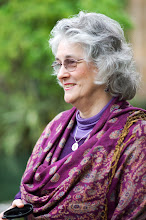
Yesterday Patrick and I attended an event at Peace Lutheran Church in Danville, CA called "Holy Convergence: An Interfaith Festival for Families." Billed as "a celebration of Ramadhan (Islam), the Feast of St. Francis (Christian [at least those brands of Christianity that have saints]), High Holy Days (Jewish), Divali and Gandhi's Birthday (Hindu) [is Gandhi's birthday a religious holiday or a national holiday?], Indigenous People's Day [fka "Columbus Day" and now known in PC San Francisco as Italian Heritage Day], Sikh Guru Gadhee, In Love with Life Season (Buddhist, Sufi and Bahai), and World Communion Sunday (Protestant Christian). Note there is no mention of Autumn Equinox, which is called by different names but celebrated by nearly all Pagans.
At the opening ceremony in the sanctuary, I met Bob Stranathan, a Christian Science practitioner, who seemed bewildered by my presence, and said he thought that Pagans were godless. I told him we had lots of gods and goddesses. Bob asked me if I were 'black or white'? We conversed in a spirit of openness and friendship. He did ask me if my poppy-tattooed arms were part of my religion. I said, no, they weren't a required accoutrement of Paganism, but, yes, they express, for me, my connection with and dependence upon the land where I live, a land covered with these flowers from early Spring until late Summer.
Right after we concluded the opening with self-introduction of religious representatives in attendance, a lovely young woman approached me and said how glad she was to see a Pagan presence there. She introduced me to her female partner and their daughter of about 9. We only had a few minutes to chat because Patrick and I were off to the first of two panels.
The first panel addressed the questions: "What are the 'end goals' of your faith? And how are they achieved in practice?" Each panelist had five minutes to speak, with the rest of the time taken up with Q&A. I didn't get all their names. A Sikh man said that Sikhs live in the world, and must leave themselves as Allah made them -- meaning no shorn head or facial hair, no embelleshments of the body (while seeming to be looking directly at my colorful arms).
The Rev. Carole Anderson from the Church of Religious Science in Concord said that there is only one god but that god can be complimented and integrated into other religions.
Rabbi Dan Goldblatt of Beth Chaim Congregation in San Ramon, said the world is borken and needs repair. He seeks to find a balance between justice and compassion, to seek peace. He said there is little in Judaism by way of theology, but that we should listen with our whole hearts.
The abbess of Buddha Gate Monastery in Lafayette, Master Jian-Sheng, claims that all sentient beings have the potential to attain Buddhahood, or enlightenment, by (1) observing the precepts -- she spoke of five precepts and eight precepts, but only itemized the six I'm mentioning here -- (2) practicing tolerance; (3) practicing charity, with no attachment and without greed; (4) practicing meditation; (5) being diligent; (6) attaining wisdom, beyond knowledge. She cautions to avoid extreme views and keep to the middle way.
The final panelist, a Sufi woman from the Rahima Foundation, said that the goal of Sufis is to attain divine pleasure and divine love, to serve 'the lord' (I don't know what lord, exactly; Allah, I assume) by serving his creation.
During the Q&A, I wanted to bring up the topic of the feminine divine. I said I felt at a disadvantage because there had been no expression of anything other than monotheism and that in NeoPaganism -- yes, I used that term in this rather conservative context -- and my question was about acknowledgment of the feminine divine. I said that many women left the religions in which they were brought up because they saw no image of the feminine divine in those religions, and instead they found a more personally meaningful spiritual path in Paganism.
Having been specifically invited to this event, you can imagine my surprise when several people, both panelists and particularly two men in the audience (one a Muslim, one Euro-American, presumably Abrahamic) spoke rudely and condescendingly. The Muslim man told me how Allah revered women. That, my friend, is not the feminine divine. The Euro-American man gave me a lecture about all the deities of both sexes in Hinduism (he neglected Ardhanarishvara and other androgynous or two-sexed deities); how highly esteemed women are in Christianity and Judaism. Again, so narrow and limited were their world views that they couldn't seem to grasp the meaning of my question. They were nasty and I was upset.
I told myself that encountering Pagans was a new experience to this community and that I should cool it and speak to individuals afterwards. I leaned over to Patrick, all nice and proper in a suit, with a CHS pin in the lapel, and tie, and whispered, "Am I being too contentious?" He said definitely not, but wait till later to address my discomfort. I said, "These guys are gettin' my Irish up. Am I being too thin-skinned?" I experienced these men (and even the abbess) as patronizing us. And if you wanna piss me off, just talk down to me.
I could have told this fellow that I attend Kali pujas on the New Moons. I could have told him lots, but alas, there was no time.
I felt that the moderator, who was at the rear of the room rather than on the dais with speakers, should have interrupted and made it clear that this was an interfaith gathering, and at interfaith gatherings we come together in respect. At that point in the day, I was ready to just leave and go home; instead, I walked around and cooled off between sessions.
While the interfaith discourses were taking place, there were other activities going on at the gathering. The various local churches and other religious organizations had tables in the courtyard where they handed out literature and had some refreshments. The Buddhists, bless them, had free bottles of water on this hot dry day. Meanwhile, some people took their pets the Children's Garden for a blessing of the animals; the Sikhs led people in chanting and dancing in the sanctuary, others walked the church labyrinth (a medieval circuit labyrinth), while children got henna tattoos or made balloon animals, worked on a large mosaic. The design of the mosaic, by Richard Caemmerer, is pictured above. Whether Pagans paths were intended to have been interwoven into this design, when I see the multicolored spiral uniting all the images, I know we're there.
After a short break, we reconvened for an "interfaith discourse" on the questions: "What are the views within your faith about other faiths? What are the relevant scriptures? What is the status of interfaith relations within your faith?" I'm happy to say that Patrick was the first to speak, and he stopped immediately when the moderator, still from the back of the room, signaled time. He was followed by a Baha'i gentleman, then Father Tom Bonacci, a Roman Catholic priest from St. Ignatius of Antioch.
Bob, the Christian Scientist I met earlier, said Jesus' job was to express the divine, not to tell about it. The goal of Christian Science is to heal "sin," and its teachings are Bible-based. He said we are to "be merciful, just and pure." From the First Church of Christ, Scientist, in Danville, Bob also maintains a healing practice from his office in Walnut Creek. He prays and performs healings by telephone or e-mail, but prefers working face-to-face.
The last to speak was the Sufi woman from the Rahima Foundation.
A woman went up to Patrick right after the discussion, so I left the room to look around at what I had missed in my hurry to get to the opening ceremony in time. People, but for a few stragglers like me, were packing their instruments and literature, folding tables and chairs, and cleaning up. I went back into the room after a bit, but I could see Patrick and the woman were deep in conversation. After another little while, I returned to the room and sat quietly waiting for them to finish. Evidently the conversation had gotten very heated on both sides; I don't think it would be constructive for me to detail it here. Suffice to say that the woman, who happened to be a Protestant convert to LDS, was apologizing profusely to Patrick, saying how ignorant she had been. What a guy he is! One of the smoothest talkers -- he surely kissed the Blarney Stone, he has such Irish charm -- one of the most diplomatic people I know, Pagan or not.
I'm glad we made this connection with the Interfaith Council of Contra Costa County. Patrick was wanting to connect with a local interfaith group close near his home.
I'm a little confused: our invitation came from ICCCC, the sponsor, yet the program indicates the event was sponsored by Interfaith - San Ramon Valley. For a completely different perspective on this event from mine, see this article from The Argus, a local paper. It also seems to have caught the attention of the Huffington Post.
Monday, October 01, 2007
Monday, September 24, 2007
A Gathering of Spirits Harvest Festival
Yesterday I drove to Fair Oaks (Sacramento area) for the annual A Gathering of Spirits Harvest Festival honoring Pagan Pride Day. I picked up Dorothea, the PSR student who's doing field work by working with CHS, at the El Cerrito Plaza BART station and headed northeast early in the morning so we could have our tables set up by the time the gates opened. Weather was iffy.
When we pulled the car up to unload, we were greeted by Krom, one of the few Sacramento Pagans I know, who used to be active in the late CCVLC-CoG. It's always nice to encounter someone you already know when you go someplace unfamiliar, which is not to say that everyone wasn't friendly and gracious. They were. Tracy showed us our tables (two, one for CHS and one for me as an author). Brighde had already left her chair and knitting there. In spite of wind and occasional rain, we set up a nice display, pulled back from the edge to avoid drips and splashes, that included not only flyers for CHS, but also for Reclaiming Cauldron of the Valley and Serpentine Music. We arranged several chairs next to, instead of behind, the tables for people to chat about CHS out of the rain.
Our booth, with the CHS banner and the tripart display Brighde made and our fancy new flyers, looked great. I neglected to take photos, even though I remembered to bring my camera. Oh, well, it does me no good sitting in my market basket all day.
Festival organizer WinterSky, wearing a gorgeous golden gown, lead the opening procession, followed by four people holding Elemental masks on sticks, drummers and chanters.
Not a lot of people came to my talk, but then again not a lot of people came to anybody's talk. I think that most of the people there were busy with booths and rituals and other jobs and that the general public hadn't arrived yet because of the weather. This was the first day of a two-day festival, and it rained in the late morning. I think that kept attendance down, even though we enjoyed a glorious sunny afternoon.
We chatted with lots of folks, which was fine with me since one of my favorite things to do is talk with other Pagans -- about what they do, how they do it, what their experiences have been, what training they've had and/or synthesized, how they experience deity, how they are accepted by their neighbors, how public they can comfortably be, and that sort of thing.
The Association of United Pagans, sponsors of the Stanislaus Pagan Pride Day (Modesto) on October 6, had a booth. It was fun to be able to chat with them without the distractions of their having to be running a festival.
I went to most of a talk Michael Gorman gave. Michael's part of Grove of the Oak, a Sacramento OBOD (Druid) group, whom I had on the panel I produced at PSR in '06. Later we attempted to chat, but he was in great demand and being dragged around, and I won't compete for someone's attention. Another time, one would hope.
On a coffee quest shortly after we arrived, I met a lovely woman named Heather. Later I spent a lot of time chatting at her booth. Turns out we have a lot in common; she brought her children up in Marin County. An artist who works in many media, one of Heather's websites is here. I hope to see her again, most likely at the Dickens Faire.
Miria now sells healing stones exclusively, lots and lots of beautiful stones. I learned more about them hanging at her booth. She's a Reclaiming person I like and don't see often because we don't live near each other.
I only had two brief opportunities to check out the vendors and other offerings. Dorothea, Brighde and I took turns, plus Brighde wanted to spend some time with her friends in the Sierra Madrone Grove ADF booth.
I had fun getting to know Dorothea better on the long car rides, and look forward to our drive to Modesto in October.
We left around the time the ADF ritual was beginning. I was exhausted and we had a long drive back to the Bay Area. On the way home we stopped by the Trismegiston covenstead, Book Haven, in Berkeley, where Corby had gone to join in their Equinox ritual, for some post-ritual conversation and comestibles.
International Day of Peace Observance

Sister Marion censing the peace pole.
The activist Dominican Sisters of San Rafael, under the direction of Sister Marion Irvine, previously mentioned in this blog, observed International Day of Peace. The UN General Assembly, by Resolution 36/67 in 2001, declared September 21 to be an international day of peace.
We gathered near the Dominican peace pole on the amidst tall old trees and sunny patches of flowers on beautiful grounds of Dominican University on an utterly exquisite early Autumn day. The peace pole has the words "May peace prevail upon the earth [sic]" on each of its four sides in four languages: English, because we are an English-speaking society; French in honor of the birthplace of the Dominican order; Spanish for our neighbors to the South and many in our community; and Arabic because so much war is taking place in Arabic-speaking parts of the world. (These are the reasons Sister Marion gave.)
We opened with a call-and-response prayer that was printed in the program, as were all the prayers and songs. I wasn't comfortable saying some of the words -- it began, "We believe in God...We believe in Jesus Christ, who came to heal us, and to free us from...oppression..." -- so I didn't say them. The rest of the opening prayer was about human rights, solidarity of all peoples, justice, freedom from hunger and violence; I was down with that.
There was also a time for community sharing when we were asked to say what thought or feeling had brought us to the gathering. I said I was aggrieved at the needless and senseless deaths of our American children and Iraqis of all kinds that was taking place in Iraq. Sister Marion repeated each reason given, reinforcing it.
A procession around the university grounds preceded the re-dedication of the peace pole. Since Sister Marion had announced as an interfaith ceremony and invited MIC members to participate, I asked her if I could contribute a chant. It was that chant we used for the procession. I learned it from the EarthSpirit Community in Massachusetts, specifically from MotherTongue's new album, "Weaving the Web of Life." My understanding of the chant's genesis is that the woman who wrote it did so right after 9/11. Her heart was roiling, so the chant begins, "Peace in my heart," and extends to "peace between our hearts," ending with the all-embracing "peace in the heart of the world." (You can hear a bit of the chant here.)
The procession.
I remained at the mike singing the chant while others walked, but I was told by several people after the conclusion of the ceremony that they kept the chant going the whole time and loved it.
After the re-dedication, the kindergarten and first grade students of St. Raphael School sang "He's Got the Whole World in His Hands," with gestures. They were adorable.
Although the ceremony was designed to honor all faiths in peace, and included three prayers in the program, all the prayers were from the Abrahamic traditions. They included "A Christian Prayer for Peace," "A Muslim Prayer for Peace," and "A Jewish Prayer for Peace." All were recited in unison by everyone there. I wonder if the sisters sought the prayers from those folks or if they chose them themselves. I was puzzled that they didn't have a Jew and a Muslim read the Jewish and Muslim prayers. In any event, I know they tried to be inclusive. I did introduce myself and say that the offering of a chant I had brought was from the NeoPagan community. Several people, including some of the nuns, came up to me afterwards and thanked me for bringing it. That felt good. It also felt good seeing and hearing all those people, especially the little children, chanting a Pagan chant. Not that there's anything that would peg it as having been written by a Pagan from a Pagan perspective, since in my view has universal appeal and applicability. That's exactly why I chose it and why I offered it. I want to see our face, or taste our flavor, in interfaith situations.
We concluded by offering personal blessings of peace upon those standing near us. I felt good about the whole affair.
Note: Photos are from Dominican Sisters website; more here.
Tuesday, September 11, 2007
Retreat Day with Two Nuns
Yesterday I spent a restorative day with others in the Marin Interfaith Council at one of our quarterly retreats. The theme was balancing the inner and outer life, taught by Dominican Sister Marion Irvine and Brahma Kumaris ("daughters of Brahma")* Sister Chandru.
Sister Chandru, who speaks very quietly with a melodic Hindi accent, told us about the founding of Brahma Kumaris by Brahma Baba (Lekhraj Kripilani) in 1936 in an area that was then in India but is now part of Pakistan. At that time Hinduism was dominated by males, and Baba thought there would be benefit in giving women charge of a group dedicated to peace. The movement began with 300-400 young women aged 16-21 years, and has now grown to 8,500 centers in 100 countries.
The Brahma Kumaris sisters at Anubhuti Meditation and Retreat Center**, the location of the retreat, were in mourning for their late leader, Dadi Prakashmani, who had died only a few days earlier. (Dadi means respected elder sister.) Dadi Prakashmani was one of the original sisters to whom Brahma Baba entrusted his entire worldly estate and the administration of the order; she joined when she was 14.
Born in Mumbai, Sister Chandru uses the masculine form of her given name, Chandra, because in her youth when she joined Brahma Kumaris, Brahma Baba told her she was like a son to him.
The Brahma Kumaris practice a form of meditation called Raja Yoga. It is a method of relaxing, refreshing and clearing the mind and heart. It helps you look inside to rediscover and reconnect with your original, spiritual essence. Meditation enables an integration of your spiritual identity with the social and physical realities around you, restoring a functional and healthy balance between your inner and outer worlds.
We spent the latter part of the morning, through lunch (delicious fresh vegetarian lovingly prepared and served by residents of the retreat) in silent meditation. We sat, and later walked the grounds or the labyrinth.
Sister Marion is a hoot. Really unshakable. When she was 47, overweight and smoking two packs of cigarettes a day, she took up running to relax after her workdays as principal of a grade school. Soon she became the oldest to ever qualify for the Olympic Trials. She even made it into Time magazine. Here's a photo (about halfway down the page) of her in her running days. She's now 77, with the spirit of a youngster and the sass of a woman who knows who she is and enjoys life.
She told us a bit about the founders of her order, the 12th Century CE Spaniard, St. Dominic de Guzman, and St. Catherine of Sienna (the youngest of 25 children!). In general, Dominicans seek to purify themselves from 'evil' by asceticism. The sisters established places of retreat for itinerant friars during the Late Middle Ages.
Dominicans have three orders. Sister Marion is in the third, or active, order. The second is contemplative, and the third is completely cloistered.
Of course, we Witches know the Dominicans as the propagators of the Inquisition, the authors of the Malleus Malifacarum (published in 1487), torturers and burners of heretics, and she did mention the Dominicans' persecution of the Albigensians. I actually considered mentioning Kramer and Sprenger, but just didn't think it was a good time to get into that particular discussion.
Sister Marion is a native San Franciscan and product of Dominican schools. In high school, she observed that her teachers, all Dominican sisters, seemed happy in their lives and work, and since she considered herself to be a rather upbeat person, she was attracted to that life. She claims she never had a mystical experience that lead her to join, and she's never had one in the sixty years she's been in the order.
I did manage to jump on a potential teaching moment when we were talking about the power of collective prayer, chant and meditation focusing on a common goal. I pointed out that this is another name for what we might call 'spellwork.'
Sister Marion showed us a teaching method used in her order wherein a short passage of the Bible is read aloud slowly, and really listened to. After a brief period of silence, they are read a second time. I volunteered and found myself in the odd position of reading just a few verses of the Gospel of Luke.
We Pagans don't have a sacred text, per se; however, I intend to try this practice with a few lines of poetry, lyrical words about Nature, or maybe part of The Charge of the Goddess. I think it could enhance our understanding. As I get older, I find I enjoy contemplative spiritual practices at least as much as more active practices, if not more.
There were some things said that were mistaken assumptions on the part of the teachers, particularly assumptions about monotheism from Sister Marion.
Although we usually think of Hindus as being polytheists, the Brahma Kumaris seem to pay little heed to individual deities. Instead, their focus is on world peace. The artwork at the retreat was comprised of a surprising number of white sculpted angels -- a large angel stood at the edge of the labyrinth -- plus photographs of temples and assemblies of people, and mystical paintings of colors and images drawing the eye into "the one."
I find enrichment in every retreat I've attended. This is the fourth. I missed the one at the Vedanta Society in West Marin, but attended two at Santa Sabina Center and one at Green Gulch Zen Center, plus several International Day of Prayer breakfasts at Congregation Rodef Shalom.
Our director, the Rev. Carol Hovis, has a real talent for putting together interesting spiritual leaders to present on topics relevant to all of us. She's someone other interfaith folks might consider looking to for creative ideas leading to greater religious tolerance and understanding.
*Brahma Kumaris means ‘daughters of Brahma.’ Seminal to the vision of world renewal was the revelation of the important and prominent role of women as spiritual teachers. Brahma Baba correctly foresaw that core values based on traditionally feminine qualities – patience, tolerance, sacrifice, kindness and love – would increasingly become the foundation of progress in personal growth, human relations, and the development of caring communities. To maintain the emphasis on this vital core of leadership, he named the organisation the Brahma Kumaris World Spiritual University.
** Anubhuti means 'to experience."
Sister Chandru, who speaks very quietly with a melodic Hindi accent, told us about the founding of Brahma Kumaris by Brahma Baba (Lekhraj Kripilani) in 1936 in an area that was then in India but is now part of Pakistan. At that time Hinduism was dominated by males, and Baba thought there would be benefit in giving women charge of a group dedicated to peace. The movement began with 300-400 young women aged 16-21 years, and has now grown to 8,500 centers in 100 countries.
The Brahma Kumaris sisters at Anubhuti Meditation and Retreat Center**, the location of the retreat, were in mourning for their late leader, Dadi Prakashmani, who had died only a few days earlier. (Dadi means respected elder sister.) Dadi Prakashmani was one of the original sisters to whom Brahma Baba entrusted his entire worldly estate and the administration of the order; she joined when she was 14.
Born in Mumbai, Sister Chandru uses the masculine form of her given name, Chandra, because in her youth when she joined Brahma Kumaris, Brahma Baba told her she was like a son to him.
The Brahma Kumaris practice a form of meditation called Raja Yoga. It is a method of relaxing, refreshing and clearing the mind and heart. It helps you look inside to rediscover and reconnect with your original, spiritual essence. Meditation enables an integration of your spiritual identity with the social and physical realities around you, restoring a functional and healthy balance between your inner and outer worlds.
We spent the latter part of the morning, through lunch (delicious fresh vegetarian lovingly prepared and served by residents of the retreat) in silent meditation. We sat, and later walked the grounds or the labyrinth.
Sister Marion is a hoot. Really unshakable. When she was 47, overweight and smoking two packs of cigarettes a day, she took up running to relax after her workdays as principal of a grade school. Soon she became the oldest to ever qualify for the Olympic Trials. She even made it into Time magazine. Here's a photo (about halfway down the page) of her in her running days. She's now 77, with the spirit of a youngster and the sass of a woman who knows who she is and enjoys life.
She told us a bit about the founders of her order, the 12th Century CE Spaniard, St. Dominic de Guzman, and St. Catherine of Sienna (the youngest of 25 children!). In general, Dominicans seek to purify themselves from 'evil' by asceticism. The sisters established places of retreat for itinerant friars during the Late Middle Ages.
Dominicans have three orders. Sister Marion is in the third, or active, order. The second is contemplative, and the third is completely cloistered.
Dominican sisters, also known as the Order of Preachers, live their lives supported by four common values, often referred to as the Four Pillars of Dominican Life, they are: community life, common prayer [both liturgical and contemplative, according to Sister Marion], study and service.
Of course, we Witches know the Dominicans as the propagators of the Inquisition, the authors of the Malleus Malifacarum (published in 1487), torturers and burners of heretics, and she did mention the Dominicans' persecution of the Albigensians. I actually considered mentioning Kramer and Sprenger, but just didn't think it was a good time to get into that particular discussion.
Sister Marion is a native San Franciscan and product of Dominican schools. In high school, she observed that her teachers, all Dominican sisters, seemed happy in their lives and work, and since she considered herself to be a rather upbeat person, she was attracted to that life. She claims she never had a mystical experience that lead her to join, and she's never had one in the sixty years she's been in the order.
I did manage to jump on a potential teaching moment when we were talking about the power of collective prayer, chant and meditation focusing on a common goal. I pointed out that this is another name for what we might call 'spellwork.'
Sister Marion showed us a teaching method used in her order wherein a short passage of the Bible is read aloud slowly, and really listened to. After a brief period of silence, they are read a second time. I volunteered and found myself in the odd position of reading just a few verses of the Gospel of Luke.
We Pagans don't have a sacred text, per se; however, I intend to try this practice with a few lines of poetry, lyrical words about Nature, or maybe part of The Charge of the Goddess. I think it could enhance our understanding. As I get older, I find I enjoy contemplative spiritual practices at least as much as more active practices, if not more.
There were some things said that were mistaken assumptions on the part of the teachers, particularly assumptions about monotheism from Sister Marion.
Although we usually think of Hindus as being polytheists, the Brahma Kumaris seem to pay little heed to individual deities. Instead, their focus is on world peace. The artwork at the retreat was comprised of a surprising number of white sculpted angels -- a large angel stood at the edge of the labyrinth -- plus photographs of temples and assemblies of people, and mystical paintings of colors and images drawing the eye into "the one."
I find enrichment in every retreat I've attended. This is the fourth. I missed the one at the Vedanta Society in West Marin, but attended two at Santa Sabina Center and one at Green Gulch Zen Center, plus several International Day of Prayer breakfasts at Congregation Rodef Shalom.
Our director, the Rev. Carol Hovis, has a real talent for putting together interesting spiritual leaders to present on topics relevant to all of us. She's someone other interfaith folks might consider looking to for creative ideas leading to greater religious tolerance and understanding.
*Brahma Kumaris means ‘daughters of Brahma.’ Seminal to the vision of world renewal was the revelation of the important and prominent role of women as spiritual teachers. Brahma Baba correctly foresaw that core values based on traditionally feminine qualities – patience, tolerance, sacrifice, kindness and love – would increasingly become the foundation of progress in personal growth, human relations, and the development of caring communities. To maintain the emphasis on this vital core of leadership, he named the organisation the Brahma Kumaris World Spiritual University.
** Anubhuti means 'to experience."
Labels:
Brahma Kumaris,
Dominican Order,
meditation,
nuns
Wednesday, September 05, 2007
Sing a Song of Summer
My friend Summer and I spent last Sunday afternoon in Speedway Meadows in Golden Gate Park enjoying a glorious day with thousands of others at the 40th Anniversary of the Summer of Love. We didn't know each other in 1967, although we were both in San Francisco. We met through the home birth movement in the '70s when Summer was a birth coach and we were both young mothers (well, not so young). Summer had a daughter and identical twin sons; I had Deirdre. Deirdre and her boys were both Geminis born in 1976.
Since then, we've tickled each other's funny bones, tipped a shot of Jameson's, celebrated birthdays and other good times. Summer inspires me to be a better person. It's not that she does or says anything in particular. It's just that when we have long talks, she gets me thinking about things in a more loving and compassionate way. Having Summer as a friend has enriched my life.
We arrived around 11:15 a.m. with folding chairs and table, rainbow umbrella and food. Every time we looked around the crowd was denser, with people streaming through the gaps in the trees on the paths down into the meadow. There were vendors and lots of good food to buy, but the lines were endless; we were glad we'd brought our own picnic. Here are a few more photos:
Peace & Flowers and Flower Children
Believe it or not, that's Grace Slick and
the Jefferson Airplane up there on the stage.
Labels:
friendship,
Hippies,
San Francisco,
Summer of Love
Saturday, August 25, 2007
Working with the Elderly
On Thursday I attended another luncheon meeting of the Marin Interfaith Council, the topic of which was "Serving Your Senior Community." Our speakers, Jenefer Duane, CEO/Executive Director of Elder Financial Protection Network, and Lee Pullen, Program Manager for Adult Protective Services, spoke about elder needs and care. Since these events are mainly directed towards clergy of the mainstream persuasions, they sought to educate about issues such folks encounter in their ministries.
They came well prepared, with a power point presentation, statistics, and handouts containing written information, resources and contacts. Elder financial abuse is a growing problem. Most perpetrators have a close relationship to the victim. Besides financial abuse, lonely, often dependent and confused, elders suffer physical assault, constraint or deprivation, neglect, over and under medication, and abandonment.
Elders may become neglectful of personal hygiene, malnourished or dehydrated. Memory loss, fear of loss of independence, feelings of shame and embarrassment, and dependence on the perpetrator(s) lead to underreporting of these crimes.
Our discussion included the argument for not isolating populations by age. Contemporary American lifestyles tend to group small children with each other, youth with youth, and elders with elders. We are better served when communities are age-integrated.
For Pagan readers of this blog, I quote the definition of clergy for mandated reporting:
If there is one thing I want Pagans to take away from this is the knowledge that if we encounter anything resembling elder abuse, we are mandated reporters. Most of you probably know we are mandated reporters for suspected child abuse, but the law requiring 'clergy' to report suspected elder abuse is recent. So now you know. May you never have to do it.
They came well prepared, with a power point presentation, statistics, and handouts containing written information, resources and contacts. Elder financial abuse is a growing problem. Most perpetrators have a close relationship to the victim. Besides financial abuse, lonely, often dependent and confused, elders suffer physical assault, constraint or deprivation, neglect, over and under medication, and abandonment.
Elders may become neglectful of personal hygiene, malnourished or dehydrated. Memory loss, fear of loss of independence, feelings of shame and embarrassment, and dependence on the perpetrator(s) lead to underreporting of these crimes.
Our discussion included the argument for not isolating populations by age. Contemporary American lifestyles tend to group small children with each other, youth with youth, and elders with elders. We are better served when communities are age-integrated.
For Pagan readers of this blog, I quote the definition of clergy for mandated reporting:
"Clergy member" means priest, minister, rabbi, religious practitioner, or similar functionary of a church, synagogue, temple, mosque, or recognized religious denomination or organization.I leave it to the individual Pagan to decide in what capacity she or he is functioning. Local and regional resources and more detailed information, by state, about elder abuse and reporting at the National Center on Elder Abuse.
"Clergy member" does not include unpaid volunteers who periodically visit elder or dependent adults, unless their main occupation or vocation involves active or ordained ministry.
If there is one thing I want Pagans to take away from this is the knowledge that if we encounter anything resembling elder abuse, we are mandated reporters. Most of you probably know we are mandated reporters for suspected child abuse, but the law requiring 'clergy' to report suspected elder abuse is recent. So now you know. May you never have to do it.
Thursday, August 23, 2007
Friends Old & New
One of the most compelling reasons for me to belong to CoG is the friends I've made through it. I hadn't attended CoG's annual meeting for several years, for reasons I won't go into here, until this year when Laura asked me to present at the Leadership Institute.
Some of the dear friends I was able to visit with this year are: Cat Chapin-Bishop and Peter Bishop, creators of QuakerPagan Reflections blog. Go there to read Cat's remarkable seven-part spiritual journey.
It's always a treat to see Penny and Mike Novack. Penny is fey if anyone ever was. I had last seen her at Dandelion 2 in May of '06. I was pleased that so many other CoG members who'd only known Penny online got to experience the full impact of her.
For the first time I met in person some co-conspirators who helped me write Witchcraft and the Web, in particular Jehana Silverwing, who did the MerryMeet07 website, and Carol Maltby, whose observations over the years, both in the business of writing that book and beyond, I've always found to be wise and compassionate. Plus she has beautiful gray braids.
My friend Jennifer Bennett, another CHS teacher, generously shared her dorm room with me. She embodied CoG's matron Coventina at the main ritual. She wore a beautiful shade of blue and carried a cornucopia. At the end of the ritual, participants were given an image of Coventina on a ribbon, handmade by the Witches of Evergreen Coven. I'm not terribly familiar with Coventina. I learned more about her from a slide show by Don Frew and Anna Korn of their trip to Coventina's well a couple of years ago, but I'd not previously known Her to be conceived as a tripartite goddess.
Our EarthSpirit colleagues produced the main ritual. I had a small part paired at opposite sides of the with Eric. Moira choreographed, Deirdre taught us a couple of new chants from MotherTongue's new album, "Weaving the Web," that I guarantee I'll be spreading around.
MotherTongue performed for us after dinner on Saturday night. In addition to chants from their new album, Andras entertained us with a raunchy contemporary version of "Gently Johnny" from The Wicker Man. This is the first time I've seen MotherTongue with their new director, Christopher LaFond.
Other non-members lives in Western Massachusetts and are my witchy pals: Mark Roblee, known in magical circles as Mark Moth. Mark and I go way back from when he lived in San Francisco. He and his wife Jacky (Wacky Jac) live in a Kahlo-esque house in the woods with their two young sons. They don't socialize much. I left MerryMeet one afternoon to have a cappuccino and schmooze with Mark, to the envy of some of his local friends who rarely see him. He's delving into learning Greek, with a goal of learning more about Greek magic. I told him about Tony's work and will recommend Tony's writings.
Most times when I'm in the area, Orion Stormcrow shows up. This time was no different; along he came, all dressed for the masquerade and looking great. I was glad for his company at the ball, glad to do some booty dancing with him.
I only got to wave at Charles Boyce, former Tech Dean of CHS, and his wife Kaitlin in passing. Kaitlin starred in a playlette called "The PerfectTear," by Silkie O-Ishi, about Cuchulain's encounter with Fand of the sidhe in the New York subway and his marital conversations with Emer.
Then there are Pagan friends who are neither members of CoG nor do they live in Western Mass: Michael York and Richard Switzer. Met for the first time in person Thea Collins and our new PIO, Jane Raeburn, both from Maine and both working with CHS. Spent a fair amount of time with CHS Board members Holli Emore from South Carolina and Debbie Fields-Berry from Boston.
I met several folks for the first time whom I know I will carry a fondness for from now on: Ludmilla, Coral, Cosette, Cuchulain, Coyote, and some whose names escape my senior mind at the moment.
Margot Adler gave a great talk about her new edition of DDTM, which opened up into a panel of long-time Witches. I was reluctant to go up to the table, but Cosette and Cuchulain urged me to. We had a fascinating discussion going on, with the likes of Glenn Turner, Penny, Andras Arthen, Anna Korn and others, but, as usual, not nearly enough time. Just like the panel at Starwood the week before. Oh, well, leave 'em wanting more, I say.
Labels:
Coventina,
friendship,
The Wicker Man
Sunday, August 19, 2007
Oldsters & Youngsters
Earlier in the month at MerryMeet in Massachusetts, Laura "Spellweaver" Wildman-Hanlon organized a conversation between long-time Pagans and younger Pagans. The older folks, myself among them, were mainly Witches. The younger folks included both teens who were brought up in Pagan families and college students from U-Mass' SPIRALS Pagan student group. The latter were people brought up in more conventional households.
I learned a lot and left feeling optimistic about our survivability as a religious movement.
I had the pleasure of meeting a younger, though neither teen from a Pagan family nor student Pagan, Cosette from Miami (a member of Everglades Moon Local Council* of CoG), as well as the teen children of Ariadne (I think of her as Ariadne even though now she goes by her give name of Lisa) and Macha/Rachel (not me). Ariadne is a long-time member of of CoG active in the Antelope Valley of California, formerly of Orange County** Local Council.
One of the highlights of this discussion, for me, was hearing Joan C. tell about her early exposure to Witchcraft in Boston. I knew her about 30 years ago when she lived in the San Francisco Bay Area, and have had the good fortune to reconnect with her on my occasional broomstick trips to Western Massachusetts. She participated in a workshop on death and dying that I facilitated at Mary Colleen McDougall & Ted Tarr's late Tarr & Feathers store in Greenfield. (Also got to chat with Mary Colleen & Ted at MM.) Then in March '06 I learned that she's a member of Apple & Oak Coven, of which Laura Spellweaver is High Priestess. I hope the younger Pagans were as fascinated by her tales as I was.
Another highlight was hearing from a young college student about how he and his spiritual beliefs are accepted in his fraternity.
I should mention that this discussion was deftly facilitated by Thea Collins, author and faculty member at Cherry Hill Seminary.
A few months earlier I'd been asked by Ariel Monserrat, the new editor of the revised Green Egg, to write something about elders and eldership. Being pressed for time, I reread an article I'd written on the same topic for the same publication back in 1996. I felt it held up to the passage of time, so resubmitted it. It appears in the Beltaine 2007 issue, which also contains lots of
I don't have enough time to keep up on all the endless discussions about elders and eldership that seem to be taking place everywhere I look. I know Druid Michael Gorman , whom I featured on a panel discussion at PSR last year, wrote one in a recent GE, and I'm aware that the legendary GE Forum has been host to lively discussion on those topics. I also notice that PanGaia magazine has been publishing articles and discussion about elders.
It's always been a topic of interest to me, perhaps because we had so few when I was new to Paganism. I could probably name the ones I knew or had heard of on one hand (at least here in California): Victor and Cora Anderson (Feri/Faery); Grandma Julie Tower (Tower Family); George Patterson (Georgian). Other friends grew to become elders during the time I knew them: Judy Foster (NROOGD); Alison Harlow (Feri/Faery).
I've always maintained that until the full spectrum of human lives is included within our ranks, we are merely a club, a clique or a fad. By the full spectrum, I mean the unborn, the babies, the children and youth, the adults, the elders, and the ancestors. If Paganism is to survive -- I believe it will -- it must reflect all the stages of life, and have a place or places for everyone in our communities. This leads to a whole different discussion beyond the scope of this little post.
In any case, I continue to ponder where we're going. I look at other cultural phenomena and see how they sustain themselves, and how they regard elders. I love history. I find it such a rich resource of observations about human nature, human behavior, human strengths and foibles.
Shorty after I came home, I received an email from a young Pagan named Gwinevere Rain, editor of Copper Moon E-Zine: A Witch's Publication for Teens and Early Twenties, an online zine in which I was interviewed a few years ago. She reminds us that Copper Moon is alive and seeking to serve younger Pagans:
* In fact, in addition to the two EMLC folks I already knew to be fun and standup and honorable, Canu and Rayna, I met several other cool folks from that LC: Coral Tran, Lord Cuchulain, and Lord Coyote, who happens to share a Pisces birthday with me.
** Here's a fascinating tidbit: Orange County is a conservative Republican area of California, yet Cherry Hill Seminary has more students from Orange County than from any other single region of the country. Go figure.
I learned a lot and left feeling optimistic about our survivability as a religious movement.
I had the pleasure of meeting a younger, though neither teen from a Pagan family nor student Pagan, Cosette from Miami (a member of Everglades Moon Local Council* of CoG), as well as the teen children of Ariadne (I think of her as Ariadne even though now she goes by her give name of Lisa) and Macha/Rachel (not me). Ariadne is a long-time member of of CoG active in the Antelope Valley of California, formerly of Orange County** Local Council.
One of the highlights of this discussion, for me, was hearing Joan C. tell about her early exposure to Witchcraft in Boston. I knew her about 30 years ago when she lived in the San Francisco Bay Area, and have had the good fortune to reconnect with her on my occasional broomstick trips to Western Massachusetts. She participated in a workshop on death and dying that I facilitated at Mary Colleen McDougall & Ted Tarr's late Tarr & Feathers store in Greenfield. (Also got to chat with Mary Colleen & Ted at MM.) Then in March '06 I learned that she's a member of Apple & Oak Coven, of which Laura Spellweaver is High Priestess. I hope the younger Pagans were as fascinated by her tales as I was.
Another highlight was hearing from a young college student about how he and his spiritual beliefs are accepted in his fraternity.
I should mention that this discussion was deftly facilitated by Thea Collins, author and faculty member at Cherry Hill Seminary.
A few months earlier I'd been asked by Ariel Monserrat, the new editor of the revised Green Egg, to write something about elders and eldership. Being pressed for time, I reread an article I'd written on the same topic for the same publication back in 1996. I felt it held up to the passage of time, so resubmitted it. It appears in the Beltaine 2007 issue, which also contains lots of
I don't have enough time to keep up on all the endless discussions about elders and eldership that seem to be taking place everywhere I look. I know Druid Michael Gorman , whom I featured on a panel discussion at PSR last year, wrote one in a recent GE, and I'm aware that the legendary GE Forum has been host to lively discussion on those topics. I also notice that PanGaia magazine has been publishing articles and discussion about elders.
It's always been a topic of interest to me, perhaps because we had so few when I was new to Paganism. I could probably name the ones I knew or had heard of on one hand (at least here in California): Victor and Cora Anderson (Feri/Faery); Grandma Julie Tower (Tower Family); George Patterson (Georgian). Other friends grew to become elders during the time I knew them: Judy Foster (NROOGD); Alison Harlow (Feri/Faery).
I've always maintained that until the full spectrum of human lives is included within our ranks, we are merely a club, a clique or a fad. By the full spectrum, I mean the unborn, the babies, the children and youth, the adults, the elders, and the ancestors. If Paganism is to survive -- I believe it will -- it must reflect all the stages of life, and have a place or places for everyone in our communities. This leads to a whole different discussion beyond the scope of this little post.
In any case, I continue to ponder where we're going. I look at other cultural phenomena and see how they sustain themselves, and how they regard elders. I love history. I find it such a rich resource of observations about human nature, human behavior, human strengths and foibles.
Shorty after I came home, I received an email from a young Pagan named Gwinevere Rain, editor of Copper Moon E-Zine: A Witch's Publication for Teens and Early Twenties, an online zine in which I was interviewed a few years ago. She reminds us that Copper Moon is alive and seeking to serve younger Pagans:
Copper Moon is an online blog magazine for Wiccan/Pagan practitioners in their teens and early twenties. Our features include eye-opening author interviews, articles, book reviews and more! This interactive site enables readers to comment on individual articles, subscribe through e-mail or in a RSS reader! Our aim is to have at least one new article or book review up each week. Since 2002 we have been providing a venue for young practitioners to express their opinions and have their writing showcased. If you are 13 to 26 we'd love to read your submission. Thanks for considering Copper Moon, one of the leading publications for young adult Wiccan/Pagans on the web.
* In fact, in addition to the two EMLC folks I already knew to be fun and standup and honorable, Canu and Rayna, I met several other cool folks from that LC: Coral Tran, Lord Cuchulain, and Lord Coyote, who happens to share a Pisces birthday with me.
** Here's a fascinating tidbit: Orange County is a conservative Republican area of California, yet Cherry Hill Seminary has more students from Orange County than from any other single region of the country. Go figure.
Thursday, August 16, 2007
Beside Myself
You know that crazy expression that someone is "beside herself"? You're jumping with joy so much that you may be multiplying, or your image becomes blurred with all that jumping? Or you're so excited you're looking at yourself in wonderment that that person who is you is so stoked? Well, I'm not literally jumping because I'm too heavy at the moment to do much hopping and jumping without injuring myself. But if I could, that's what I'd be doing. Let's just say I'm so excited I can barely contain myself. Why, you wonder?
Cherry Hill Seminary has just launched a brand new Chaplaincy Program under the direction of Patrick McCollum. Patrick, Brighde Indigo, Malendia Maccree and I (as Chair of the Public Ministry Department, of which this is our first really big official program) worked out this program over a period of months. We've been ready to launch it since January, but only now has CHS filled in our infrastructure sufficiently, with the hiring of two wonderful new volunteer professionals, Jane Raeburn, our PIO in Maine, and Eddie Cranford, our Tech Dean in South Carolina, to announce it to the world.
Hooray for Jane and Eddie! Hooray for Patrick, Brighde, Malendia and me! Hooray for those students who join us! Hooray for Pagandom!
Thursday, August 09, 2007
More on Starwood '07
Talk about horny!
Among the first performers we saw on the night Corby and I arrived was
Incus, great drumming, great fusion music, wonderful belly dancers with a PoMo twist.
We spent a lot of time schmoozing with Chameleons Ian & Liafal, A.J., Steph, Maddox & little Sydney Ginger. Their pavilion is a communication hub and a welcoming 'green room' for presenters. We sampled some of A.J.'s amazing elderberry mead, as well as all manner of cookies baked by A.J. and his 10-year-old son Maddox. Three-month-old Sydney Ginger was conceived at Starwood '06. Her brother intends to use her as a babe magnet when she's a toddler.
Again this year we feasted with Druid colleagues at the ADF potluck, giving us more leisurely time to become better acquainted with Kirk Thomas from Sonoran Sunrise Grove in Tucson and other Druids from faraway places. They didn't seem to have much familiarity with Northern California groves.
Later in the week we enjoyed the singing of Awen, the duet of Ian and Liafal. Jack from Maryland was enchanted by their rendition of "Jack in the Green," one of my favorite Spring Equinox songs. They also sang a beautiful Stephen Foster song that seems to have made its way into Pagan music, "Hard Times Come Again No More."
Presenter Lon Duquette arrived hungry, and so was I, so I took him over to Phill's Grille for a moderately priced, delicious Mediterranean repast. Phill's food is about a billion times better than you'll find at most Pagan festivals. Lon and I discovered that we had many more friends in common that just the late Tim Maroney who first introduced us some years ago. While sitting there, we also met Tara, who, with my pal Kevin Roddy and others, runs the Fire Tribe Hawaii festivals on the Solstices.
We hung a fair amount with presenters Jo Byers and Tony Mierzwicki. I enjoyed them immensely. Evidently, thanks to my pal Patrick McCollum, my reputation had preceded me because Tony told me what a great connection they'd had with Patrick and how he'd spoken highly of me. Always a great entrƩ.
From Tony's website: back row: Tony, A.J. and Jo with
her arm around Michaela. In front of A.J. are Steph,
Sydney Ginger, and her big brother Maddox
her arm around Michaela. In front of A.J. are Steph,
Sydney Ginger, and her big brother Maddox
I was pleasantly pleased to run into Minnesotans Nels & Judy from Sacred Harvest Festival and old CoG friend Vinnie Russo of Arsenic & Old Lace in Cambridge, MA.
Folks seemed to love my "Buffing & Polishing" workshops (two consecutive sessions). One of the men who came to one of my workshops was a NASA physicist from Florida, there because his children are interested in Paganism and he knew little about it.
One of the more remarkable presenters was Halim El-Dabh, an 84-year-old world-renowned musician from Egypt. His first name is Arabic, his middle name is Coptic, and his last name is Pharoic. A friendly man who hugs whenever the opportunity arises, Halim, accompanied by his wife Deborah, engaged in lively conversation wherever he went. I remember meeting him very briefly several years ago when he was doing a drumming workshop at a PCCO event in Ohio.
Corby and I and other Californians like LaSara Firefox are always blown away by the fire everywhere: luminaria lighting the pathways, campfires, tiki torches, candles in the notches of trees. Above all, fire dancing and twirling of flaming hula hoops as part of the spectacular Friday night fireworks display.
Late on Saturday we convened a panel, because both Ian and I love panels and we love talking with other Pagans about who we are and what we may mean in the world. In addition, Ian likes to talk about that irresolvable topic, thea/ology. This panel was on teaching methods.
Starting with the older known form of Paganism, Gardnerian Witchcraft, Deborah Lipp spoke of the older forms of training and how we cannot, in the present state of Paganism, teach everyone that way. She and I both still prefer that method, one that allows for a more gradual integration of knowledge, skills and experiences into the whole cloth of one's life, with guidance and mentoring. I spoke of Anderson Feri/Faery, since that precedes Reclaiming and is older than Church of All Worlds or ADF. Oberon Zell spoke about CAW, Ian Corrigan (later Skip Ellison) talked about ADF's training methods, I spoke of Reclaiming teaching as I knew it when I was active and as I observe it in the context of WitchCamps, which are an international phenomenon. Later Oberon explained something of his Grey School, a colorful endeavor with, not surprisingly, a strong scifi/fantasy flavor.
I got a chance to describe what we're doing at Cherry Hill Seminary in some detail. I think many there were surprised at the caliber of teachers and courses we have and the high bar we're attempting to set for Pagan seminaries that may follow us.
Although he was not officially on the panel, since there were two ADF folks already there, Isaac Bonewits contributed plenty of commentary.
I think it's fair to say we all enjoyed it. Our frustrations were two-fold: (1) It was scheduled too late, at the end of the day of the last full day of the festival, not a time when people are eager to take in more information. (2) We could have used lots more time; we were all juiced up when our time ran out.

Also from Tony's website: Corby, Gnorm our charioteer
and me wearing our glostiks all ready for the Saturday
night bonfire.
Me, Tony, Jo and Corby. Do we look like we're twinkling?
Bonfires are so primal and So Much Fun, especially for us Californians who have to be so much more fire-conscious. We found the Saturday night bonfire thrilling.
Sunday morning we cleaned up, packed, and embarked on our seemingly endless trip home.
I hope to go to more Starwoods in the future. Long may they thrive!
Wednesday, August 01, 2007
Passing Through
Just home from Starwood in Pennsylvania and off to MerryMeet in Massachusetts in a few hours. Lots to tell when I find time.
Celebrated Lughnasad at a fine nighttime ritual in the Nemeton with Druid friends of Ćr nDraĆocht FĆ©in (ADF)
Lughnasad blessings to all!
And don't forget International Forgiveness Day on Sunday.
Celebrated Lughnasad at a fine nighttime ritual in the Nemeton with Druid friends of Ćr nDraĆocht FĆ©in (ADF)
Lughnasad blessings to all!
And don't forget International Forgiveness Day on Sunday.
Tuesday, July 31, 2007
Alighting from Starwood '07
Starwood is a phenomenon unto itself, a wonderful one!
This year Corby came with me. That made the entire experience so much more fun. (Not to mention the ease of traveling with a companion so you can buy coffee without dragging all your carry-on with you, and use the restroom without having to struggle getting the carry-on into the stall with you. Whew!)
The weather is difficult to adjust to for us soft, spoiled Californians. Stickiness is the operative word when it comes to Starwood weather. We had rains off and on, plus a brief but intense, and close, thunderstorm just as I was concluding my "Earth Religion & the City" workshop. That workshop, I think, went well. There were people from inner-city Detroit, Phoenix, Shreveport, LA, and several closer Northeast locations.
This year I managed to get to a few workshops other than my own. One was Ian Corrigan's "Building a Personal Paganism," which was excellent and informative and provided a good lead-in to my two-part "Buffing & Polishing for Self-Taught Witches & Covens."
My thanks to Liafal & Ian, Steph, AC, Maddox & Sydney, Bruce & Linda, Gnorm the charioteer, Jeff Rosenbaum, Lisa the registrar, and all the other hardworking Chameleons who made our participation possible.
And no thanks to whatever it was that bit me and whatever it is that has made my feet, ankles, lower legs, hands and fingers so marred, weepy and itchy! Hopefully it will be gone by the time I reach Amherst, Massachusetts for CHS' biannual intensive/CoG's Leadership Institute, followed by Grand Council amidst MerryMeet.
Sunday, July 22, 2007
Remembering Marin's Homeless
Memorial Tree and Plaque
This wicked hot Sunday afternoon the Marin Interfaith Street Chaplaincy held a procession and memorial ceremony for the homeless in Marin who've died in the past year. Through Carol Hovis, Director of the Marin Interfaith Council, I volunteered to participate on behalf of Pagans.
I had done this last December in San Francisco. I offered the same short prayer and longer chant. This time I had sent it to the Rev. Paul Gaffney, the organizer, beforehand. He expressed delight in its appropriateness.
About 50-60 people gathered at Albert Park and, carrying signs, swinging a censor, and chiming Tibetan bowls periodically, walked in silence to the courtyard of St. Raphael's Church. Just in front of the church grounds the interfaith community planted a Japanese red leaf maple, marked by a plaque, in memory of the homeless of Marin who've died in the streets. Prior to the ceremony, marchers placed photographs and flowers in this space. When I returned afterwards to shoot these pictures, the photos were understandably gone; the flowers remained.
Standing in the hot sun across from the reconstructed Mission San Rafael ArcƔngel, we were welcomed by Father Rossi. Unfortunately, I never got a program so I was not primed for who was doing what when. The 125 names of the dead printed in the program were read by individuals and repeated by all. One was a baby. Some were only first names or nicknames. After the list had been completed, Paul invited the assembly to add others names. About seven more names were added to the memorial. A man read a Buddhist poem.
Then it was time for me to speak Starhawk's prayer "For One Who Has Died Violently or in Great Distress." I could barely see the words on the page for the salty sweat that was stinging my eyes. I taught Anne Hill's and Starhawk's chant, "When We Are Gone," line by line, then two lines at a time, then all four. I was pleased that nearly everyone sang, including the Dominican nuns -- you can always count on the local Dominican sisters to walk their talk when it comes to issues of social justice. When I did this in San Francisco last December, getting everyone to sing was all uphill. The most willing were the Buddhists and the Quakers. Today, we continued the chant for five full repetitions. A man with a deep, strong voice spoke each line after we sang it. I loved it. It enhanced what we were doing. I'd have tried to break us into a three-part round if I'd had a couple of shills in the courtyard to help carry it. I find that when I try to do that myself, people get confused when I sing the first line a second and third time, even when I've told them at the outset that we'll be breaking into a round and I'm looking at and signaling a different segment of the group with each repetition.
Paul concluded with a reading from Isaiah.
As soon as the crowd began to disband to make its way to the Vineyard Christian Fellowship of Marin a few blocks away, a young man wearing a pentacle came up to me and thanked me for remembering to honor Pagans. He said there are other Pagans among Marin's homeless. He lives in a local shelter and attends Mass at St. Raphael's because he was brought up Catholic in Salem, Massachusetts and finds comfort in group worship. He directs his attentions to Mary, Mother of God.
This man, Jon, asked me where he could do ritual with Pagans. I told him about the public sabbats Reclaiming puts on in San Francisco, and reminded him they'd be doing a Lammas ritual this coming weekend. He'd forgotten Lammas was so close. He has internet access so he's going to check Reclaiming's website and go to San Francisco for the rite.
There was press present. I was aware of photographers along the route, and I noticed someone interviewing Father Rossi at the conclusion of the service.
I walked with Paul and his wife Anne and some others to the Vineyard Christian Fellowship. I've been by this place countless times, never expected I'd be in it. There, I chatted with some of the people who'd approached me to tell me they liked what I'd contributed. I felt good about being so welcomed and evidently useful. The event concluded with refreshments, music and socializing in this blessedly air-conditioned space.
* * * * * * * * * * * * *
Some of the questions this experience generates are: What is interfaith all about? How can people of so many belief systems work together on a common cause? Why do this? When we do this sort of work with people of other religions, are we not doing a form of magic? My answer is yes.How can emerging Pagan culture address the overculture assumption of the availability and desirability of regularly offered group worship? How much of what we do is worship? How much is magic? How much is 'other'?
I want to learn more about the phenomenon I recently found out about called the "protestantization" of religions practiced in America. This is a term used in the field of religious studies. It refers to the tendency of non-Christian religions to adapt a template of the organization of Protestant churches for their own use, even though these religions in their native locations aren't organized that way. For instance, rabbis, originally those who studied Jewish sacred texts and commented on them, now assume additional roles associated with Christian clergy, such as the administration of the synagogue. The Buddhist woman who heads Green Gulch Zen Center isn't a "reverend," but uses that term in the context of relating to the public. Some Pagans use this title, too. I think it's inaccurate and can lead to a separation between practitioners and priest/esses.
Fodder for lively discussion and many more blog posts.
Friday, July 20, 2007
What's in a Name?
For the past few years I've been considering "coming out" with what we Witches call our mundane names.
I have a perfectly good mundane name, Aline O'Brien, given me at birth by my parents. It has served me well for over 60 years. Except for the fact that many people, in my experience, have some kind of "name bank" in their heads, so if you give a name that's unfamiliar to them, they try to fine a file folder for it in their minds and they tend to put you in one they already know. For instance, my given name, Aline, is uncommon in this country. Upon hearing it, people file it under Eileen, Elaine, Helene, Arlene. When they see it in print, they transform it into Alice, Alien and even Olive. ??? When hearing or reading Macha, they call me Martha, Monica, Mocha, and Macha with a "ch" sound as in cha-cha. It's a breathy "k" sound made in the back of throat, or even a hard "h."
How I came by the name M. Macha NightMare is a convoluted tale dating back to around 1980, nine years after I first encountered NROOGD Witchcraft. I arrived on a Pagan path via four routes: Second Wave Feminism; lifelong love of mythology and folklore; concern for the environment; and inchoate awareness of the value of intuition.
I grew up the child of what was considered in those days to be a "mixed marriage." My mother is from a long line of Methodist ministers and my father was Irish Catholic, both of them hardcore. I had a bunch of Catholic cousins and a bunch of Protestant cousins. My social environment was primarily Christian, with a token Jew here and there. That is all I was exposed to, and believe me I was totally immersed. My mother took my sister and me to church all the time -- two to three services on Sundays (church service, Sunday School, and sometimes an evening service); I went to Vacation Bible School and some church camps in Summertime; weekly choir rehearsals; and Methodist Youth Fellowship when I was older.
If I were annoyed with my mother, I'd simply go to Mass with my dad and that got me by on attendance. When I stayed with my paternal relatives, I went to Mass with them. I managed to genuflect on my left knee one time and incurred a reprimand from the nun who was corralling my Catholic school cousins into a pew at the O'Brien family parish, Our Lady of Good Counsel in Moorestown, NJ. (Isn't that a great name for a church? I still revere Our Lady in all Her aspects.)
Christians had no feminine image of the divine. Well, Catholics had Mary and some female saints, but they remained secondary to the father god. Protestants had an empty cross. As a lover of iconography, an idolator* even, I've always found Protestant iconography rather plain and institutional.
So that's where Second Wave Feminism intersects with a goddess-centered spiritual life. A polytheistic goddess spirituality, not Yahweh-in-drag.
Another cultural phenomenon American society experienced around that time was Alex Haley's Roots, and all the heritage-searching it inspired in hyphenated Americans of various ethnicities. Until then, America was a society that encouraged assimilation whose immigrants were more than happy to comply. Now I have some understanding of why my Irish grandmother from County Galway, in Connaught, the Irish-speaking area in the West, never taught me Gaelic, her native tongue, though I often asked her to -- mainly because of my interest in languages.
Feminist Witches often took goddess names as their magical names. Sometimes because we admired a particular goddess, or if we wanted to grow stronger in some of her attributes. Or because a particular goddess came from our ethnic heritage. Or because our personalities resembled them in some way.
In my case, I have always been drawn to the Dark Mother. I'm of Irish (and other European) descent. Macha is often, but not solely, a war goddess. Taking the form of a hooded crow (Corvus cornix), she incites warriors in battle frenzy. I identify strongly with crows, ravens and other corvids. Both crows and I talk a lot. We hang around the edges and keep an alert eye on things. We move our vantage point from place to place. We're common, we're found everywhere.
Irish warriors had a custom of taking the heads of their slain enemies and hanging them from the ridgepole of their lodges. This act showed respect and admiration for the qualities of the opponent. These heads were called "Macha's acorn crop."**
Macha is swift of foot and also takes the form of a mare. The Ulster Saga, The Cattle-Raid of Cooley (TÔin Bó Cúalnge), speaks of her famous race on Emain Macha, now called Navan Fort, where she was forced to race King Conchobar's mounted men when she was about to give birth. She won, and immediately gave birth to twins. Then she cursed the men of Ulster that they may be struck with pains as a woman in childbirth in the hour of Ulster's greatest need.
The NightMare part ties in with the darkness and horses. The horse is one of the forms Macha takes. When I was young, I often felt like a horse as I ran through meadows with my long hair streaming behind me like a mane. The NightMare is the mare who rides through your dreams.
Macha is also midwife to the dying, easing their passage through the veil. (This last tidbit I only learned after the death of my friend Raven Moonshadow.)
There's much more to the story of how I came to be called Macha. This I can say for certain: it was not done with any marketing in mind. It was intended to be used solely within the context of my religion.
However, as I became more active in both Reclaiming and CoG, I became known among my co-religionists by that name. So when Starhawk and I were signing the contract for the publication of The Pagan Book of Living and Dying, I had the opportunity to choose which name to use. Because Pagans would have been unlikely to know who Aline O'Brien was, I chose Macha NightMare.
Pagans are known for taking some outrageous names. Obviously, with a name like mine, I cannot throw stones. It's not been easy to wear in public. Still, it's who I am.
There was also a time when prudence dictated discretion in terms of public identity as a Witch. Further, my family would never have understood. All of my living relatives I'm still in contact with know who I am. Whether it bothers them or not, I don't know. I do think it bothers my conservative born-again Protestant cousins. That's their problem. My father is gone and my mother's mind is gone, so there's no chance of misunderstandings or hurt feelings in my immediate family. My daughter grew up in a Pagan household, with two Pagan parents and a host of Pagan friends.
During the past several years I've been doing more and more work in the field of interfaith relations. This is where my funny name can be off-putting to some folks. Plenty of other religious folks take religious names. Catholic nuns do. But people are not threatened or amused by their names. They are of the name NightMare. One thing, though, is that people never forget the name NightMare. In my own interfaith counsel I'm known as Macha.
I'm not ashamed of either Aline or Macha, and at this point in my life I don't feel the need to have a separate identify in the Pagan world. We've seen tremendous changes in the past 30 years in terms of how Pagans and Witches are perceived. In fact, the whole Pagan identity thing has become something of a pop phenomenon as much as a spiritual path.
So this public name change, particularly in light of the fact that I'd like to do more writing about other things besides Pagan topics, is something that's been simmering on the back burner of my mind for some time now. I haven't quite decided yet. I guess this very public rumination is something of a test run.
If a rose by any other name would smell as sweet, would Macha?
* More about idols and idolatry another time.
** Considering the fact that my matron goddess is Kali Ma, who is often depicted wearing a necklace of skulls, I find this attribution in Macha startlingly appropriate.
Labels:
Alex Haley's Roots,
Gaelic language,
hooded crows,
Macha,
names
Thursday, July 19, 2007
International Forgiveness Day
To my surprise, one of the guests at the Marin Interfaith Council Annual Meeting last month was an old friend of mine I haven't seen since 1965 (no, that date is not a typo), an attorney named Bob Plath. Bob has founded the Worldwide Forgiveness Alliance. WFA sponsors International Forgiveness Day on the first Sunday of August each year.
I asked Bob what was behind his founding this group. He said it was a lot of things, but much concerned his relationship with his father, his anger at his father after father's death. He says forgiveness can be hard. I can attest to the truth of that.
Forgiveness doesn't mean we forget. It doesn't mean that we expose ourselves again to sources of potential hurt or harm. Without working towards forgiveness, we drag along all kinds of old, cumbersome, unnecessary emotional baggage that impedes our forward momentum. Our growth. Forgiveness benefits the forgiver more than the forgiven.
Between now and August 5th, think of someone or something you are willing to forgive, including yourself. Write a message of forgiveness -- a letter, prayer, or a simple statement -- and send it to the Temple of Forgiveness at templeofforgiveness@gmail.com. These messages will be taken to Nevada's Black Rock Desert where a magnificent "Temple of Forgiveness" is being built this summer as part of the Burning Man Festival. The messages will be placed in the Temple and consecrated for individual and planetary healing. As is the custom, on the last night of the Festival, the Temple and all of its contents will be ceremonially burned.
Please consider joining others around the globe on Sunday, August 8, 2007, in a ceremony of your own creation or by simply gathering and talking about the value of forgiveness. I know I will -- in Amherst, Massachusetts at MerryMeet.
Tuesday, July 10, 2007
Disappearing Spell
I haven't posted much of a magical bent lately. Writer Barbara Ardinger reminded me of an ancient disappearing spell. I offer it here:
My friend Susan in Kalamazoo wonders where he might reappear should this work. Does disappearing assume reappearing?
Then there is the matter of ethics re: interfering with another's free will. Well, maybe he'd like to disappear. Besides, we're talking about a mass murderer here.
Here's another one:
Come to think of it, this would open a door for Nancy Pelosi. What an improvement that would be!
GEORGEWALKERBUSH
GEORGEWALKERBUS
GEORGEWALKERBU
GEORGEWALKERB
GEORGEWALKER
GEORGEWALKE
GEORGEWALK
GEORGEWAL
GEORGEWA
GEORGEW
GEORGE
GEORG
GEOR
GEO
GE
G
|
GEORGEWALKERBUS
GEORGEWALKERBU
GEORGEWALKERB
GEORGEWALKER
GEORGEWALKE
GEORGEWALK
GEORGEWAL
GEORGEWA
GEORGEW
GEORGE
GEORG
GEOR
GEO
GE
G
|
My friend Susan in Kalamazoo wonders where he might reappear should this work. Does disappearing assume reappearing?
Then there is the matter of ethics re: interfering with another's free will. Well, maybe he'd like to disappear. Besides, we're talking about a mass murderer here.
Here's another one:
RICHARDBRUCECHENEY
RICHARDBRUCECHENE
RICHARDBRUCECHEN
RICHARDBRUCECHE
RICHARDBRUCECH
RICHARDBRUCEC
RICHARDBRUCE
RICHARDBRUC
RICHARDBRU
RICHARDBR
RICHARDB
RICHARD
RICHAR
RICHA
RICH
RIC
RI
R
|
RICHARDBRUCECHENE
RICHARDBRUCECHEN
RICHARDBRUCECHE
RICHARDBRUCECH
RICHARDBRUCEC
RICHARDBRUCE
RICHARDBRUC
RICHARDBRU
RICHARDBR
RICHARDB
RICHARD
RICHAR
RICHA
RICH
RIC
RI
R
|
Come to think of it, this would open a door for Nancy Pelosi. What an improvement that would be!
Monday, July 09, 2007
Love Abloom Everywhere
On June 30th, Corby and I celebrated Max and Nava's 25th anniversary with them. Someone with a camera promised to send me a photo of the two of them for this blog, but since it hasn't arrived yet, this will 'go to press' sans photo. Max Dashu is a truly amazing independent scholars and founder of the Suppressed Histories Archives. I've mentioned Max and her work before on this blog. I would love it if more people knew of and supported her work. Check her website if you or your group or one you know of might be interested in sponsoring one or more of her awesome slide presentations.
What came to mind during their brief ritual when we were invited to offer blessings was a poem by one of my all-time favorite poets, the imagist Amy Lowell. Called "A Decade," this poem was written by a woman to a woman. To me, it's from a lover to a lover, and suits any committed relationship that's lasted, for a decade or for a quarter century, or more.
Anthony's possessed of a remarkably even disposition, in contrast to his wife's more high-strung one. And Gods know he's more than proven himself as he's supported Catherine, and us, through some challenging domestic crises! I'm glad to have him in the family.
Photo taken immediately after Catherine and Anthony's wedding ceremony.

Very front row: Bride Catherine, with groom Anthony behind her; their UU minister.
Front row only: Corby in kilt, me, Vincent PorthƩ, husband of Catherine's daughter Rainbow in green strapless; Catherine's daughter Allie in yellow print sun dress; Anthony's daughter Gina; Anthony (mentioned above); Anthony's nephew Ray; his brother Lewis' girlfriend in pink and brother Lewis with arm around her; seated in pink is Victoria, an old college friend of Catherine. Two people behind me is my daughter Deirdre in dress with dark bodice and white sweater on shoulders.
What came to mind during their brief ritual when we were invited to offer blessings was a poem by one of my all-time favorite poets, the imagist Amy Lowell. Called "A Decade," this poem was written by a woman to a woman. To me, it's from a lover to a lover, and suits any committed relationship that's lasted, for a decade or for a quarter century, or more.
A DecadeThen again on 7/7/07 at 7:07 p.m. Corby and I celebrated my sister Catherine's wedding to painter Anthony Montanino. They exchanged vows at 7:07. The reception was held out on the Palo Alto Baylands Preserve. They had a drawing at the reception for two tiles painted by Anthony, as well as a painting of a scene of the cable car line at Mason and Union Streets in North Beach, San Francisco, directly across the street from the Mason Street flat where Deirdre was born. We didn't win the drawing, though.
When you came, you were like red wine and honey,
And the taste of you burnt my mouth with its sweetness.
Now you are like morning bread,
Smooth and pleasant.
I hardly taste you at all for I know your savour,
But I am completely nourished.
Anthony's possessed of a remarkably even disposition, in contrast to his wife's more high-strung one. And Gods know he's more than proven himself as he's supported Catherine, and us, through some challenging domestic crises! I'm glad to have him in the family.
Photo taken immediately after Catherine and Anthony's wedding ceremony.

Very front row: Bride Catherine, with groom Anthony behind her; their UU minister.
Front row only: Corby in kilt, me, Vincent PorthƩ, husband of Catherine's daughter Rainbow in green strapless; Catherine's daughter Allie in yellow print sun dress; Anthony's daughter Gina; Anthony (mentioned above); Anthony's nephew Ray; his brother Lewis' girlfriend in pink and brother Lewis with arm around her; seated in pink is Victoria, an old college friend of Catherine. Two people behind me is my daughter Deirdre in dress with dark bodice and white sweater on shoulders.
Labels:
Committed Relationships,
Imagist Poetry,
Love
Thursday, July 05, 2007
Summer Fun -- Quilts & Needlework
I spent much of the Independence Day week/weekend staffing a booth at the Marin County Fair for Obama for President. I've been tabling at the Downtown San Rafael Farmers Market on Thursday evenings.
This county fair is just like a real old-time country county fair, with Ferris wheel and cotton candy, pig races and 4-H, judging of chickens, pies, orchids, jams, roses, bonsai, theme-related school projects, dressage, bee-keeping, sheep, and all manner of other things. The painting, photography and sculpture is always top notch, but of all the categories I think I enjoy the quilts and needlework the best.

When we first walked into the needlework section of the
exhibit hall, I was struck by this splendid baby block quilt.

This green geometric quilt took a blue ribbon.
I wish it didn't have that apron obscuring the center.

This magical Cretan labyrinth quilt reminds me of my friend Vibra.
This was one of Corby's favorites. It reminds me of a healing quilt Victoria* created for a sick friend. She gave friends the opportunity to cut out and assemble individual squares (these particular squares had little houses and trees, with skies and sometimes people in the windows or doors). I loved both process and result of the one I did. That quilt had colorful squares, but not quite as bright as this one, which has a lot of little Japanese images that might not be visible in this photograph.
* Victoria is currently Driving Audhumla to a family reunion in Seattle.
This county fair is just like a real old-time country county fair, with Ferris wheel and cotton candy, pig races and 4-H, judging of chickens, pies, orchids, jams, roses, bonsai, theme-related school projects, dressage, bee-keeping, sheep, and all manner of other things. The painting, photography and sculpture is always top notch, but of all the categories I think I enjoy the quilts and needlework the best.
When we first walked into the needlework section of the
exhibit hall, I was struck by this splendid baby block quilt.
This green geometric quilt took a blue ribbon.
I wish it didn't have that apron obscuring the center.
This magical Cretan labyrinth quilt reminds me of my friend Vibra.
This was one of Corby's favorites. It reminds me of a healing quilt Victoria* created for a sick friend. She gave friends the opportunity to cut out and assemble individual squares (these particular squares had little houses and trees, with skies and sometimes people in the windows or doors). I loved both process and result of the one I did. That quilt had colorful squares, but not quite as bright as this one, which has a lot of little Japanese images that might not be visible in this photograph.
* Victoria is currently Driving Audhumla to a family reunion in Seattle.
Labels:
Barack Obama,
County Fairs,
Labyrinths,
Quilting
Friday, June 29, 2007
Cat Naps
Okay, folks. This post is for cat-lovers and friends of cat lovers.
Our lovely kitties, like all kitties, have their own favored napping spaces and styles. This afternoon these are Fernando's and Oona's styles.

On this hot Summer day, SeƱor Fernando chooses the cool of downstairs, on the rug in front of the couch.
062907.JPG)
Then he repositions himself. He's a sweet, trusting cat and will spread out on his back, belly up, for a scratching without even opening his eyes.

I found Oona upstairs in the bathroom sink. This is how she acknowledged my presence.
062907.JPG)
Then she spread out in this inviting pose. Check out that awesome multicolored plume of a tail.
06297.JPG)
As I was ready to leave with the camera, she bestowed this enticing pose, showing her lovely markings.
As I've said many times, I believe cats neutralize bad vibes. Call that California woo-woo if you want. It works for us. I know our recent, and ongoing, family crises are eased by the soothing, often playful, presence of these sacred beasts.
My operating principle is that our cats' job is to entertain and amuse us, and in return we adore and worship them. Corby gets mad when I say they have a job. He says they're animals and have their own lives; they owe us nothing. We humans have messed with them by domesticating them and owe them respect and honor and care, but shouldn't expect them to do a job for us. In spite of his feelings, as our symbiosis with these two critters has grown, he's come round to my way to thinking.
Our lovely kitties, like all kitties, have their own favored napping spaces and styles. This afternoon these are Fernando's and Oona's styles.
On this hot Summer day, SeƱor Fernando chooses the cool of downstairs, on the rug in front of the couch.
Then he repositions himself. He's a sweet, trusting cat and will spread out on his back, belly up, for a scratching without even opening his eyes.
I found Oona upstairs in the bathroom sink. This is how she acknowledged my presence.
Then she spread out in this inviting pose. Check out that awesome multicolored plume of a tail.
As I was ready to leave with the camera, she bestowed this enticing pose, showing her lovely markings.
As I've said many times, I believe cats neutralize bad vibes. Call that California woo-woo if you want. It works for us. I know our recent, and ongoing, family crises are eased by the soothing, often playful, presence of these sacred beasts.
My operating principle is that our cats' job is to entertain and amuse us, and in return we adore and worship them. Corby gets mad when I say they have a job. He says they're animals and have their own lives; they owe us nothing. We humans have messed with them by domesticating them and owe them respect and honor and care, but shouldn't expect them to do a job for us. In spite of his feelings, as our symbiosis with these two critters has grown, he's come round to my way to thinking.
Subscribe to:
Posts (Atom)