Showing posts with label elders. Show all posts

Wednesday, February 26, 2020

One Witch's PantheaCons

PantheaCon 2013 "Crones"
rear l-r: Magenta Griffin, Rachael Watcher, Macha NightMare, Selena Fox,
Vivianne Crowley, Margot Adler; front Anna Korn, Glenn Turner
I’m annoyed that the comments for the post on The Wild Hunt are closed only two days after its publication.  I had stuff to say.  I’ve been to many a Pcon, and have been there in various capacities, both inside organizing as a volunteer and as a presenter.  Thus, I’ll share what I had wanted to say, and more, on this blog.

The first year, in downtown San Jose, not near the airport, I helped run the Green Room and had a role in Reclaiming’s Brigit ritual there.  

Over the years, I’ve had panels that have had people sitting in the aisles and spilling out the doorway.  (Pagan Clergy, Death & Dying, et al.)  I’ve been a functionary in rituals others created and presented some of my own. (big Brigit ritual written by Laurel Olson Mendez, 19 priestesses; “Witchual: A Spell”; Oracles from the LivingTarot – really screwed up on that one; et al.)

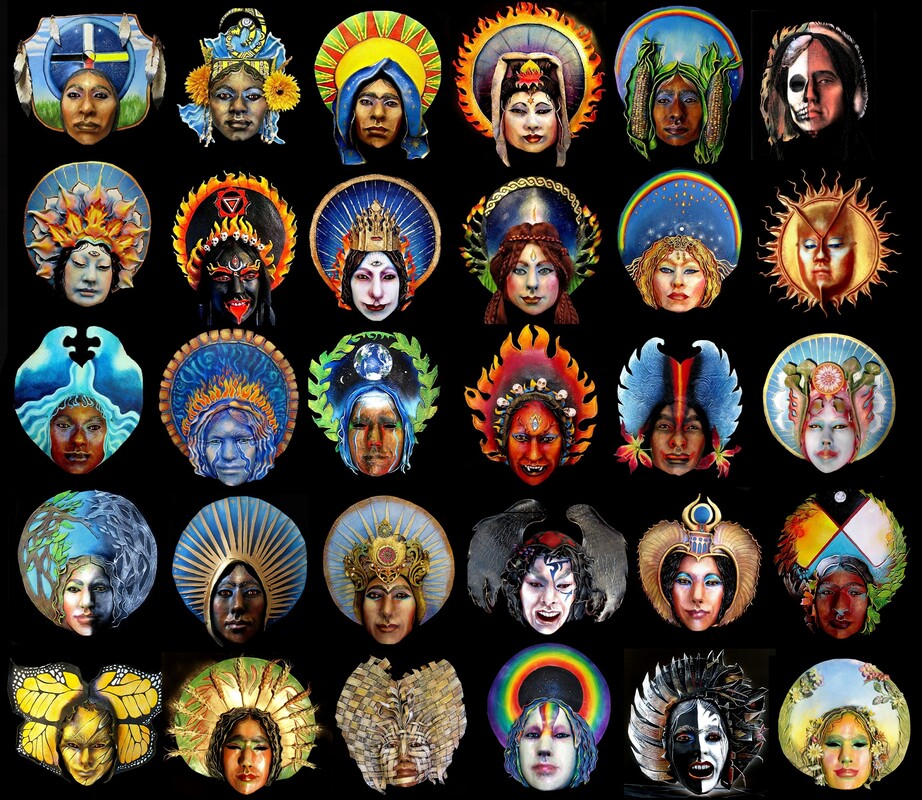
The year 2000 CE saw the first performance of three of Goddesses Alive! using Lauren Raine’s gorgeous goddess masks, in celebration of the late Abby Willowroot’s Goddess 2000 project, at the old Jack Tar Hotel in San Francisco.  This ritual, in a much more polished form, was performed again that December at New College of California (RIP), and had its final performance at the Parliament of the World’s Religions in Salt Lake City in 2015 — one of the great honors of my life.  

One year when it was at the Oakland Convention Center I headed the volunteers.  It was not a good experience for me, sorry to say, since my efforts were stymied by arbitrary interference, to the point where I would never again volunteer there.

Cherry Hill Seminary presented symposia the day before the Con began three or four years, thanks to PantheaCon's Glenn Turner’s offering us rooms in which to hold them.  One year we even managed a CHS hospitality suite shared with the House of Danu.

Our Predecessors
In 2008, we did a Besom Brigade -- thank you, Steven Posch -- in the DoubleTree lobby.  


My “Growing Pagan Elders” study was rejected three years in a row, for reasons unknown.  I had originally conducted this study for presentation at the Claremont Conference on Current Pagan Studies, and I’ve been paid to present it elsewhere.  It was a lot of work and was about something we as Pagans were facing as our movement matured.  I got over 700 responses on my open-ended survey on Survey Monkey.  By “open-ended” I mean I left lots of space for narrative,

Finally, after three years, I was given the 9 am Monday time slot, when everyone has left or is preparing to do so.  So who was sitting in my very unsexy presentation that year?  Margot Adler, Selena Fox, Ivo Dominguez, Michael Smith, Amber and Azrael K, and other leaders, so I guess it was interesting enough for them.  Hmm, do I sound bitter about that?  

After that I quit submitting proposals, except for sitting on a panel now and then, and just attended so I could visit old, seldom seen friends, attend a ritual or presentation as they interested me and if they were led by a friend – in which case I knew they’d be good.

Some years I was away at another Pagan gathering the same weekend.  Last year I didn’t go because of the furor and dysfunction.  

This year I was given the 7 pm Friday evening time slot, a time when many had not yet arrived, for another unsexy talk on creating Pagan infrastructure called “Have Paganisms Gone Mainstream? The Spiritual Meets the Secular.”  To my surprise, we had a full house, a double room that was one full room and about 1/3 of the spill-out room, maybe 50 people.  Of course, I forgot to ask someone to take photos and forgot to pass around a sign-up sheet.  Discussion was so lively that Con staff had to throw us out of the room for the next talk, and I got lots and lots of positive feedback throughout the rest of the Con.  Very satisfying.

I do applaud and appreciate Glenn for creating these opportunities to create Pagan culture.  'Back in the day' that creation and cross-fertilization was done in the context of outdoor camping festivals, especially in the South and Midwest.  My theory about why there were so few on the West Coast was that we are already liberal and accepting and don’t need to sneak off for private meetings where we weren’t jeopardized by the threat of outing.  PantheaCon has played a major role in the cross fertilization and evolution of contemporary American Pagan culture.

Tuesday, February 05, 2013

Claremont Pagan Studies Conference - II

Day Two, Session Five, was a panel on Bringing Pagan Sensibilities into Classroom Pedagogy, and featured Zayn Kassam, Jennifer Rycenga, and Dorothea Kahena Viale. 

Jennifer Rycenga's talk, "Richard Jeffries and F.C. Happold: The Presumption of Nature's Naïveté," introduced us to the work of English nature writer and mystic Richard Jeffries.  She quoted some beautiful passages of his soul's awakening from The Story of My Heart. available online at Project Gutenberg.

Dorothea Kahena Viale described her current teaching innovations at Cal Poly-Pomona using art, movement, and rhythm in "Drumming, Dancing, Masks and Circles in the Academic Classroom"

The next panel was on the Pagan History Project, an idea that arose out of last year's conference.  Armando Marino (Murtagh anDoile) initiated this project, and he and I have discussed it in interim -- I did not attend the conference last year -- with a plan to join our resources for the enrichment of the effort.  Tagh emerges from NECTW in New England while I emerged only a few years later on the West Coast.

In Tagh's talk, "Reconsidering Magic and Witchcraft in America Before Gardner: Grandmother Stories Reconsidered, or 'Don't Throw out the Baby with the Bathwater," he spoke of the emergence of Craft in the 1950s, its flowering in the 1960s; how groups adopted such things as working in circles, watchtowers, and a divine dyad to give themselves some sort of legitimacy; and how they became progressively more secretive.  The people he spoke of were Lady Gwynne/Gwen Thompson (Phyllis Healey, d. 1986), her grandmother Ariana Porter, and the influences of Spiritualist Emma Hardinge Britten, folklorist Charles Godfrey Leland, anthropologist Margaret Murray, James George Frazer, and Aleister Crowley.  He cites the appearance of The Rede after Doreen Valiente in 1964, and also the research of Robert Mathiesen.

Sabina introduced each speaker and moderated this panel.  When it came time for my presentation, "Elders and Oldsters, Ancestors and Teachers," she gave such a glowing introduction I was stunned and surprised, especially by the applause the followed, even before I spoke.  This provided me the perfect opportunity to preface my talk by telling why and how I happened to be there that weekend.  I said I'd been invited by some of the organizers, and helped in the effort to get there, because, as they told me, they sympathized with how rootless I'd been feeling since cutting myself off from my long-time community and they wanted me to know that they, too, were one of my communities, and that they appreciated and loved me.  I was deeply touched.  You can see why this weekend was restorative and healing for me.

Sam Webster followed with "Theurgy and the Ancient Origins of Today's Pagan Religion," in which he spoke of Iamblicus, Agrippa, and the Golden Dawn; theurgy = possession, channeling, drawing down, aspecting, from the Chaldean Oracles; anagogy = ascending into "the one"; solar worship = ascending into the light); and photogogia = bathing in the light.

With all of these presentations, information I wanted to note was coming fast and furious, thus what I was able to capture is frustratingly limited.  Also, many presenters had more slides in their Power Points that time allowed, so they were forced to omit stuff and they rushed the slides along faster than note-taking could accommodate.

Part III to follow shortly.


Wednesday, June 29, 2011

Growing Pagan Elders: An Exploration of Sustainability


I began exploring the notion of Pagan elders about 15 years ago when the then-editor of The Green Egg asked me to write an article. I'm pleased to say that the article made it into the Green Egg Omelette, an anthology of the best of GE over the years.

In the Fall of 2010 I created a survey on Pagan attitudes about elders on Survey Monkey. Between then and January 2011, 627 Pagans responded to that survey. I allowed plenty of room for comments. This volume of responses allows us to begin to assess how Pagans feel about this subject.

I come to this subject from personal motivations.

As Carol Christ has said, and as I have often repeated – and I paraphrase -- it’s not enough to reject the ways we have been given if we find them unsuited to who we find ourselves to be, because in times of stress we will turn back to those ways. Rather, we need to create effective alternatives. That was one of the motivations for our writing The Pagan Book of Living and Dying, and it is my motivation in exploring the notion of Pagan elders.

I believe that in order for a community to be sustained, it must include the full spectrum of ages, from the ancestors to the unborn. In between, babies, children, youth, young adults, parents, and elders. Elders may simply be older members of a community. Or there may be an acknowledged group of individuals who play a more formal role in community life.

We Pagans often speak of ourselves as belonging to a tribe, and in the broadest sense I feel that way, too. But we are not like the tribes of our Native American contemporaries or of our (mostly) European, African and Asian ancestors. Pagan groupings are not like the clans of the Celts or the tribes along the Rhine; not like the villagers in Tuscany or Malta. We lack a common familial ethnicity, mores, lore, culture, foods, songs. We contemporary Pagans do, of course, share lore, music, customs, and a language, but not nearly to the degree that tribes do.

We arose primarily from the counter-culture. We were seeking meaning and connection in a rapidly modernizing, culturally diverse, and frequently socially fragmented world. In essence, we sought a tribal identity. And we found it -- only the state in which our tribes find themselves is inchoate, rudimentary, immature, not fully formed. We lack the cohesion of a tribe.

If a tribe is
a social division in a traditional society consisting of families or communities linked by social, economic, religious, or blood ties, with a common culture and dialect, typically having a recognized leader : indigenous Indian tribes | the Celtic tribes of Europe.
then you can see that we are missing several characteristics of tribe, while others exist in a rudimentary form.

When I was “coming up” as a Witch in the San Francisco Bay Area in the 1970s and ‘80s, there were few real distinctions made among traditions and few elders. We were all Witches. Some of us were Faery Witches, some NROOGD, Garderians, Alexandrian, Georgian, Majestyc, Tower Family, and plenty of unspecified. The only “elders” of which I was aware were Victor and Cora Anderson (Faery, now spelled Feri) and Grandma Julie of the Tower Family.[1]

In my particular case, I had been doing ritual and magic with a coven, Holy Terrors, and a larger, more public group, Reclaiming Collective, until after some years this particular style of Craft grew to become a tradition in its own right, called Reclaiming.[2]

Well, a few years down the line and matters began to arise that called for the involvement of what, for want of a better term, one might call “elder.” As a member of CoG who met the criteria CoG sets for the issuance of Elder credentials, to wit: “capable of perpetuating the tradition,” I have long held CoG Elder credentials. I officiated at weddings, memorials, baby blessings, etc. I think this criterion is a valid one, but it leaves the matter of what knowledge, skills, and characteristics an elder must have up to the covens and traditions, since CoG is primarily a federation of covens rather than individuals.

But I wasn’t very old, only in my 30s.

I never felt I had anywhere to look, anyone to consult, when difficult community matters arose, not to mention when I had questions about my own psycho-spiritual experiences encountered during the development of my personal and group practice of Craft.

What happened was that I gradually accrued a circle of friends, a series of friendships, with co-religionists I liked, respected, and admired. They were not necessarily from within my own tradition, although frequently they were. Most were active in other Pagan communities, so they had a similar set of experiences upon which to reflect and proffer conclusions, yet were not directly involved with some of the things about which I sought counsel.

These same individuals reciprocally consulted me about matters in their own communities.

For the most part, that practice has worked well. But it’s not appropriate for many matters. For instance, when someone within one’s community (using the term “community” very loosely) feels an injustice has been done, or that someone else has behaved in an inappropriate manner in the context of community work. In the case of Reclaiming, that might be about something someone did or that happened at a WitchCamp or in a class or public ritual.

One of our attempts at addressing such issues is to have a “listening circle. This is especially helpful if there are two or more parties to a dispute and only one of them wants to resolve it. There is, or at least has been, no way to compel anyone to come parley. Yet if there remains someone who feels dissed, unheard, disrespected, or in some other way offended or transgressed upon, I do not think it’s helpful to disregard that person’s, or those people’s, grievance. In such cases, the aggrieved party seeks out others from within the trad whom she sees as fair, and asks them to sit in a listening circle. Those sought out are always people who have been part of the particular tradition for a long time, often since its beginning. I am unaware of any young people having been asked to serve in a listening circle. All of which is not to say that those sitting in the circle are Elders, per se.

These listeners usually reflect back to the offended what they hear, and perhaps offer suggestions of either coping or eventual resolution.

Listening circles do not have the authority of something like a panel of judges.

How do we assure accountability for one’s actions within a trad? Is this a function of elders?

There is also the option of mediation if both parties to a dispute wish to resolve it. In that case, an outside professional may be hired. Alternatively, a group of three to five specially selected “elders” might sit in discussion. Discussion usually opens with some informal ritual, lighting a candle, setting or creating sacred space – such a conference may be done in the context of a sacred circle – or with a prayer or solicitation to a particular deity.

This whole question of Pagan elders is an open one, and will remain so for years as we grow our communities and work to keep them healthy. I have suggested some of the criteria that's been used, or might be used.

The elephant in the living room is what happens to Pagans when they grow old and less able to care for themselves. Should we consider gathering funds for their care as many communities do? Should we begin establishing homes or retreats or other places where we can house our elders in comfort as well as assuring them space at our gatherings and in our homes?

Although this is a subject for another blog, and much, much more discussion, I believe, as I said early on in this blog, that if our communities are to survive and thrive, we need to address the notion of elders, both as a precious resource that can contribute and enrich our lives, and as a group we need to assist as they age.

* * * * *

[1] Today there are several lines of Faery and at least two lines of Tower Family.

[2] Some consider Reclaiming to be a line of Faery/Feri.

Sunday, August 19, 2007

Oldsters & Youngsters

Earlier in the month at MerryMeet in Massachusetts, Laura "Spellweaver" Wildman-Hanlon organized a conversation between long-time Pagans and younger Pagans. The older folks, myself among them, were mainly Witches. The younger folks included both teens who were brought up in Pagan families and college students from U-Mass' SPIRALS Pagan student group. The latter were people brought up in more conventional households.

I learned a lot and left feeling optimistic about our survivability as a religious movement.

I had the pleasure of meeting a younger, though neither teen from a Pagan family nor student Pagan, Cosette from Miami (a member of Everglades Moon Local Council* of CoG), as well as the teen children of Ariadne (I think of her as Ariadne even though now she goes by her give name of Lisa) and Macha/Rachel (not me). Ariadne is a long-time member of of CoG active in the Antelope Valley of California, formerly of Orange County** Local Council.

One of the highlights of this discussion, for me, was hearing Joan C. tell about her early exposure to Witchcraft in Boston. I knew her about 30 years ago when she lived in the San Francisco Bay Area, and have had the good fortune to reconnect with her on my occasional broomstick trips to Western Massachusetts. She participated in a workshop on death and dying that I facilitated at Mary Colleen McDougall & Ted Tarr's late Tarr & Feathers store in Greenfield. (Also got to chat with Mary Colleen & Ted at MM.) Then in March '06 I learned that she's a member of Apple & Oak Coven, of which Laura Spellweaver is High Priestess. I hope the younger Pagans were as fascinated by her tales as I was.

Another highlight was hearing from a young college student about how he and his spiritual beliefs are accepted in his fraternity.

I should mention that this discussion was deftly facilitated by Thea Collins, author and faculty member at Cherry Hill Seminary.

A few months earlier I'd been asked by Ariel Monserrat, the new editor of the revised Green Egg, to write something about elders and eldership. Being pressed for time, I reread an article I'd written on the same topic for the same publication back in 1996. I felt it held up to the passage of time, so resubmitted it. It appears in the Beltaine 2007 issue, which also contains lots of

I don't have enough time to keep up on all the endless discussions about elders and eldership that seem to be taking place everywhere I look. I know Druid Michael Gorman , whom I featured on a panel discussion at PSR last year, wrote one in a recent GE, and I'm aware that the legendary GE Forum has been host to lively discussion on those topics. I also notice that PanGaia magazine has been publishing articles and discussion about elders.

It's always been a topic of interest to me, perhaps because we had so few when I was new to Paganism. I could probably name the ones I knew or had heard of on one hand (at least here in California): Victor and Cora Anderson (Feri/Faery); Grandma Julie Tower (Tower Family); George Patterson (Georgian). Other friends grew to become elders during the time I knew them: Judy Foster (NROOGD); Alison Harlow (Feri/Faery).

I've always maintained that until the full spectrum of human lives is included within our ranks, we are merely a club, a clique or a fad. By the full spectrum, I mean the unborn, the babies, the children and youth, the adults, the elders, and the ancestors. If Paganism is to survive -- I believe it will -- it must reflect all the stages of life, and have a place or places for everyone in our communities. This leads to a whole different discussion beyond the scope of this little post.

In any case, I continue to ponder where we're going. I look at other cultural phenomena and see how they sustain themselves, and how they regard elders. I love history. I find it such a rich resource of observations about human nature, human behavior, human strengths and foibles.

Shorty after I came home, I received an email from a young Pagan named Gwinevere Rain, editor of Copper Moon E-Zine: A Witch's Publication for Teens and Early Twenties, an online zine in which I was interviewed a few years ago. She reminds us that Copper Moon is alive and seeking to serve younger Pagans:

Copper Moon is an online blog magazine for Wiccan/Pagan practitioners in their teens and early twenties. Our features include eye-opening author interviews, articles, book reviews and more! This interactive site enables readers to comment on individual articles, subscribe through e-mail or in a RSS reader! Our aim is to have at least one new article or book review up each week. Since 2002 we have been providing a venue for young practitioners to express their opinions and have their writing showcased. If you are 13 to 26 we'd love to read your submission. Thanks for considering Copper Moon, one of the leading publications for young adult Wiccan/Pagans on the web.

* In fact, in addition to the two EMLC folks I already knew to be fun and standup and honorable, Canu and Rayna, I met several other cool folks from that LC: Coral Tran, Lord Cuchulain, and Lord Coyote, who happens to share a Pisces birthday with me.

** Here's a fascinating tidbit: Orange County is a conservative Republican area of California, yet Cherry Hill Seminary has more students from Orange County than from any other single region of the country. Go figure.