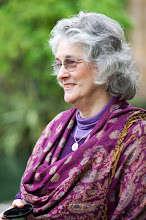
About a year ago I happened to run into a friend when I attended a panel sponsored by Compassion in Dying (now Compassion & Choices). A primary speaker was Barbara Coombs Lee, Chief Petitioner for Oregon's Death with Dignity Act and a woman who has frequently testified before the U.S. Congress on end-of-life issues. I'd met this friend, Susan Stern, in some of the first circles to which I was invited back in the 1970s; we hadn't seen each other in years. When I inquired what brought her to this event, she told me of her father's death on July 5th of that year, just a few months earlier, and how he'd left a video for herself and her sister. She was there as part of her research for the film she was making with this material. The result of Bob Stern's gift to his daughters is The Self-Made Man. So even though I was unable to attend the film's debut screening, I was delighted to know that it had been completed. Not only done, but done so well it's up for an Emmy.
I finally had an opportunity to watch this film last night on our local PBS station, KQED. Susan has built the story the around her father's amazingly pragmatic decision to cut his losses and spare his family and himself the aftermath of cardiac surgery, and more perilously, advanced prostate cancer, by taking his own life. But, just as Susan had told me at our fortuitous meeting, before he did this, and as part of his process he discussed it with his wife Adele and son Mike, and, left a videotape for his daughters, Laura and Susan. Featuring interviews with family, old friends and eventually grandchildren, voiceover ruminations by the filmmaker, and a synopsis of Bob Stern's self-made, and financially bountiful, life, The Self-Made Man offers a personal insights into the timely issue of 'conscious self-deliverance.' Filmmaker Susan Stern , her family, and especially her dad, have given us a beautiful, thought-provoking and compassionate film.
Bob is all the more remarkable for having been a pioneer in the field of solar power in California's Central Valley. Thus, his life had great meaning on many scores, meanings that live beyond his mortality.
As an advocate for choice in matters of living and dying, I cannot recommend this film more highly. Here is a schedule of airings on PBS' Point of View.
Susan is also the producer of Barbie Nation: An Authorized Tour.
Wednesday, September 27, 2006


Monday, September 11, 2006
Nobel Peace Laureate Inspires

Last night my friend and colleague Malendia Maccree and I went to Angelico Hall at Dominican University here in my town to hear a talk by Shirin Ebadi. She spoke to a full house of 700 on the topic of "Human Rights, Islam and the West."
I was delighted to see that she was introduced, in Persian, by my colleague in the Marin Interfaith Council and on the Board of Directors of the Foundation for the Advancement of Women in Religion (NAWR), Dr. Nahid Angha, founder of the Sufi Women Organization. The enthusiastic crowd greeted Ms. Ebadi with a standing ovation when she first stepped onto the stage, once during her talk, and at the conclusion, with many bursts of applause throughout the evening.
During the Q&A afterwards, one question was what she'd tell George Bush about Iran if she were to meet with him. She answered, ""I would suggest to him that he not be president anymore." Full report in Sunday's edition of the Marin Independent Journal.
Afterwards, Malendia and I chatted in the lobby with a few of the folks I've met through MIC, before buying her book, Iran Awakening: A Memoir of Revolution and Hope, which Ms. Ebadi autographed.
Only Sunday morning did I realize I had blown another interfaith event I'd intended to experience. Tibetan monk Losang Samten created a sand mandala of the 2,500-year-old Wheel of Life design at the Marin Center Exhibition Hall. On Saturday he swept it away and disbursed it in the lagoon. I'm really disappointed I missed it. The only other one I've seen was in the late '90s when my friend Pitch and I went to see the Tibet exhibit at the old De Young Museum in Golden Gate Park.
Cool Online Lecture

About six months ago I got the idea that if we, meaning Cherry Hill Seminary where I chair the Public Ministry Program, were using educational software to create cyber classrooms, we might as well expand our virtual campus with the addition of a lecture hall. I'm delighted to say that our initial foray was a great success.
I think tonight’s lecture started the series off with a bang. Beginning with Mary Windrider Bowerman’s gracious introduction, followed by Chas Clifton's fascinating presentation, and ending with provocative Q&A, it went off without a hitch. Chas had posted some excellent resources which he referenced in his talk. We had no delay with Chas dial-up connection, nor did anyone get bumped from the chat even once.
I found Chas' three divisions of "Nature religion" -- cosmic (astrology, 15th century CE European "natural magic," observations and celebrations of the seasons in the Wheel of the Year); Gaian (Earth as sacred being or embodied goddess, ecological point of view); and erotic or embodied (knowledge of the sacred comes from experiences perceived through our bodies, the sacralization of sex) -- a clear, insightful way to view our movement.
I urge you, dear reader, to consider attending next month’s lecture by Patricia Monaghan, one of the foremost goddess scholars in the world. Drawing from her book, The Red-Haired Girl from the Bog, Patricia’s topic is "The Celtic Path: Spiritual Geography and the Irish Goddess."
The map of Ireland is also the map of the year's progression through the seasons and the related festivals. Each province is also connected with several important goddesses, with the island itself named for the goddess of the center, Eriu. Experiencing the spiritual geography of Ireland offers an opening to examining the spiritual geography of other lands as well.
My thanks to all who participated, especially Chas, for diving into these mysterious waters and playing together. May word of this offering spread around Pagandom and may we be joined by many others on October 8th.
Monday, September 04, 2006
Voices from the Other Side

It's obvious that the nights are lengthening and Autumn is approaching because I seem to be drawn to reflecting on old friends who've crossed over. Not necessarily friends who've left recently, either. Raven died in 1986 and came to mind -- well, he frequently comes to mind, mine and the minds of many others -- because his and our Shadowfax was dying. Ann Turner died in the '80s and Judy Foster in 2000. When Corby and I visited Ireland in 2004, our friend, linguist Jim Duran (Séamas Ó Direáin), now living in Galway, told us of the death of my old friend Padraigin McGillicuddy.
I have no photo of Padraigin. I can find nothing on the Web except references to her old radio show, "A Terrible Beauty," on KPFA. What I do have is fond memories.
Padraigin used to live in a huge old Victorian in Oakland, said to have been the childhood home of Gertrude Stein. She who is said to have said of Oakland, "There is no there there." I can't say what Oakland was like in the late 19th century when Gertrude lived there, but I find plenty there now.
Padraigin had a son named Sean Peter who died tragically some years ago, by his own hand. Our mutual friend, harper Sharon Devlin Folsom tells me that Padraigin's daughter, Kerry McGillicuddy, is an athlete, perhaps a phys ed teacher, a personal trainer or a coach. A Google search netted me the information that she used to be the recreation director of LYRIC and that she recently has been a women's basketball referee.
I'm mentioning all this detail because two people have contacted me about Padraigin. One has some family photos she'd like to give to Kerry. The other would like permission to reprint material from Padraigin's booklet, The Patriarch Revealed: A Feminist View of St. Patrick (1981). And speaking of the departed, another old Institute of Celtic Studies friend, Ken Ruffner, did the artwork on the cover and inside the book.
In the meantime, I've tried contacting another contributor to the book, Bob Callahan of Before Columbus Foundation and the New College Irish Studies Program to seek permission and to see if he can help me locate Kerry. If you have any information about Padraigin or Kerry, please contact me.
Tuesday, August 29, 2006
Music & Healing & Dying
Last week I attended a workshop given by Hospice of Marin for "Marin clergy and spiritual leaders," meaning I got the invitation by way of the Marin Interfaith Council. Hospice of Marin is the oldest hospice on the West Coast and second oldest in the country, to Connecticut. They must have a good source of funding because they recently moved into some mighty fancy digs. They outgrew their former building.
What a caring, dedicated group they are! I've met some of the hospice workers at MIC events. I've always considered people who do that work to be saints, or at least 'saintly,' even though we Pagans don't exactly have such a category of mortals. In any case, besides hospice care, MIC provides grief counseling and offers educational programs, like the one I'm writing about, to the communities they serve. They've expanded to serve Sonoma County, San Francisco County and part of San Mateo County.
The workshop included a presentation by Kathy Speas, a member of the Threshold Choir, a group of women who sing at the bedsides of dying people. (For some reason their website is down; I provide this link in case it's fixed by the time you read this. If it's not, you can read more here.) The Threshold Choir itself is about 15 women, but only two or three go to individuals; more could create too much commotion in a place where a peaceful atmosphere is best. They have some CDs available for purchase.
Another group that ministers to the dying through music is the Chalice of Repose: The Voice of Music-Thanatology.* Based in Missoula, Montana, but having centers in various cities around the world, Chalice of Repose offers harp music for the dying.
My friend Evergreen Erb, a Reclaiming Witch in Vermont, also does harp therapy to aid healing and to ease dying. She's a member of the International Harp Therapy Program; her magical harp can also be heard on some Reclaiming CDs.
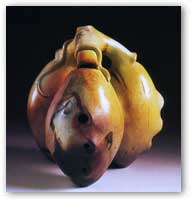
The other speaker at the workshop was Maryliz Smith. (Her website does not appear to be working either.) Maryliz commutes from Marin County to Vancouver to work with cancer patients at the Callanish Healing Retreats Society; her bio is here. She played for us a triple ocarina. Ocarinas have been around for 12,000 years nearly everywhere humans have lived, but this was the first triple one I'd seen. One chamber plays a drone while the other two can be played by opening and closing the finger holes. At first I thought the sound was celestial, but as I listened I realized that it had the sound of wind in caves. I pictured Hekate leading Odysseus down into Hades, hearing the songs of shades in the darkness. The sound is engendered by the element Air resonating inside the clay of Earth. I want one! So far, the least expensive one I've found is $350, so if one comes into my possession, it ain't gonna happen anytime soon.
During the socializing at lunch, several of the people (one man, maybe eight or nine women) expressed frustration with their choir directors, pastors and rabbis because they'd found them to be inflexible about what music was appropriate to play for funerals and memorials. These women felt that using music that was meaningful to the deceased and her or his loved ones was important, even if traditional liturgical music were part of the ritual. Too frequently they'd met with opposition to this from those they'd most expected to want to care and help.
I could only nod my head, thinking of how creative we Pagans are when it comes to any kind of rite of passage. We are free to use what works best for us, regardless of whether it's considered secular or sacred. In my opinion, using secular music in a sacred manner sanctifies it. Nearly every day I'm reminded how great it is to be Pagan.
* Thanatology is "the scientific study of death and the practices associated with it, including the study of the needs of the terminally ill and their families."
Saturday, August 19, 2006
Bringing Reclaiming Back into the Circle
Since I'm having trouble posting comments to The Wild Hunt, I've decided to just take the discussion over here.
Regarding Reclaiming's flaws, Andy sez:
Again, I realize Andy is talking about British Reclaiming (and by extension presumably Avalon WitchCamp), about which I know next to nothing. I do know that the lovely Ann Flowers has also felt frozen out, so maybe there's something to look a there. I'm only speaking about the larger, and vaguer, Reclaiming identity, not about the health or dysfunction of any particular Reclaiming-identified entity.
It seems a natural human phenomenon to fear change. I don't think it's a healthy attitude, and I share it myself at times, but I do think it's part of the human condition. The only thing we can be sure of is change. I remind myself that, "She changes everthing She touches, and everything She touches changes."
I've experienced some of the disillusion and hurt that Andy seems to be experiencing now. In defense, I can only say, from my longer-range vantage point, that we're human. I, for one, am sticking around.
Regarding Reclaiming's flaws, Andy sez:
There are too many sheep, too many shepherds for an organisation which (a) shouldn't be an organisation and (b) repeats ad nauseum that it is non-hierarchical when it clearly is and to anyone who falls outside the walls is visibly dependent on those who look up and those who are looked up to.I don't quite get the "too many sheep, too many shepherds" analogy, since presumably we teach, among other things, self-empowerment, and sheep just follow. Further, I don't see any organization "which shouldn't be an organisation"; rather, I see us as a collective identity rather than a specific group. No one can ever accuse us, or most other Pagan groups, or being organized. >smile< is a hierarchy within Reclaiming, and there always has been. Unacknowledged hierarchy is toxic.
There seem a million and one issues to be looked at and hopefully addressed but for me the problem is that those doing the examination are those who fall within the walls and so all you'll get is a core group of people making changes which others will have to choose to either accept or move on. You will still have 'them and 'us' with some acknowledging that and others pretending otherwise.Many, if not most, of those of us "within the walls," as Andy puts it - I'm assuming he's counting me among the insiders, although I'm not; I've just stuck around all along -- have always been open to the involvement and opinions of others. I've noticed changes having been made -- I could name a few -- but I've only accepted the ones I like and I've ignored the ones I don't like. I know I'm not alone in this attitude.
Again, I realize Andy is talking about British Reclaiming (and by extension presumably Avalon WitchCamp), about which I know next to nothing. I do know that the lovely Ann Flowers has also felt frozen out, so maybe there's something to look a there. I'm only speaking about the larger, and vaguer, Reclaiming identity, not about the health or dysfunction of any particular Reclaiming-identified entity.
For my own part, I now consider myself a solitary Reclaimer - not that I work in isolation, as I find I now work with a wonderfully eclectic group within which are people following different traditions but working together, what a shocker! - and I feel somewhat resentful, I must admit, towards the tight ball of beliefs which make up Reclaiming today, many of which are bolted onto its original values.Again, differences in perception, I guess. I have always worked with Witches of different traditions. In fact, there have often been Witches of different trads, and even non-Witches >gasp!<, involved in the annual Spiral Dance Samhain ritual in San Francisco. In my observation, magical working groups form more around friendships and interpersonal compatability than around a given tradition.
British Reclaiming, certainly, is making little if any difference to wider society. I believe it makes no difference whatsoever and if it grows, it grows so slowly as to make demands for it to be reappraised worthy of being listened to and acted upon. But they aren't. There is no stomach for change. It's too cosy, too much of a club.First, I don't see growth as an important goal. If the Craft grows, it does. If it doesn't, it doesn't. What I would like to see expand, however, is an attitude of respect towards the world and its inhabitants and workings, an awareness of our interconnectedness and interdependence, honor and love for Earth. It doesn't matter to me whether people are Witches or not. Christians, Buddhists, Hindus, atheists, anyone, as long as they can appreciate this interdependence.
It seems a natural human phenomenon to fear change. I don't think it's a healthy attitude, and I share it myself at times, but I do think it's part of the human condition. The only thing we can be sure of is change. I remind myself that, "She changes everthing She touches, and everything She touches changes."
Ask most British pagans and witches, do you know what Reclaiming is? The answer is invariably, what? And, who? After so long a history, it is telling that Reclaiming - with so much to offer on paper, as it were - remains practically invisible here. There are more people involved in strange cults centred around science-fiction novels. Why is that?Does it matter? We Pagans are fringe religions. So what? There's something to be said for moving in the shadows and along the borders. We are, after all, edgewalkers, are we not? Treading the liminal realms. If there are more people involved in scifi cults, that's because scifi is an industry, a commercial venture to sell books, movies, cartoons and gear. They are powered by profit motive and underwritten by corporations with their marketing strategies.
M Macha Nightmare is quite right in that damning line about Reclaiming being 'great for ravers and other energy junkies' - and the question is, can a religious/spiritual collective so dense, so compacted, so self-deluded into thinking it is non-hierarchical when it clearly has become so if it wasn't always, ever stand a chance of renewing and refreshing itself?As I've mentioned above, I admit that there is (unacknowledged) hierarchy within the larger complex of Reclaiming as well as within individual Reclaiming groups, and that that isn't good or healthy. But Reclaiming is anything but monolithic. Otherwise these discussions wouldn't be taking place.
Reclaiming has become a starched monolithic organisation closer to a corporation in its outworkings than a vibrant spiritual tradition.I see no evidence of a corporate structure, in spite of some Reclaiming groups having incorporated and written bylaws, designated (not elected) officers, and acquired 501(c)(3) tax status with the Internal Revenue Service (in the US). I have to laugh because I see no evidence of starchiness anywhere. Maybe a bit of scorching here and there, but everything's pretty loosey-goosey from my perspective.
My own take is that Reclaiming values and principles are sound enough and work for me as an individual. They resonate with truth. It is (some) people I have been disillusioned by. I doubt in the UK whether Reclaiming will ever become anything other than a marginal, near-invisible tradition within the pagan community here. The flaws with its structure are too apparent and sadly detract from the core values when presented to those who might otherwise be drawn towards it but find themselves running in the opposite direction.It seems as though Andy has taken the best of what Reclaiming has to offer and applied it in his life. That's what it's all about. Huzzah!
What's the solution? Well, can any one person say? What I do know is that dissenting, arguing voices are stamped upon more often than not, often treated appallingly unjustly and inexcusably maligned, and while that climate of repression and bullying is condoned and promoted, there seems little hope of seeing an end to the navel-gazing which goes no deeper than the surface.Well, I certainly have observed, and even been victim of, this dismissal of unpopular or unwelcome opinions. That said, I don't agree that it has been universally condoned or promoted. I've spent many hours in meetings while such differences are worked out -- or not. But more often than not the effort is made. Sometimes the 'fit' just isn't right and one or more people come to realize that they might find a better fit elsewhere.
I've experienced some of the disillusion and hurt that Andy seems to be experiencing now. In defense, I can only say, from my longer-range vantage point, that we're human. I, for one, am sticking around.
Thursday, August 17, 2006
Brief Break for Reminiscing
Back in the early '70s I worked at a place called the National Center for Experiments in Television in a warehouse down at 7th and Folsom in San Francisco. NCET was at the cutting edge of the new medium of video art. The Ford and Rockefeller grant money that funded this artistic endeavor was admistered by KQED, one of the three most respected stations in the PBS network (with WNET in New York and WGBH in Boston) -- back when public television really was public television and not the wimpy corporate toady it's become now. Now so much of the programming is motivational speakers and music concerts appealing to boomers. Nothing to upset the current administration, that's for sure.
Anyway, the PR person at NCET and I grew to be good friends. Her name was Ann Turner, later called herself Anna Mystic when she and Stephen Hill broadcast Music from the Hearts of Space from the KPFA studio very late at night.
Ann had asked me to let her know when I went in to labor. That night, June 10, 1976, I phoned her just as she was about to go on the air. She played music to welcome Deirdre. It was the Full Moon in Sagittarius. We had the radio on in the room but I wasn’t paying attention, obviously.
The following Full Moon in July, I had the show on and I heard this lovely mysterious music. It sounded so familiar. So I phoned Ann and asked her what it was. She told me it was Alan Stivell playing Breton harp music, and checked her playlist from the previous month for the time Deirdre was born in the wee hours of the morning of June 11th. Sure enough, that was the exact thing she’d been broadcasting when Deirdre came into the world.
After Ann left NCET and Hearts of Space, she collaborated with musician Constance Demby. Ann and I had lost touch for some years, until one day some years ago when I was reading "the Irish Sporting Green," i.e., the obituary pages of the paper, I saw that she'd passed away. From the award-winning little Point Reyes Light:
Anyway, the PR person at NCET and I grew to be good friends. Her name was Ann Turner, later called herself Anna Mystic when she and Stephen Hill broadcast Music from the Hearts of Space from the KPFA studio very late at night.
Ann had asked me to let her know when I went in to labor. That night, June 10, 1976, I phoned her just as she was about to go on the air. She played music to welcome Deirdre. It was the Full Moon in Sagittarius. We had the radio on in the room but I wasn’t paying attention, obviously.
The following Full Moon in July, I had the show on and I heard this lovely mysterious music. It sounded so familiar. So I phoned Ann and asked her what it was. She told me it was Alan Stivell playing Breton harp music, and checked her playlist from the previous month for the time Deirdre was born in the wee hours of the morning of June 11th. Sure enough, that was the exact thing she’d been broadcasting when Deirdre came into the world.
After Ann left NCET and Hearts of Space, she collaborated with musician Constance Demby. Ann and I had lost touch for some years, until one day some years ago when I was reading "the Irish Sporting Green," i.e., the obituary pages of the paper, I saw that she'd passed away. From the award-winning little Point Reyes Light:
Stinson resident dies at age 53. A Stinson Beach resident for more than 10 years, Anna Turner died of cancer Aug. 27 at her home. She was 53. A music producer and a writer, Ms. Turner was one of the first writers for KQED's Focus magazine. "She was a very talented craftsman of words," said her mother, Rosalind McRoskey of San Mateo this week. Born in San Mateo, Ms. Turner attended Northwestern University before transferring to UC Berkeley and earning a degree in Journalism. She joined the then-emerging KQED radio and television stations as a writer, McRoskey said, noting that one assignment involved traveling to Mexico to teach people there about American television. Ms. Turner also co-founded "Music from the Hearts of Space" radio program of ambient electronic, multi-cultural music..."In love may she return again."
Wednesday, August 16, 2006
Cooling Down
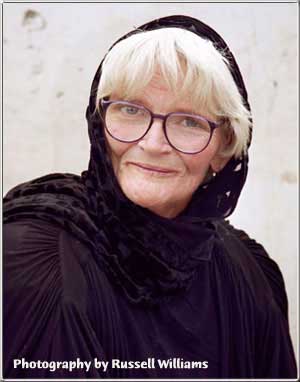
I feel much better tonight after checking out some facts. I'm not leaving this community. I can't be gotten rid of that easily. If that were the case, I'd have been gone long ago. It's not just stubbornness either. I've put a lot of myself into Reclaiming over the years. I haven't been at the center of things all of that time, by choice. But I've been involved. I've contributed and collaborated, consensed and created. I've done grunt work and visible work. I've also griped about what I think we're doing wrong and praised and bragged about what I think we've done right.
When I've done the former, I've managed to upset people who don't want to hear what I have to say, but I can honestly say that I've tried very hard to offer my critiques in as constructive a manner as possible, avoiding ad hominem/feminem attacks. I have my late friend and colleague Judy Foster* to thank for insisting that I hone that skill.
At the same time, every single time I've spoken to something that others might think is an unpopular sentiment, at least one person, and usually three or four, will breathe a sigh of relief and say, "Oh, I'm so glad you said that! I was thinking that and I didn't want to say it. Thank you." Let this be a word of advice for whenever you feel shy or reluctant to express what you think may be an unwelcome cautionary: Say it! If you are working in a trusting consensual manner, you will be heard, and your concerns will be addressed. I have never known this to have any other outcome.
So maybe that's what we're doing now -- reflecting and seeing the patterns that have developed over the last 25 years. Then trying to articulate them in a loving, contructive way.
I don't see Reclaiming, or any other kind of Craft, as simply a launching pad. My friend Cat Chapin-Bishop reminds me of the riddle: "What do you call a 4th degree Witch?" Answer: "A Buddhist." Meaning, of course, that a lot of Pagans leave the path for other spiritual traditions where they can get more training, or go deeper (in their way of thinking). Or find another teacher or guru. I suppose it could be considered a launching pad for people whose true personal path leads elsewhere. But if you make use of what you've learned, Witchcraft becomes a way of life and a lifetime pursuit.
To me, learning Craft gives us the sacred technology(ies) and thealogical framework to then proceed to work it and work it and work it, season after season, Wheel after Wheel. And with each working, we can go deeper, gain clearer understandings, have more profound experiences of the numinous. We can gain insights into the workings of the Worlds and the workings of our own hearts. We can grow in compassion and understanding of our sisters and brothers of our species. We can build a greater awareness of our interdependence on the Web of Life. We can feel our interconnectedness with all of life. We can learn wisdom. We can finder inner peace and the strength to work for positive change in our own lives and in the wider world.
I'm reminded of the words of my dear friend Steven Posch of Paganistan (one of the two best Pagan ritualists in all of North America, IMO):
"Witches' work is turning the wheel,* This rememberance of Judy's life neglects to mention that she is one of the founders of NROOGD (New Reformed Orthodox Order of the Golden Dawn) Witchcraft as well as having been a much-loved member of Reclaiming Collective. I consider her to be among our Mighty Dead.
And round the wheel doth turn."
Monday, August 14, 2006
Priestesses Compare Notes
I'm in shock. Stunned! Nonplussed. I just learned something tonight that probably should have been obvious to me based on my observations of how certain people have regarded other certain people throughout our (Reclaiming's) existence. But not me! I really had no idea. I feel hurt, betrayed, like a stooge, a fool, a dupe. Dismayed, disillusioned, distressed. (The 'dis' my partner Corby used when hearing this is "disgusting.") At the same time, I feel disloyal in feeling that way. Recently I responded to an entry on Anne Hill's blog, saying, "maybe I'm just a slow learner." I feel like that tonight. How could I have missed this?
At the most recent Dandelion Gathering in May when people were calling for the use of the word "action" in the BIRCH statement of intention, I stated that I thought we needed to add the word "reflection." I believe that action without reflection is unbalanced and unhealthy. That magical intent seems to be manifesting. We, meaning those in the greater Reclaiming community who post on lists (specifically Spider, supposedly a WitchCamp teachers and organizers lists, although I am neither), maintain blogs, and otherwise interact in cyberspace, are now actively engaged in discussing our identity; our organization, or lack thereof; our processes, both acknowledged and covert; our strengths and weaknesses; our standards, or lack thereof; our accountability (to whom? to what?); our thealogy; our sacred technologies; our shared values and points of agreement (and disagreement); our ethics. It's not easy.
When Anne posted her first two reflections on the trad, and in particular her unique view of it, I just had to respond. Probably because it has meant so much to me. I was a little uneasy because blogs are so wildly public. Then again, I value transparency in most things, and I'm known for my candor. (In fact, I think that particular characteristic of my personality is what accounts for my shock at the information that was just revealed to me tonight.) Actually, it felt rather liberating talking about all this right out in the open.
Sure enough, though, soon I find my more inflammatory comments quoted on Chas Clifton's blog and on The Wild Hunt.
Anyone interested in following this unfolding may wish to check Oak's Roots Down as well as the above-mentioned Blog o' Gnosis and here from time to time.
Obviously this is an inappropriate medium for me to go into details about the cause of my shock. Besides, I'm still in too much shock to achieve a clear perspective. Suffice it to say that the fact of this distressing situation does not reflect an inadequacy on my part. One thing that is clear to me -- and that was stressed by my informants -- is that evidently my habit of questioning the status quo, or certain individuals, authority or assumptions, threatens some others.
At the most recent Dandelion Gathering in May when people were calling for the use of the word "action" in the BIRCH statement of intention, I stated that I thought we needed to add the word "reflection." I believe that action without reflection is unbalanced and unhealthy. That magical intent seems to be manifesting. We, meaning those in the greater Reclaiming community who post on lists (specifically Spider, supposedly a WitchCamp teachers and organizers lists, although I am neither), maintain blogs, and otherwise interact in cyberspace, are now actively engaged in discussing our identity; our organization, or lack thereof; our processes, both acknowledged and covert; our strengths and weaknesses; our standards, or lack thereof; our accountability (to whom? to what?); our thealogy; our sacred technologies; our shared values and points of agreement (and disagreement); our ethics. It's not easy.
When Anne posted her first two reflections on the trad, and in particular her unique view of it, I just had to respond. Probably because it has meant so much to me. I was a little uneasy because blogs are so wildly public. Then again, I value transparency in most things, and I'm known for my candor. (In fact, I think that particular characteristic of my personality is what accounts for my shock at the information that was just revealed to me tonight.) Actually, it felt rather liberating talking about all this right out in the open.
Sure enough, though, soon I find my more inflammatory comments quoted on Chas Clifton's blog and on The Wild Hunt.
Anyone interested in following this unfolding may wish to check Oak's Roots Down as well as the above-mentioned Blog o' Gnosis and here from time to time.
Obviously this is an inappropriate medium for me to go into details about the cause of my shock. Besides, I'm still in too much shock to achieve a clear perspective. Suffice it to say that the fact of this distressing situation does not reflect an inadequacy on my part. One thing that is clear to me -- and that was stressed by my informants -- is that evidently my habit of questioning the status quo, or certain individuals, authority or assumptions, threatens some others.
Sunday, August 13, 2006
Passion for Poppies
I have a passion for California poppies. When my dad drove our whole family across the continent from New Jersey to California in 1959, our point of entry into the state was at Lake Tahoe in the Sierra Nevada Mountains that proved so daunting to the Donner Party in the snowy Winter of 1846-47.
The month we arrived, however, was June, the beginning of Summer. Besides the deep blues of the lake, the colors that struck me were those bright oranges of the state flower, the Eschscholzia californica, or California poppy, with its delicate bluish-green foliage. This hardy little wildflower blooms everywhere all over the state from April through August, although not in areas where it gets below 20º F at night. I've been enamored of it ever since. It grows in unlikely places. It volunteers in freeway divider strips and vacant patches of dirt as well as covering acres. Wherever and whenever I see their bright orange faces, my day is lightened and I have to smile -- and I don't even much like orange.
I have a few tattooes in strategic places. Most are not visible when I'm clothed. All but one were done by my friend Madame Vyvyn Lazonga. For years now I've been wanting something akin to tribal markings on the backs of my hands, my wrists and the back of my lower arms. Until now I wasn't exactly sure what I wanted them to look like. What 'my tribe' is, I guess. I'd considered the ubiquitous Celtic designs. Vyvyn designed Celtic spirals for my inner left thigh. She put a vivid Kali yantra on my lower belly. As of tonight, I'm ready to get a California poppy design on my hands, wrists and arms. I'm not sure how adviseable it is to tattoo such delicate places that are so full of tiny bones and muscles and upon which we are so dependent for dexterity. I know Vyvyn has a light touch, though, so we shall see.
The month we arrived, however, was June, the beginning of Summer. Besides the deep blues of the lake, the colors that struck me were those bright oranges of the state flower, the Eschscholzia californica, or California poppy, with its delicate bluish-green foliage. This hardy little wildflower blooms everywhere all over the state from April through August, although not in areas where it gets below 20º F at night. I've been enamored of it ever since. It grows in unlikely places. It volunteers in freeway divider strips and vacant patches of dirt as well as covering acres. Wherever and whenever I see their bright orange faces, my day is lightened and I have to smile -- and I don't even much like orange.
I have a few tattooes in strategic places. Most are not visible when I'm clothed. All but one were done by my friend Madame Vyvyn Lazonga. For years now I've been wanting something akin to tribal markings on the backs of my hands, my wrists and the back of my lower arms. Until now I wasn't exactly sure what I wanted them to look like. What 'my tribe' is, I guess. I'd considered the ubiquitous Celtic designs. Vyvyn designed Celtic spirals for my inner left thigh. She put a vivid Kali yantra on my lower belly. As of tonight, I'm ready to get a California poppy design on my hands, wrists and arms. I'm not sure how adviseable it is to tattoo such delicate places that are so full of tiny bones and muscles and upon which we are so dependent for dexterity. I know Vyvyn has a light touch, though, so we shall see.
Saturday, August 12, 2006
Blog Is Blooming
The blogosphere is blooming with analyses of Reclaiming over at Anne Hill's Blog o' Gnosis. I've spent way too much time this week holding forth on Spider (Reclaiming's internal, i.e., organizing, list), the CoG members lists -- MerryMeet, in Ft. Lauderdale this year, is fast approaching -- and on the Cherry Hill Seminary Executive Committee list -- Fall semester is upon us, also a brand new Fall online lecture series. To the neglect of this little blogspace. If you've missed me, that's why. I haven't been idle, just elsewhere.
I'm really excited about the lecture series. We've lined up four outstanding speakers: Chas Clifton, Patricia Monaghan, Sabina Magliocco, and Nikki Bado-Fralick. This is a great way to check out some of the fine teaching we offer and to try out our Moodle classroom software without making a long-term commitment to CHS. Maybe if you like it, you'll consider enrolling in one of our programs. Or encouraging your friends to do so.
I'm really excited about the lecture series. We've lined up four outstanding speakers: Chas Clifton, Patricia Monaghan, Sabina Magliocco, and Nikki Bado-Fralick. This is a great way to check out some of the fine teaching we offer and to try out our Moodle classroom software without making a long-term commitment to CHS. Maybe if you like it, you'll consider enrolling in one of our programs. Or encouraging your friends to do so.
Friday, August 04, 2006
More Besom Fun
My friend Anna Korn, one of the late Gwydion Penderwen's five widows, currently married to Don Frew, recently visited Scotland where she found a gift for me. It's a coaster printed with the Scottish definition of "besom," to wit:
Here's a source for traditional besoms.
P.S. This program has bugs; it refuses to return the font to normal size and it insists on italicizing the block quote. All this in spite of the fact that the html code is correct and it shows correctly on my screen. Curses!
besom (biz-um) bisom Dialect, chiefly Scot. ~n. 1. obstreperous girl or woman; female upstart [as in “Dinnae pou’ yer brither’s hair, ya wee besom”]. 2. woman of low moral standing; a hussy (“Thon yin’s a right mucky besom”). 3. broomstick or scourge; any broom made from loose twigs. 4. a comet or its tail.Suits me fine.
Here's a source for traditional besoms.
P.S. This program has bugs; it refuses to return the font to normal size and it insists on italicizing the block quote. All this in spite of the fact that the html code is correct and it shows correctly on my screen. Curses!
Thursday, August 03, 2006
Mom Shakes
Woo-hoo! We were just sitting down to dinner about 8:10 tonight when I felt the floor tremble. I asked Corby, "Did you feel that earthquake?" He didn't, but he did hear the floor creak, like someone stepping on a creaky board. The 11 o'clock news said the earthquake occured at 8:08 pm PDT and was centered in Glen Ellen in Sonoma County, maybe an hour from here. It was a 4.4, followed by three smaller aftershocks about 25 minutes apart. Map and other details here. If you track your mouse over each different zip code, you can see how many people responded; ours is 94901, with 145 responses, intensity III.
I'm excited by earthquakes. Luckily, all I've experienced so far haven't been all that severe. I was way up in Nevada County up in the Mother Lode when the Loma Prieta quake occurred in 1989 so didn't feel it.
I felt a couple when I lived in North Beach back in the 1970s. Once I was sitting in the bathtub and when the quake hit, the water sloshed around; it sloshed around in the nearby toilet, too. When they happened, people would come outside their front doors and look around and ask each other if we felt it. That was way before the Internet with its near-instant official USGS data.
I'm excited by earthquakes. Luckily, all I've experienced so far haven't been all that severe. I was way up in Nevada County up in the Mother Lode when the Loma Prieta quake occurred in 1989 so didn't feel it.
I felt a couple when I lived in North Beach back in the 1970s. Once I was sitting in the bathtub and when the quake hit, the water sloshed around; it sloshed around in the nearby toilet, too. When they happened, people would come outside their front doors and look around and ask each other if we felt it. That was way before the Internet with its near-instant official USGS data.
Tuesday, August 01, 2006
Starwood Virgin
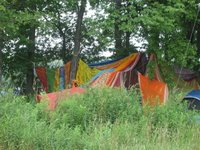
I was a Starwood virgin. No, more, though. I had a fabulous time. Loved the liberated feeling of living in an un-PC environment with 1400 other freaks for several days. I have a lot more to tell, but for now, here are some photos (sans humans) to give you an idea of the site and size:
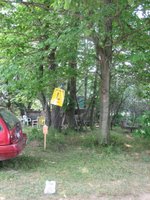
A workshop area.
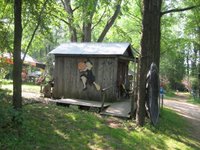 On the way in.
I happily ran into two other California friends, Richard Ely and LaSara FireFox. Among the three of us, we represented the three counties just north of San Francisco: Marin, Sonoma and Mendocino. Starwood was a likely scene for all of us. Both Richard and LaSara had been there before. The down side was that we barely found time to talk.
There are lots more photos here.
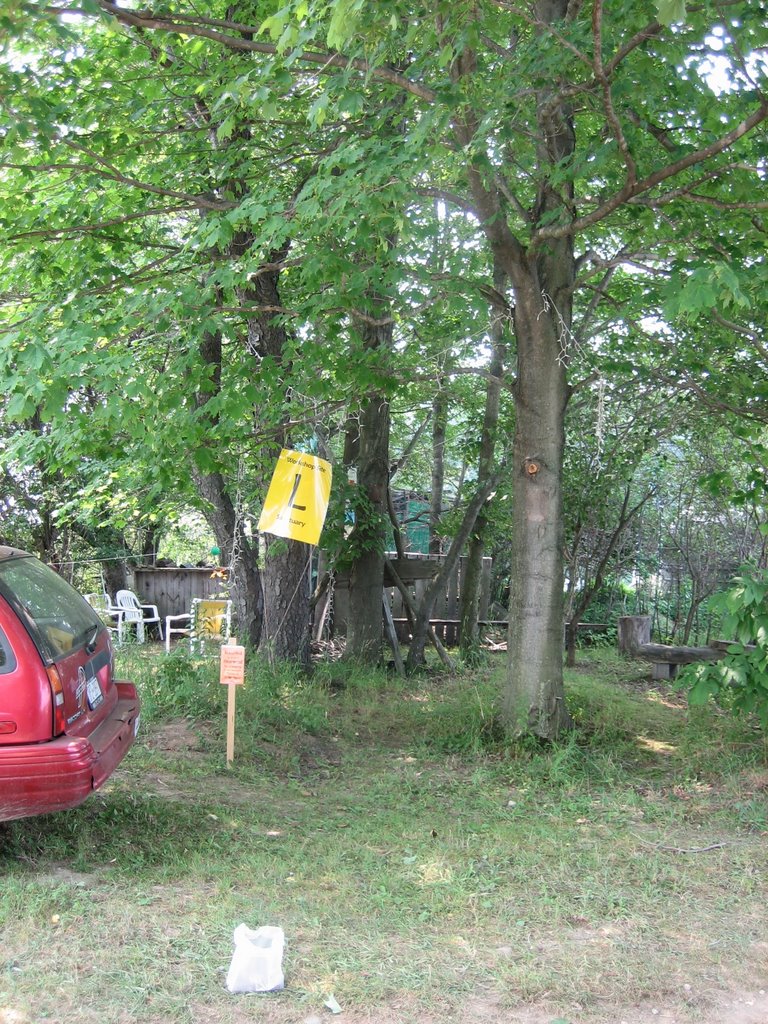
A workshop area.
 On the way in.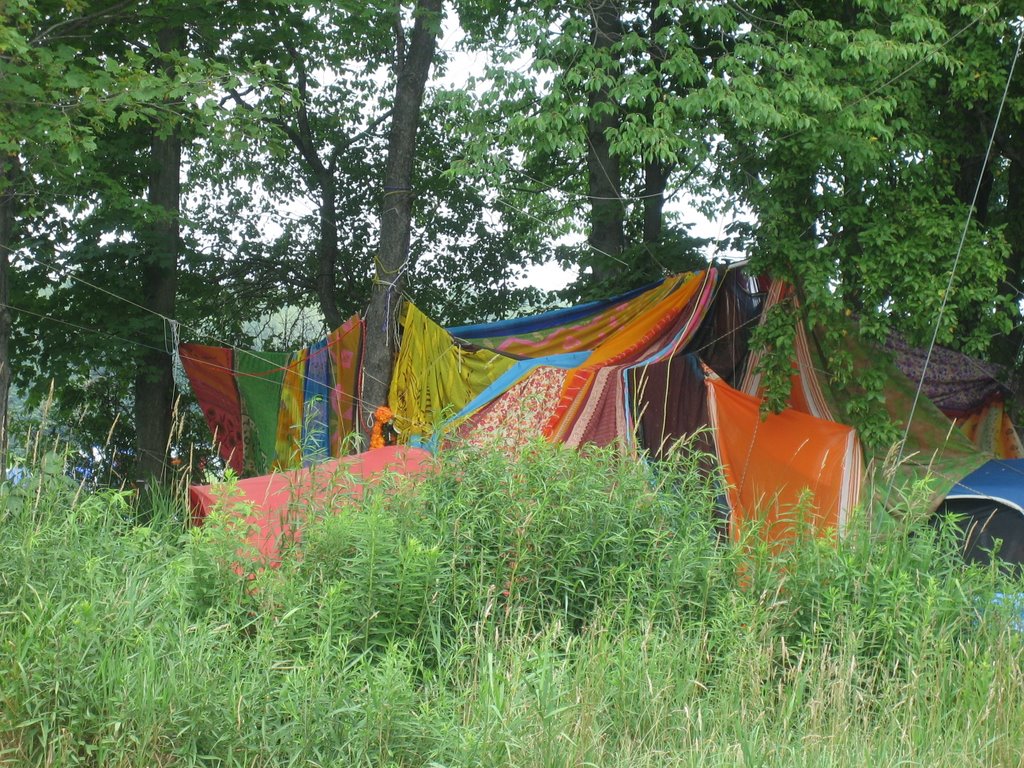
Gypsy tents.
I happily ran into two other California friends, Richard Ely and LaSara FireFox. Among the three of us, we represented the three counties just north of San Francisco: Marin, Sonoma and Mendocino. Starwood was a likely scene for all of us. Both Richard and LaSara had been there before. The down side was that we barely found time to talk.
There are lots more photos here.
Monday, July 31, 2006
Besom Brigade on the Web
Victoria found this on the Web. We have no idea who made it, but if you watch it till the end, you can see a little clip of our WOW (Witches Opposing War) Besom Brigade at an interfaith Pagan parade and festival in Berkeley a few years ago. You can see Diane Darling, Prudence Priest and Annie Weller and a bit of me (far left) making the pentacle.
I love it that Pagans and Witches have such a great sense of humor that they can parody themselves. No sacred cows for us, no siree!
I love it that Pagans and Witches have such a great sense of humor that they can parody themselves. No sacred cows for us, no siree!
Dancing with Gaia
Corby, Victoria and I attended a preview screening of Jo Carson's new movie, Dancing with Gaia, last night. About 10 people shared a potluck, viewed the film, and gave feedback. It's coming together, needs more polish and more editing. It contains extensive footage of Fred Adams of Feraferia and some precious footage of the late Monica Sjöo. In fact, she spent three entire days and nights with Monica in the early '90s, filming all the while; I think that footing in itself could make a fine stand-alone film.
Jo has also make a file called A Dance for the Goddess, showing the seasons in Southern California and each ritual with which Feraferia celebrates the turning of the Wheel of the Year. This film was shown in 1990 at a screening and panel I organized in Berkeley and, most recently, in January 2006 at "Visions of the Past and Memories of the Future: NeoPaganism in California," co-sponsored by the Pagan Alliance and Pacific School of Religion. A set of DVDs of those panel discussions, plus others from 1992 and 1993, will be available by this coming Samhain. Keep your eye out for them.
Jo has also make a file called A Dance for the Goddess, showing the seasons in Southern California and each ritual with which Feraferia celebrates the turning of the Wheel of the Year. This film was shown in 1990 at a screening and panel I organized in Berkeley and, most recently, in January 2006 at "Visions of the Past and Memories of the Future: NeoPaganism in California," co-sponsored by the Pagan Alliance and Pacific School of Religion. A set of DVDs of those panel discussions, plus others from 1992 and 1993, will be available by this coming Samhain. Keep your eye out for them.
Thursday, July 27, 2006
Pagans in Prisons and & Press
A few weeks ago I was contacted by referral by a reporter for Associated Press, Kristen Gelineau, who was writing a story about an Asatru man on Virginia's death row who evidently killed another man as part of an Asatru ritual in prison and claimed his religion as part of his defense. I found Kristen to be a thoughtful listener who asked intelligent questions. I referred her to both Patrick McCollum and Prudence Priest; she'd already interviewed Patrick about it. I felt reasonably confident -- well, as confident as one can in such undertakings, given the editorial process, etc. -- that she'd present us fairly.
The story hit the wires this week. Shortened versions of it were published in the NY Times and elsewhere to which some Pagans took offense.
Here is the full story, in which both Patrick and I are quoted. I'm not among those who took offense; I think it's fair.
The story hit the wires this week. Shortened versions of it were published in the NY Times and elsewhere to which some Pagans took offense.
Here is the full story, in which both Patrick and I are quoted. I'm not among those who took offense; I think it's fair.
Monday, July 24, 2006
Change, Growth & Consensus Process
I've been working at consensus process decision-making since my days in the SF Women's Studies Collective back in the 1970s. A few years later when Reclaiming Collective was formed, I found myself working with people with as strong a commitment to the process, except that experience and writings about it had proliferated in the meantime. When my then-coven, Holy Terrors, first joined the Covenant of the Goddess, its members were also committed to consensus process. So it's clear that this is my preferred method of collaboration.
Now that things -- Reclaiming (no longer a collective, per se), CoG and other groups -- have expanded, I'm wondering how effective consensus process can be. Can we still operate that way? It will be a challenge for the recently birthed BIRCH (Broader Intra-Reclaiming Council of Hubs). BIRCH folks have the advantage of having had good training and consistent experience with the process. It seems that in CoG in particular some matters, such as the annual choosing of National Board officers, have devolved into voting. I don't like it. It fosters a competitive spirit that threatens to erode the trust and solitarity so carefully and lovingly nourished over a period of many years. Is there a better, more satisfying way to accomplish these necessary organizational business matters? I keep hoping there is.
I’ve thought about this a lot over the last year or two. I’m not sure I have any answers. I do know, however, that I was tremendously favorably impressed by how well folks at the Dandelion Gathering in May used consensus process so effectively.
On the plane to Starwood — a Really Fabulous experiment in temporary counter-culture community, BTW (more about Starwood anon) — I read a book called Blink: The Power of Thinking Without Thinking, by Malcolm Gladwell. I was inspired to read it based on an interview with him I found on the Charlie Rose show while channel-surfing late one night.
On the strength of Blink, I plan to read his earlier book, The Tipping Point: How Little Things Can Make a Big Difference. Although TTP is not about consensus process, I'm hoping that Gladwell's thinking will inform and inspire me to feel better about the future of consensus on a larger scale.
Now that things -- Reclaiming (no longer a collective, per se), CoG and other groups -- have expanded, I'm wondering how effective consensus process can be. Can we still operate that way? It will be a challenge for the recently birthed BIRCH (Broader Intra-Reclaiming Council of Hubs). BIRCH folks have the advantage of having had good training and consistent experience with the process. It seems that in CoG in particular some matters, such as the annual choosing of National Board officers, have devolved into voting. I don't like it. It fosters a competitive spirit that threatens to erode the trust and solitarity so carefully and lovingly nourished over a period of many years. Is there a better, more satisfying way to accomplish these necessary organizational business matters? I keep hoping there is.
I’ve thought about this a lot over the last year or two. I’m not sure I have any answers. I do know, however, that I was tremendously favorably impressed by how well folks at the Dandelion Gathering in May used consensus process so effectively.
On the plane to Starwood — a Really Fabulous experiment in temporary counter-culture community, BTW (more about Starwood anon) — I read a book called Blink: The Power of Thinking Without Thinking, by Malcolm Gladwell. I was inspired to read it based on an interview with him I found on the Charlie Rose show while channel-surfing late one night.
On the strength of Blink, I plan to read his earlier book, The Tipping Point: How Little Things Can Make a Big Difference. Although TTP is not about consensus process, I'm hoping that Gladwell's thinking will inform and inspire me to feel better about the future of consensus on a larger scale.
Sunday, July 16, 2006
Women, Spirituality & Politics

Corby and I attended a presentation last night by independent scholar Max Dashu. Using the theme of Female Shamans in Indigenous Resistance Movements: Women Spiritual Leaders Confront Empire, Max showed slides and spoke of women whose stories we seldom, if ever, hear:
Priestesses, diviners, healers, and holy women stand out as leaders of aboriginal liberation movements against empire. Spiritual spheres of power have always been a crucial staging area for women's political leadership and for challenging systems of domination on many levels. This new show looks at how indigenous women draw on their cultural traditions to resist colonization and how, by virtue of who they are and where they stand in the social order, their personal access to direct, transformative power makes the spiritual political.The founder of the Suppressed History Archives, Max, who is incredibly knowledgeable and passionate about her subject, has over 90 of slide talks, the one we saw last night being one of the newest, plus her own artwork. If you or your groups wish to sponsor one or more of her talks, contact her through her website.
Including: Veleda of Bructerii (Netherlands) * Dahia al-Kahena (Tunisia) * the Kumari of Taleju (Nepal) * Juana Icha (Peru) * Kimba Vita (Congo) * Maria Candelaria (Chiapas) * Queen Nanny of the Maroons (Jamaica) * Toypurina (Tongva Nation) * Wanankhucha (Somali Bantu) * Lozen (Apache Nation) * Nehanda Nyakasikana (Zimbabwe) * Teresa Urrea (Sonora) * and more...
Plus: Black South Asia. The most ancient peoples of Indonesia, Malay peninsula, Philippines, the Andaman Islands, and south India...
Fortunately for me, we live near enough to be able to keep up with Max's work; I've been attending her shows off and on since the early 1980s, and she was on the panel I produced at PSR in January, "Visions of the Past and Memories of the Future" (available on DVD by Samhain). Luckily for those who cannot attend these lectures due to location or for whatever reasons, she has plans to release DVDs of her talks in the future. Also in the works, a book, The Secret History of the Witches.
These stories must be told and heard.
Saturday, July 15, 2006
Fractured
Well, I finally heeded the advice of friends and went to Kaiser to have my arm checked out and X-rayed. The internist didn't see a break, but the radiologist, more skilled in reading the complexities of elbow construction, found a small fracture just below the elbow. It's been nearly a month since I fell. I've been doing all the right things: icing, supporting, Ibuprofen, favoring it. But often I just have to use it too much and it really, really hurts. I still cannot straighten my arm out all the way or bend it all the way up or rotate it. That makes doing things like turning on the car ignition and putting it into gear, unscrewing bottle caps, and turning keys in locks hard. I can get some pressure from the left arm to turn doorknobs and keys, but the car ignition is on the right. I can't write, turn my hand up to lift food to my mouth with my right hand, or get much action in brushing my teeth. I'm nowhere near as dextrous with my left hand, though I try hard. But then 'dexter' means right anyway, right? I'm gonna get one of those battery-operated toothbrushes before I go to Starwood next week.
As soon as I get back I have an appointment with an orthopedist. In the meantime, I'll sweetly ask for help dealing with my carry-ons on the plane and at the festival.
More than you needed to know. Oh, well...
As soon as I get back I have an appointment with an orthopedist. In the meantime, I'll sweetly ask for help dealing with my carry-ons on the plane and at the festival.
More than you needed to know. Oh, well...
Subscribe to:
Posts (Atom)