Showing posts with label interfaith. Show all posts

Tuesday, February 20, 2018

AAR Annual Meeting - II


Native Traditions in the Americas and North American Religions Units.

Standing Together at Standing Rock: Cross-Cultural Perspectives and Critiques: The #NoDAPL campaign at Standing Rock drew thousands of protesters representing tribal nations in the United States, indigenous peoples from around the world, as well as diverse religious groups and nonindegenous peoples.  The protesters were drawn by a common cause but participated in ways that both created unity and dissension.  The papers address these distinctions ranging from interrogating Standing Rock as a social or protest movement to address these distinctions ranging for interrogating Standing Rock as a social protest movement to examining the occupation as a milestone moment in modern inter-religious dialogue.  Papers give consideration to the complexities of the movement while drawing on indigenous cosmological understandings and global interests in human-earth relationships.

«    Margaret McMurtreyStanding Rock: Movement or Spiritual Call?  Confrontations Concerning Space- and Place-based Rhetoric.  Standing Rock: social movement or spiritual call?  To the non-native observer, it is a movement: a call to action on behalf of the environment and the people of Standing Rock.  For most Native and indigenous people, it calls forth a complex and nuanced relationship with the land.  This paper examines the current and historical legacies of native and non-native alliances around social and spiritual “movements” that help to interrogate Native and non-native responses to Standing Rock.  Native people are demanding that the “meaning” of Standing Rock be explained within a rhetorical context of space and place.  The challenge: how can the language of ”social movement” be illumined within the rhetoric of space– and place-based religiosity?  Can space- and place-based rhetoric be articulated to explain the nuances of Standing Rock from a Native and indigenous perspective while facilitating the understandings of and promoting the formation of large-scale community alliances? 

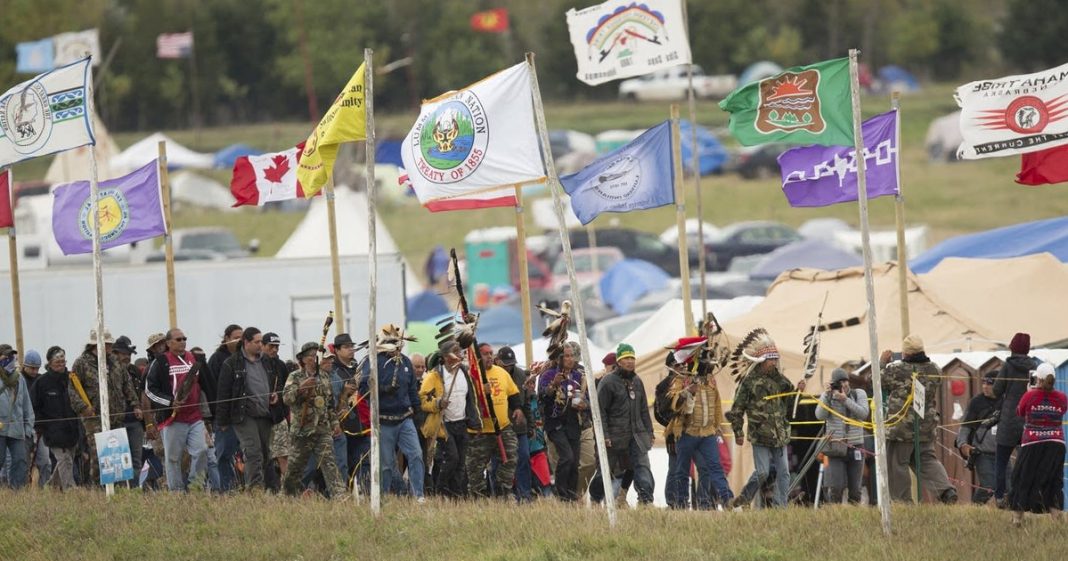
«    Peter HuffParliament of Religions on the Prairie: Standing Rock as Interreligious Event.  The 2016-17 Standing Rock phenomenon constitutes a turning point in the history of modern interreligious dialogue.  Oceti Sakowin and related encampments represent not only the greatest Native American tribal gathering since the nineteenth century but the most extraordinary open-air interfaith “camp meeting” in U.S. history.  Representatives from Buddhist, Hindu, Jewish Muslim, Sikh, Unitarian Universalist, Wiccan, Protestant, Catholic, and Quaker traditions assembled with Native American spiritual leaders and international indigenous leaders, forming not only a spontaneous parliament of religions on the prairie but the first mass modern interfaith event informed by indigenous values and practices.  Based on first-person participant observation and interviews with local actors, the paper traces the development of the Standing Rock interreligious experience from the spring of 2016 to the February 2017 camp evictions.  Drawing upon the critical literature on the history of modern interreligious dialogue, the paper identifies Standing Rock as a milestone in global interreligious dialogue.  

I came into this session after it had commenced; however, I think I experienced more than 90% of it.  Again, my post-stroke note-taking leaves much to be desired.

Chief Arvol Looking Horse
Peter Huff spoke of the leadership of Chief Arvol Looking Horse, 19th Generation Keeper of the Sacred White Buffalo Calf Pipe Bundle.[1]  White Buffalo Calf Woman (Ptesanwin) brought the Pipe to the Dakota People more than 300 years ago.  Chief Arvol Looking Horse said:

In our prophecy, the White Buffalo Calf Woman told us she would return and stand upon the earth when we are having a hard time.  In 1994, this began to happen with the birth of the white buffalo.  Not only their nation, but many animal nations began to show their sacred color, which is white.

Those gathered in protest performed and/or participated in an “Esseron”[2] interfaith ritual.  This turned out to be a much bigger deal than the organizers expected.  Karen Van Fossen, a minister at Bismarck-Mandan UU Congregation in North Dakota, and Father John Floberg of the Standing Rock Episcopal Churches, who were among the conveners, issued a notice to the interfaith communities, resulting in more than 500 clergy-people and/or representatives from religious communities coming, as opposed to the dozen they were expecting.  Some readers may be aware that Andras Corban Arthen and Patrick McCollum, both prominent Pagan interfaith activists, were present, as were Cornel West and others from around the country and beyond.


The ceremony was one of joyful community and rising concern.  They burned the Doctrine of Discovery,[3] then celebrated the easement with fireworks.  Among the participants were some teachers of interfaith for reconciliation from Belgium, as well as Veterans for Peace.

Unfortunately some leaders of this gathering were targeted with hate mail.

There was little access to the Internet, there being only one place on a certain hill for Internet access.


«    Lily OsterDecolonizing Earth-based Spiritualities: Negotiating Earth-awakening without Appropriation.   This paper explores the ethical complexity of white engagement with earth-based spiritual traditions, addressing patterns of cultural appropriation of indigenous traditions while also recognizing the potential benefit of more widespread human orientation toward the earth as sacred.  In a moment when humanity urgently needs to cultivate ecological consciousness, many indigenous traditions contain teachings of planetary connectedness and worldviews that undermine extractivist framings of human-earth relationship.  However – as was recently highlighted by the migration of many white visitors to the pipeline resistance camps on Standing Rock Sioux land – indigenous traditions are not necessarily open to converts, and white seekers are not necessarily attuned to the protocols of non-appropriation.  This paper makes a case study of white encounter with native religion at Standing Rock, considering the decolonial possibilities and pitfalls of Eurowestern spiritual engagement with traditions, practices, and philosophies grounded in the sacredness of the earth.

Many Native activists have made it clear that they want no white leaders.  Nor are non-natives able to participate in the Sun Dance.  I understand this exclusion of non-natives in an eco-cultural context.
 
However, with the growth in numbers of people practicing one or another Pagan spirituality with their commonly (not universally) espoused emphasis on the holiness of Nature and our interdependence, and considering that Neo-Pagans are mostly white and urban, I wonder where we can respectfully fit in.  As an urban white, associated with colonization and appropriation, I can certainly appreciate Natives’ insistence on exclusion of non-natives.  Nonetheless, in broader interfaith activities I, as an ecologically concerned Pagan Witch, think that our “greenness” is an asset and can inform others who hold a more “dominionist” (the attitude, not the Christian right) perspectives on the world, its assets, and its inhabitants.  I wish to contribute to the fortification of everyone’s efforts to address climate change, regardless of religion or ethnicity or any other difference.

The basic underlying tenet of these Native people is that everyone looks out for each other.  That’s behavior I try to cultivate and that I wish were more common among non-Natives.

«    David WalshCeremony in Historical Perspective at Standing Rock.   The #NoDAPL movement and the protests at Standing Rock have attracted media attention for the direct action with police.  However, this focus has obscured the historical context of protest through ceremony.  In this presentation, I discuss cosmological understandings of the indigenous participants.  Their actions such as individual ceremonies, the camps as ceremony, and direct action with police as ceremony, suggest that the #NoDAPL movement is primarily a spiritual ecology movement.  To properly understand this movement, then, it must be put into historical context with other spiritual movements of resistance, such as the Ghost Dance movement and Idle No More.  Only then can we understand how water protectors are protecting the source of life, water, from the forces of destruction, the black snake, as they continue their cosmological battle to cut off the head of the snake before it spills its poisonous venom – oil across the land.

Mr. Walsh claims that the protests against the proposed Dakota Access Pipeline at Standing Rock are pan-indigenous spiritual movements of resistance.  One practice is to bring water to pour into the river. 

He likened this to a “mini Mokami,” which is a reference either to (1) a river trail in present-day Labrador used by the three indigenous peoples of that land: the Innu (Innu Nation), the Inuit (Nunatsiavut), and the NunatuKavut (Southern Inuit); (2) a place in central Missouri; or (3) a place in Santa Clara County in California.  The phrase he credited to “mini Mokami” is “Water Is Life.”  Regardless of the source, this statement applies universally.

This mixture of waters is similar to a ritual honoring the Waters of the World that is widely practiced in the interfaith movement, both national and international.  Participants from many places bring water from a spring, creek, lake, river, or ocean near where they live to ritually comingle with the waters brought from far and wide.  I’ve been told that this rite of mingling waters of the world (not pouring them into a river) began as a UU practice.  In any case, the practice has been taken up within the Pagan movement, where it is not uncommon.

Nonetheless, It is important to remember that indigenous rituals, whether environmental or otherwise, are focused on the local rather than the universal, even when they have been displaced.

Mandans hold wisdom of the sky is covered and erased by dams.  The Native peoples at DAPL liken oil to the “black snake that destroys the land.”  That is an image I can easily envision.  Protests opposing extraction from tar sands in Alberta began in 1967, and amped up in the 2000s.

One of the activities mentioned concerned approaching and standing upon a sacred mountain on the DAPL encampment.  Humans who seek to go there must put cedar bark in their shoes as a sign of humility and respect for the sacredness of this mountain.  Beyond respecting this practice, I think such practices can be consciousness raisers for non-indigenous people.

Created by people of Canada’s sovereign First Nations, Idle No More soon grew into one of the largest Indigenous mass movements in Canadian history.  “Idle No More calls on all people to join in a peaceful revolution, to honour Indigenous sovereignty, and to protect the land and water.”  INM began demonstrations in 2012 to resist extraction and assimiliation.

In addition to the Ghost Dance in South Dakota and actions at Wounded Knee, Native Americans and First Nations people have conducted Round Dances at shopping malls.  They hold Sitting Bull as an honored ancestor.

By Mother Nature, Mother Earth and other names, I join all peoples in respecting, preserving, conserving, and celebrating Earth, our beautiful and sacred home.


[1]           See Keepers of the Sacred Tradition of Pipemakers.  Don’t be fooled by the English names.

[2]           The word I heard as esseron, thought it may have been asseron.  In any case, I don’t know its meaning and have been unable to find any useful information about it.

[3]                The Covenant of the Goddess issued a Resolution To Repudiate the Doctrine of Discovery, and Implement the UN Declaration on the Rights of Indigenous Peoples in 2012.

Thursday, October 12, 2017

Becoming a Sanctuary Congregation: How Faith Communities Can Support Immigrants


Marin Interfaith Council sponsored a gathering of religious leaders to learn about the sanctuary movement.  A total of 62 attendees came out on August 29th for the gathering focused on sanctuary congregations.  The speakers addressed:

What does it mean to provide sanctuary?  What are the levels of sanctuary?  What is the process to become a sanctuary congregation, and what are the challenges/risks?

The Rev. Deborah Lee, Program Director of the Interfaith Movement for Human Integrity, and Rabbi Elana Rosen-Brown of Congregation Rodef Sholom, spoke in both practical and moral terms about how faith communities can utilize their resources to serve the immigrant community in this time of need.  Different examples of sanctuary congregations were provided to help attendees understand the range of ways to offer sanctuary.  Both leaders also echoed the importance of defining mentally, spiritually, and emotionally what sanctuary means for your faith community so that you can create and implement an appropriate response.  [Emphasis intentional]

Rev. Deborah Lee
Deborah first spoke to the overall problems about the impact of undocumented immigrants in practical terms.  She asserts that there has been a coordinated attack on the word “sanctuary.”

The U.S. is a destination for migrants; many immigrants come to the U.S. to escape danger.  California and the San Francisco Bay Area more so.  It behooves us to demonstrate compassion and mercy, and to consider the underlying causes of their migration.  After all, but for a small population of Native Peoples that we -- all of us whose families came here as immigrants at some point – have decimated.  All of us Euros, Africans, Asians, and blends are immigrants, regardless of how far back our ancestors.  Latinos, on the other hand, are native to the Americas.

Further, homo sapiens is a migratory species.  We arose in East Africa and have migrated to every continent and subcontinent on the planet and most islands in Earth’s oceans. [Emphasis intentional]

There are more than 200 detention facilities for people seeking citizenship in this country; only two of them are for women and children.  All are overcrowded and the conditions in those facilities are worse than those in state prisons.[1] 

Additionally, recent news reports that many detained women are miscarrying, and the nutrition children and all other detainees leaves a lot to be desired.  Not to mention the lack of educational opportunities for young detainees.

On top of that, immigration costs more than $18 billion a year, more than any other federal program.  One of the largest detention facilities is West County Detention Facility in Richmond, CA, about four miles across a bridge from where I sit typing.  West County gets big bucks of our tax money from Immigration and Customs Enforcement (ICE).  On the first Saturday of each month an interfaith prayer group meets from 11:00 a.m. till noon outside the gates.

Conversely, there has also be an increased in sanctuary communities locally from five to twenty-seven.

Since the current administration in Washington took over the federal government, ICE has instituted fast deportations with no judges or hearings.  Concomitantly, the number of deportees has increased.  ICE also seeks to have any immigrant who is arrested, no matter the crime or transgression, turned over to ICE by the jail or prison authorities. 

I have witnessed this policy in action where I volunteer at San Quentin.  One of our regular circle members, when he was up for parole, disappeared.  This man, an immigrant from Mexico, had a questing mind and took every advantage during his incarceration to better himself (working towards a college degree, for instance).  I viewed him as someone who was motivated and who would become a contributing member of society after his release.  Alas, when I asked about his whereabouts, assuming he’d have been assigned to some kind of halfway house as he had expected, I learned that he’d been deported.

There has been resistance to this policy by some law enforcement authorities who decline to comply, but this resistance has been inconsistent.  My county and several nearby counties and cities are sanctuary cities.  And now, thanks to Governor Jerry Brown, our state is a sanctuary state.  I sit now in a library where several signs are posted welcoming immigrants specifically, and everyone (ages, races, gender, abilities, languages, et al.).  Deborah claims that deportees are returned to slave-owners.

As mentioned above, we (the San Francisco Bay Area and the wider State of California) are a destination for migrants.  We have legal resources, whereas no counsel is offered to deportees.  Our progressive legislature assures that undocumented children can go to school.  Immigrants don’t qualify for rent subsidies, but they do have tenant rights of which most are unaware.

Deborah cautions us to expect pushback for our efforts.  We see that now that Governor Brown has designated California as a sanctuary state, the current administration has ordered ICE to amp up their raiding here.

While guides suggest speaking with an attorney who is knowledgeable about immigration law, the fact is that there is almost no legal risk.  See ACLU’s Sanctuary Congregations and Harboring FAQ.  Familiarize yourself with harboring laws, stay open, announce that fact, and report on incidents of reprieve.  ICE can enter your sanctuary to apprehend undocumented immigrants, but they are under witness of community.

She urges us to resist untruths about immigrants with those who hold them.  She offers three “R” principles:  Right thing to do; Relationship to immigrants; and Risk to share with immigrants and to take a chance.

The motto of the organization for which Deborah works, the Interfaith Movement for Human Integrity, is “Every human person is sacred across all borders.”  Here is what IM4HI tells us about how sanctuary looks today.

“A public, corporate commitment to walk alongside immigrants, mixed-status families, refugees, and other targeted communities to uphold the dignity, due process, and full acceptance and participation of all people in our society through protection, support, and advocacy.  Congregations can write their own statement of sanctuary to reflect what they specifically will do.”


IM4HI suggests four ways that congregations are demonstrating their commitment to sanctuary.  Some of them are things that we -- as individuals, as covens, as a covenant – can do even though we generally don’t have physical facilities.

Advocacy:

«    Advocate at the local, state, and national levels for policies that protect the due process of immigrants and promote their full dignity and integration into our local communities.
«    Advocate for policies that help to prevent mass deportation and fear by creating clear separation between ICE  and local law enforcement and civic institutions, for example, strong sanctuary city and county policies.
«    Engage in local public actions and activities to shift public discourse towards immigrants, Muslims, and refugees, and bring attention to our responsibility

Accompaniment of Immigrant Families or Youth:

Individuals and congregations can immediately help accompany immigrants in urgent situations and need of accompaniment.  This can include newly arrived migrant families, unaccompanied minors, people facing deportation crisis, those just released from detention centers.  Trained volunteers can help to provide courtroom accompaniment, access to services, and concrete and emotional support and/or transitional housing to help those in a period of crisis.

There are 13 teams in the East Bay doing accompaniment.  They claim that this issue warrants “God’s special attention.”

Networks of Protection & Rapid Response:

«    Join a rapid response Network to respond to ICE workplace raids, home raids, or other enforcement activity.
«    Connect with targeted communities to help develop relationships and networks of protection.

Housing Hospitality:

«    There are various kinds of needs for housing hospitality:  (1) short-term respite housing for someone released from detention; (2) housing for newly arrived immigrant family seeking asylum; (3) protective housing for someone with a final order of deportation; and (4) hosts needed in order for the government to release individuals from immigration detention,
«    Depending on the case, housing hospitality could be in a private home of a member, or on congregational property.

I know that some Pagan nonprofits shy away from civic involvement out of concern for their nonprofit status.  I can state with certainty that religious organizations with nonprofit status can indeed offer opinions, suggestions, recommendations, and urging to their congregations about secular issues such as immigration without jeopardizing their nonprofit status.

Many years ago when the Reclaiming Collective was young, we -- I was active in the collective in those years and I was instrumental in acquiring these classifications -- applied for and received incorporation as a nonprofit religious organization from the Secretary of State of California as well as 501(c)3 tax status from the Internal Revenue Service.  One of the things we wanted to accomplish was to provide sponsorship of an immigrant couple (one from Senegal and the other from England) so that they could remain in this country and acquire permanent residence status.  This occurred with no effect on Reclaiming’s legal status.

Some years ago when ICE was regularly doing predawn raids in the Canal District, a predominantly Latino neighborhood of our city, our local Marin Interfaith Council’s Justice Advocacy Team organized predawn vigils, both to demonstrate our concern and solidarity and to assist victims of raids and their families.  Immigrants do have tenants rights, among other rights, of which they may be either unaware or reluctant to use for fear of deportation.

A couple of months ago, an immigrant construction worker who had entered nearby Travis Air Force Base to work on a job was held for deportation by ICE.  This man had been a contributing member of our community for more than 17 years, had married and had children who were American citizens.  He and his family were known to be law-abiding members of our city, but for the father’s immigration status.  A call went out from MIC to its members, asking them to write letters of support to representatives, government entities, and the press.  MIC is also a 501(c)3 nonprofit.


* * * * *

Rabbi Elana Rosen-Brown
Rabbi Elana Rosen-Brown told of the ways in which the members of her Congregation Rodef Sholom committed to create a sanctuary for immigrants.  She spoke of Rodof Shalom’s process of becoming a community network.  She cited T’ruah: The Rabbinic Call for Human Rights, which has published Mikdash: A Quickstart Guide for Sanctuary Synagogues, a step-by-step, easy-to-access pdf.  In addition to providing us with a copy of this document, she gave us copies of the “Resolution of the Board of Directors of Congregation Rodof Shalom Affirming Congregational Solidarity with Undocumented Immigrants.”  To demonstrate its commitment to this resolution of its Board, they created a Source Sheet, a useful document she also shared with us.

The first thing to do is to change hearts and minds. Becoming a sanctuary community begins with networking.  Concurrently, reach out to local immigrants rights group to understand local needs and partners.  It’s good as well to have immigrant folk speak to the congregation so that the members can better understand and appreciate their urgent needs.

Elana recommends Sanctuary Not Deportation (SND), which has a list of local coalitions.  Sanctuary groups are already well established in such places as Denver, Philadelphia, New York City, Boston, Austin, Chicago, Southern Arizona, Milwaukee, Kansas City, Phoenix, Washington, South Florida, Colorado Springs, and New Mexico.  Our neighboring state of Oregon’s Interfaith Movement for Immigrant Justice is another resource for learning to become a sanctuary community.

SND offers instructions on becoming a sanctuary community, including strategy and tactics.  Different religious traditions have published denominational statements as well as liturgical materials; however, all are Christian except for one issued by Reformed Judaism.  SND appears to be a useful site, but it could certainly benefit from having a more diverse coalition.

Now we Pagans don’t usually have buildings to use and to maintain; even so, there are plenty of ways we can help.  Several ways are suggested above.

After the presentations of our two guests, I got an idea of how we – me, anyway – might help.  I propose providing immigrants with prepaid cell phones.  With cell phones, immigrants can receive announcements pertinent to their situations. They can access information and resources in their own languages.  And if circumstances result in their relocating, they can remain connected with friends, allies, and supportive groups.  My idea was to contact CREDO Mobile or other cell phone services to enlist their cooperation by providing the phones, perhaps new but discontinued models that are harder to sell.  CREDO is a social change network of 5 million activists organizing and mobilizing for progressive change; each month CREDO donates all profits to various nonprofits, voted on by subscribers.  I haven’t followed through on this yet.  What do you think?


[1]           She actually cited San Quentin, probably because it is local; however, I volunteer with the Wiccan circle there and so far I haven’t been exposed to deplorable conditions.  Bleak and institutional, yes.  Of course, I only see communal areas, not cellblocks.

Thursday, June 08, 2017

Table to Action Design Workshop


Back in October 2016 I wrote about attending the initial SF Bay Area meeting of Table to Action[1].  I mentioned soliciting one or three of my local interfaith colleagues who are Roman Catholic, Buddhist, and/or Hindu.  Unfortunately, I was unsuccessful.  A college professor friend recommended a liberal Catholic at her institution, and introduced us by email.  I invited her and got her in the loop for the next meeting in February.  She responded that she was eager to come, but for whatever reason(s) she did not attend.

Sponsored by Auburn Seminary and Starr King School for the Ministry, that second meeting was very like the first one.  Table to Action had planned a longer follow-up workshop to take place in April.  It was an evening, followed by a daylong design workshop.  This is some of what the invitation said:

From September 2016 through February 2017, a multi-religious group of about thirty Bay Area spiritual and community leaders have gathered…to form a community of resilience and accountability and discuss common questions related to our struggles for justice.

When we began…the questions before us were related to our spiritual, emotional and physical sustainability in the context of relentless demands and challenges and frequent setbacks.  We approach the questions intersectionally, both from personal and communal standpoints,

We asked ourselves what kind of justice movement we dreamed of, one that would engage issues intersectionally, respected our different social locations and histories and honored our bodies and souls as we are in the struggle.  …

After the elections, we checked on how our bodies and souls and our community fared in the midst of constant multiple attacks on the values and communities we love.  We asked ourselves how we could best support each other across our different communities, and strengthen our capacity to build a sustainable and resilient local community or resistance and resilience.

This longer engagement culminated “with a DesignShop[2] … [to] imagine together where we might want to reimagine ways to collaborate for justice in the Bay [Area] in these times.”  The title was:

We Are Not Afraid to Reimagine[3]
A Design Shop Intensive[4]

We gathered at City of Refuge United Church of Christ in Oakland on the evening of April 23 and all day on April 24.  The Hospitality Services of City of Refuge, an excellent venue, conveniently located with plenty of parking and a small garden outside, catered our event.  The food was great, accommodating various dietary concerns, and the food preparers (all women, it seemed) friendly and kind.  They earned several applauses throughout the two days.

The first evening entailed a re-acquaintance with other participants, and for those who hadn’t attended the first two meetings, getting to know each person.  Again, I was unsuccessful in recruiting either Buddhists, Catholics, or Hindus, although I know that all three are active in interfaith, social justice, and environmental concerns.  To be fair, there are few Hindus in my immediate area except for a Vedanta retreat, which is a member of Marin Interfaith Council.  However, there are plenty of activist Catholics and Buddhists.  And since this was a Bay Area-wide effort and there are many Hindus in the Santa Clara Valley (aka Silicon Valley), I found their absence worth mentioning.  It wasn’t I who convened this group, so I don’t know how wide a net they cast.  Regardless, I did invite Felicity Grove, an interfaith colleague from NCLC-CoG.[5]  Surprisingly, among this group of about thirty, there were four Witches.  One, Courtney Weber Hoover works at Auburn and is part of the program, so she was an employee-participant.  The other was local Witch Luna Pantera, whom I’ve known for many years and knew of her involvement with NOW.  I had not encountered her at interfaith activity until now, although I’m now aware that she attended the second MountainTop in Atlanta in 2015, as I did in Nashville in 2013.  I was glad to see her taking the step of further involvement.

As in earlier DesignShop sessions, we gathered in small working groups, where we were given a topic or a problem to address collaboratively.  The specific configurations of these groups changed with each change of topic; all were timed to 30 minutes.

An artist documented our full group discussions on whiteboards around the room.  I described this here, starting at the sixth paragraph. 

Get on the Bus

Round One of this exercise involved teammates depicting “the Bay Area’s movement work as if it were a bus on a journey…traversing any kind of landscape.”  Includes details such as obstacles, challenges, landmarks, “as well as the nature of the interaction on the bus…”  After this we walked around to see what others had been talking about.

“It’s easier to get from THERE to HERE than it is to get from HERE to THERE.”
DesignShop Axiom

For Round Two, teams drew a bus that represented the ideal Future State, three years from today, then chose a team member to report the group’s final ideas to the whole gathering.

Design a Home

For this module we formed new teams in which each of us was given a description of a specific person and assigned to enact that individual in the discussion.  We were five people, each decidedly different from the other in terms of age, health, economic situation, ethnicity, et al., seeking to share housing in the Bay Area.  We were to consider each participant’s needs: cost; location; quiet hours or quiet area; rooms for entertaining visitors; sharing food and/or meals or not; accessibility of public transit; pet(s) or none; house meetings; levels of fastidiousness; chores; need for yard or garden area; etc.  No one knew who the other was portraying prior to the role-playing discussion.

My role was that of a 52-year old gen X-er, middle class, working in nonprofit, given to inclusivity, reflection and discussion, no rash decisions.  The names given to each participant were not generally seen as being gender-specific.  My name was Leslie.

“To add someone’s experience to your experience, 
to create a new experience, is possibly valuable.”
DesignShop Axiom

Then we debriefed for another 20 minutes, setting aside our roles and reviewing what just happened in our housemate meeting.  Questions we considered were:

1.              What process did you work out to make this decision?  Who took the lead?  Was it an explicit process or did it just evolve?

2.              What worked well and what could you have done differently in listening to what was important to each of the other housemates?

3.              How did you balance incompatible objectives and priorities?

4.              How was this scenario like some of the trade-off decisions that have to be made in creating a more racially and economically equitable Bay Area?

5.              What did you learn about design decisions like this one that you can use going forward?

At the end of that time, we reported what we learned to the whole gathering.  I felt okay about how this module went.

“Everything that someone tells you is true; 
they are reporting their experience of reality.”
DesignShop Axiom

Designing a Game
Design the Sustainable Justice Game

Beginning with the assumption that everything can be turned into a game, we were tasked with designing a “sustainable racial and economic justice game.”  Colored paper, beads, yarns, colored markers, and other game-making materials were provided.  Both Felicity and I were in this group together with two other people.

Questions we considered in devising this Sustainable Justice Game were:  Choosing a game to model; the objective of the game; what winning looks like; who can win and under what circumstances; strategies leading to success or failure; what advances play or sets players back; barriers/obstacles to winning and how to overcome them; resources/skills players need and whether they’re easy to pick up or can be offered from one player to another; who are the players and what are their roles and characteristics; player interactions and powers, limits or constraints; cooperation or competition; field of play; and rules.  And importantly, what unique characteristics of the multifaith movement for social justice can be built into our game?

We began by brainstorming a list of our favorite games.  There was one game that neither Felicity nor I knew anything about.  Both of us clearly expressed this numerous times.  Nevertheless, time was running out and we hadn’t settled on one game to use as a template that all of us agreed on, so the person most invested in using the game she suggested took the lead and began writing about it on our whiteboard.  We settled with doing the support work of making the board and the pieces according to what the other two were telling us about how the model game goes.  Personally, I felt excluded from designing the game and handicapped due to our ignorance of it.  And I will say that this exercise was not fun for me.  Nor was it an equitable collaboration.

Our result, ideally, was writing the rules, preparing the board (or other field of play), pieces, and other elements so that another team can actually play it.

“If you can’t have fun with the problem, 
you will never solve it.”
DesignShop Axiom

We then moved our tables together to hear what another group designed and to share what we designed.  The other group created a game I really liked.  It was a board game, with all roads leading to the center.  The object was to get to the center, and for those who reached the center sooner to work towards bringing along every other player.  I couldn’t hear their explanations due to the distance created by two large tables pushed together, the acoustically “live” room, and the softness of their speech.  I did the obvious, which was to request the speaker to speak louder because I wanted to hear what they had to say but couldn’t.  The first time I said this, the speaker duly increased her volume.  However, the next speaker again spoke softly and again I said I couldn’t hear.  This situation was exacerbated by people leaning in to hear better and thereby blocking my view.  Of course, I kept moving my vantage point so that I could see the speaker, but it didn’t do much good

We concluded the day by gathering once again in a circle, where Melvin Bray, the facilitator asked that someone from each team tell us what they did.  This is where things got dicey among four who participated in the game design segment.  The facilitator did not extend our talk so that we could express our frustrations and resolve our differences.  Perhaps others didn’t see the tension and bewilderment on our faces.  I was disappointed.  Normally I would do that myself  -- speak up.  However, we were at the end of the day and there seemed to good way to deal with the problem without being disruptive.  Instead, I spoke to another team member one-to-one after the close, expressing that I wanted to clear things up.  I have heard nothing more.

In hindsight, I see that we – or I, at least – participated in a lower key, less take-charge way because we were conscious that we were viewed as the seemingly privileged middle-class educated white folks, or using the term I prefer in such circumstances, Euros, among a minority majority assembly.  We tended to hold back more than we usually would in service, I thought, of good behavior, not bullying or trying to take over.

At each of the three Bay Area sessions, I met and talked with several very interesting people, folks it’s unlikely I’d meet otherwise, because they were primarily from the Abrahamic religions and I don’t usually have occasion to attend Christian, Jewish, or Muslim religious ceremonies.  At all three Table to Action events I attended, I met several people I’d like to know better, and perhaps ultimately either supporting each other’s efforts or perhaps collaborating.  I would have enjoyed more socializing -- just in general, not specifically at these events.  Because those of us to participate in interfaith (or, more appropriately in our case, inter-religious) activities know that it is in opening ourselves to and cultivating personal friendships that forge and sustain our efforts.  In order to make this happen, we would need to be able to remain in contact so we could deepen these connections to the extent that each of us was moved to do so.

So my primary frustration with this whole project is that we have been provided no way to continue our conversations and to help with and/or fortify each other and each other’s interfaith work.  For some reason I was under the mistaken assumption that this project was intended to forge alliances.  Some of us did, individually, exchange contact information.  I hope that a contact list is provided at some point, although I don’t anticipate more sessions.


[1]  Unfortunately the FAQs on the Table to Action website appear to be in Latin.
[2]  DesignShop is a method created by Rob Evans of Imaginal Labs.  Here’s a brief talk about it.  You may recall my post about MountainTop in 2013, which I explained as I experienced it.  The founders explain it here. 

[3]   “We Are Not Afraid to Reimagine” is a line from a poem written collectively at the Table to Action dinner on September 20, 2016.
[4]   “DesignShop is a methodology that puts participants into interaction with one another to identify challenges, concerns, problems or opportunities and to design together a way of addressing them.  The future is coming, whether we are ready or not.  Our desire is a future by design—that we shape toward justice—not by default.”

[5]   Northern California Council, Covenant of the Goddess

Thursday, March 30, 2017

MIC Clergy Luncheon on Diversity and Inclusion


If you do not intentionally include, you unintentionally exclude.” 
~Neil Lenane

Last week I attended one of Marin Interfaith Council’s monthly clergy meetings.  I learn a lot at these meetings, not so much about religio-spiritual stuff as much as about organization, institutionalization, healthy and dysfunctional groups and how some institutions work towards healing community.  Also about lots of social justice issues – immigration, capital punishment, war, teen suicide, LGBTQ concerns, domestic violence, et al.

MIC is mostly white folks, reflecting the demographic of our locale.  We solicit and welcome as much diversity as our region has.  Yet we are aware of the limitations that our relative homogeneity might present.


 This meeting addressed our assumptions and behavior around diversity and inclusion.  To that end, we had a presenter from the San Francisco & Marin YWCA.  The Y’s motto is “eliminating racism/empowering women.” Human Resources at the W.K. Kellogg Foundation says:

The foundation has come to understand that diversity and inclusion are about the experiences staff members have while they work here and how all of our actions influence the work environment, from learning about and celebrating our differences to addressing structural barriers that perpetuates inequalities.  [Emphasis in original.]

Presenter Laura Eberly brought “a strength-based lens and motivational interviewing technique to group and individual cultural competency development.” 


Laura provided an Inclusion Inventory for us to consider when evaluating our own cultural literacy and attitudes.  She took us through five stages of evolution to help us understand some of our unconscious assumptions that tend to separate us from others.

The first, Denial, applies to missing the differences.  Sometimes privileged people say to themselves, “I don’t have to be concerned about ‘that’.”  She also pointed out that “passing” is a minimization.  Perhaps some seek to “pass” for reasons of safety; however, if they feel unsafe, we need to work towards a society where instead of seeking safety by passing, everyone feels safe and accepted, welcome and included.

The second, Polarization, seeks to judge our differences.  Polarization reinforces and affirms stereotypes, even while acknowledging our diversity.  It can put us in an oppositional stance, which is good for no one.

Minimization de-emphasizes difference.  In my view, this attitude makes our world bland, colorless, lacking vibrancy and nuance.  It’s also trivializing.

Reaching the level of Acceptance means that we understand differences.  This enriches our cultural competence.  We’re not yet where we want to be, but nearing that goal.

Finally, Adaptation bridges difference.   Bridging difference, finding common ground, allows us to work together with trust and respect.  Bridging brings the greater resources of everyone included.  Lessons, customs, talents, ideas from everyone who wishes to contribute give us a richness and pool of resources and ideas we wouldn’t otherwise have.  Working together presents a stronger force with which to resist oppression and foster positive change for everyone.

Certainly as Pagan and Witchen religious expression has diversified, it behooves us to look towards how others address and resolve these issues.  I would like to see us explore this subject in more depth within our own diverse and inclusive Pagan communities.