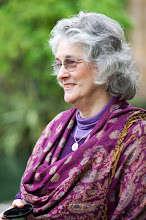
Peter Dybing gave Sunday's keynote speech, "Stirring the Cauldron of Pagan Sensibilities." A worthy pursuit to my mind. In an animated talk, Peter emphasized that Paganism was not a monolithic institution. He also spoke of the need for boundaries, avoiding what he called "the 2 a.m. crisis." During feedback, I reminded folks that one of the required courses for degree-seeking students at Cherry Hill Seminary is Boundaries & Ethics. I took the proto-class from Cat Chapin-Bishop back around 2000 and found it one of the most valuable classes I've ever taken.
He itemized several issues and then compared the attitudes about them of older Pagans and to those of younger generations. He said that older Pagans generally held tightly to beliefs whereas younger ones welcomed debate. I think this is true of any social phenomenon when it achieves some years; however, I don't think it's universal. I count many Pagans, myself among them, as being open-minded, adaptable, and willing to engage on current issues, far from being hidebound.
It was helpful for me to hear, even though it's obvious, that we bring with us the cultural attitudes of our times. I know that the feminism that underlies my being, religious and otherwise, has informed my views and practices. I know that my experience pre-Second Wave Feminism is very unlike the experience of women who, for instance, grew up in a world where reproductive choice is a given. And that's just on one issue. I know that the zeitgeist of my formative years differs from the zeitgeist of subsequent generations. Sometimes hearing something stated clearly from another person gives the fact a more crystalline ring. Thank you, Peter.
There was a contention Peter made with which I disagree. He showed photos of about six prominent Pagans and said how important it was to respect them. (I think 'respect' was the verb he used.) In any case, the sentiment was that we should excuse bad behavior among Pagans who've had a strong positive impact for many seekers. (Peter, I welcome clarification of this if I've misunderstood.) Respect cannot be forced. There are some I simply cannot respect. That doesn't mean I'm gonna run out and trash them all over the place. I see no benefit to anyone. On the other hand, if a sincere question comes my way concerning some incident or behavior and I have personal experience of the party(ies) involved, then I can't in good conscience ignore what I consider damaging, or potentially damaging, conduct and turn my back to the querent. My answer may be oblique and avoid specifics, but it will not whitewash. That said, such problematic individuals are thankfully rare.
We live in a culture of celebrity. None of us, including Pagan leaders, is immune to its allure. So it's understandable (1) that people might have a tendency to hero-worship those they perceive as Pagan celebrities, and (2) that prominent Pagans might succumb to the glamor of being 'celebrated.'
Indeed, it behooves us to show our appreciation for the gifts of our more visible and activist Pagans, be they artists, musicians, writers, or whatever, and to treat them with respect. At the same time, I believe everyone is accountable to her or his community (whoever that may be and however that is defined). With leadership goes responsibility.
For all of my high-mindedness from up here on my horse, I cannot say what any individual has to learn from another. Teachers and teachings sometimes come in unlikely packages.
Remember, though, young and haler Pagans, to notice if some greying person near you might need a chair, would welcome a place at the front of a long food line, or could use a hand with that luggage.
* * * * *
The
final session consisted of four presenters: Sam Webster on "Pagan Soteriology," Tony Mierzwicki on "Pagan Warriors Past
and Present," Amber Dineén Gray "On Racism, Misogyny, and Homophobia in Pagan Reconstructionist
Communities," and Helen Hye-Sook Hwang on "Field Research of Collecting the Oral Stories of Gaeyang Halmi, the Sea
Goddess of Korea, and Uncovering Her Magoist Implications."
Having a concern for the well-being of returning military veterans,1 I found Tony's presentation especially interesting. Again, my notes are fragmented, but I jotted down "betrayal of those in power," "guilt for surviving," and "alienation on return," all of which are common among the battle-worn. Tony claimed that the key to avoiding PTSD is to adhere to a strict moral code. He explained that it's the custom among warriors to say prayers in unison and to pour libations before entering battle.
Tony's sources reveal that there are approximately 20,000 Pagans in the U.S. Armed Forces. I know from reading and from hearing from service members that chaplains often lead prayers with those about to enter combat, and also that there is pressure put upon all military to accept some form of Christianity. Their mission is evangelic. The job of chaplains is to serve the spiritual needs of all their clients regardless of their religions. Unfortunately, that's more the stated expectation than the reality. The largest portion of military chaplains in today's forces are Southern Baptist who have a goal of bringing people to their way of thinking about Jesus Christ. (This latter imbalance I have learned from my interfaith involvement.) I don't think I need to say how dangerous it is to enter battle, and how critical it is to feel the bond with one's unit that means everyone has everyone else's back. Because of this imbalance, as a priestess, I'm open to opportunities to help military Pagans feel more supported.
Tony described two military traditions from the ancient world2 that seem more humane to me than what I know of more modern practices. He said that the defeated side in a battle was allowed to collect its dead, and that the shrines of the defeated side were not defaced or destroyed.
I'm grateful to Tony for giving me a better understanding of the religious dimension of ancient warrior culture.
Others have reported on Amber Dineén Gray's unsettling experiences with racism, misogyny and homophobia in a reconstructed tradition. I concur with them that she was brave to share her knowledge, and I hope we were able to reassure her that her experience is not typical of most Pagans. In a way, what Amber encountered relates to the Pagan fundamentalism of which Dr. Magliocco had spoken the previous day.
Having a concern for the well-being of returning military veterans,1 I found Tony's presentation especially interesting. Again, my notes are fragmented, but I jotted down "betrayal of those in power," "guilt for surviving," and "alienation on return," all of which are common among the battle-worn. Tony claimed that the key to avoiding PTSD is to adhere to a strict moral code. He explained that it's the custom among warriors to say prayers in unison and to pour libations before entering battle.
Tony's sources reveal that there are approximately 20,000 Pagans in the U.S. Armed Forces. I know from reading and from hearing from service members that chaplains often lead prayers with those about to enter combat, and also that there is pressure put upon all military to accept some form of Christianity. Their mission is evangelic. The job of chaplains is to serve the spiritual needs of all their clients regardless of their religions. Unfortunately, that's more the stated expectation than the reality. The largest portion of military chaplains in today's forces are Southern Baptist who have a goal of bringing people to their way of thinking about Jesus Christ. (This latter imbalance I have learned from my interfaith involvement.) I don't think I need to say how dangerous it is to enter battle, and how critical it is to feel the bond with one's unit that means everyone has everyone else's back. Because of this imbalance, as a priestess, I'm open to opportunities to help military Pagans feel more supported.
Tony described two military traditions from the ancient world2 that seem more humane to me than what I know of more modern practices. He said that the defeated side in a battle was allowed to collect its dead, and that the shrines of the defeated side were not defaced or destroyed.
I'm grateful to Tony for giving me a better understanding of the religious dimension of ancient warrior culture.
Others have reported on Amber Dineén Gray's unsettling experiences with racism, misogyny and homophobia in a reconstructed tradition. I concur with them that she was brave to share her knowledge, and I hope we were able to reassure her that her experience is not typical of most Pagans. In a way, what Amber encountered relates to the Pagan fundamentalism of which Dr. Magliocco had spoken the previous day.
1. See "Beyond Memorial Day: Understanding the Hidden Wounds of War," an interfaith event in which Don Frew and I were the only Pagan participants.
2. I'm not sure exactly which ancient world, although I suspect Mediterranean, because Tony had way too many written words on Power Point slides for us to get all the juicy information offered. Several presenters in addition to Tony had to skip over interesting work due to time constraints on each presentation.